JavaScript Testing Frameworks You Must Know in 2026
Not all JavaScript testing frameworks are equal. This guide covers the best unit, integration, and E2E tools for 2026.



Choosing the right JavaScript testing frameworks is one of the highest-leverage decisions a dev team makes, and one of the easiest to get wrong. With over a dozen active options in the ecosystem, the wrong pick leads to slow CI pipelines, flaky test suites, and a team that quietly stops writing tests altogether.
The landscape has shifted significantly over the past two years. Vitest went from newcomer to the most-loved JS testing tool. Playwright overtook Cypress in npm downloads. And the Node.js built-in test runner matured enough to handle real workloads.
If your team hasn't re-evaluated its testing stack recently, you're likely leaving performance on the table.
This guide compares the most important JS testing tools available in 2026 with real adoption data, honest trade-offs, and practical setup examples to help you make the right call for your stack.
What is a JavaScript testing framework?
A JavaScript testing framework is a pre-built environment that provides structure, utilities, and APIs to write, execute, and report on automated tests for JavaScript applications. It handles test discovery, assertion logic, mocking, and result output so you can focus on writing the actual test logic.
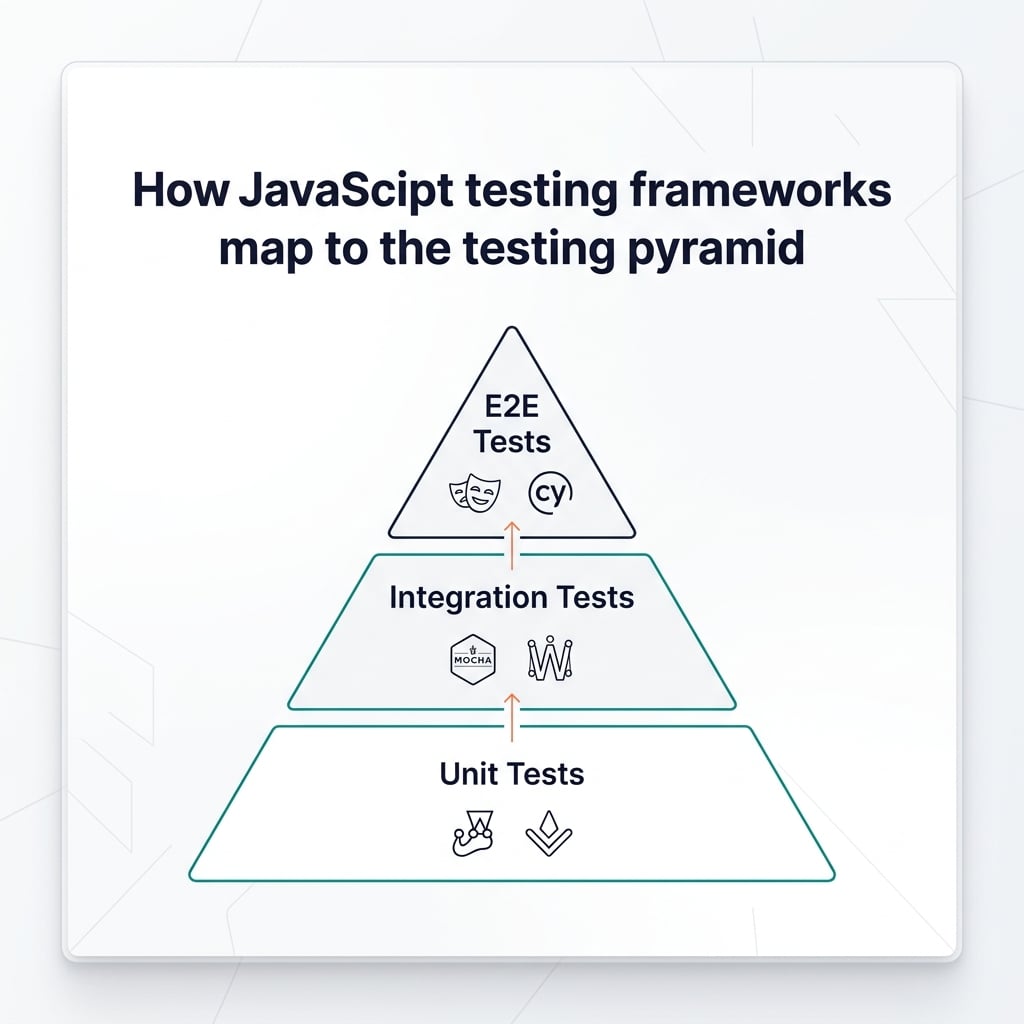
At a high level, types of software testing break down into three categories that matter for JavaScript projects:
-
Unit tests validate individual functions or modules in isolation.
-
Integration tests verify that multiple modules or services work together correctly.
-
End-to-end (E2E) tests simulate real user workflows in a browser.
Different JavaScript testing libraries target different layers. Jest and Vitest dominate unit and integration testing. Playwright and Cypress own the E2E space. The mistake most teams make is trying to use one tool for everything, which leads to either painfully slow unit tests or unreliable E2E coverage.
The best JavaScript testing frameworks in 2026
Let's walk through each framework in detail, starting with JS unit test frameworks and then moving to browser testing tools.
Jest (v30.x)
Jest is maintained by Meta and remains the most widely used JavaScript test runner. The State of JavaScript 2024 survey reported Jest usage by 7,262 respondents, more than any other testing tool.
It ships with a built-in assertion library, mocking system, snapshot testing, and code coverage out of the box. For most React or Node.js projects, it works with zero configuration.
const sum = require('./sum');
test('adds 1 + 2 to equal 3', () => {
  expect(sum(1, 2)).toBe(3);
});
Where Jest struggles: In large monorepos with 500+ test files, Jest's startup time becomes noticeable. Each test file spins up a separate worker, and the overhead of module resolution and transformation compounds quickly. Teams in this situation often see 30-60 second cold starts before a single test runs.
Best for: Established React and Node.js codebases, teams that need a massive plugin ecosystem, and projects requiring snapshot testing.
Vitest (v3.x)
Vitest is the modern alternative that's rapidly displacing Jest for new projects. It's built on top of Vite and uses the same transformation pipeline as your build process, which eliminates the overhead of duplicate transpilation.
In watch mode, Vitest leverages Vite's Hot Module Replacement (HMR) to re-run only the affected tests. On medium-sized projects (200-500 test files), this can mean 5x to 15x faster feedback compared to Jest's full process restart. The State of JS 2024 survey ranked it highest in developer satisfaction among all testing tools.
import { describe, it, expect } from 'vitest';
import { multiply } from './math';
describe('multiply', () => {
  it('returns the product of two numbers', () => {
    expect(multiply(3, 4)).toBe(12);
  });
});
Where Vitest struggles: Some Jest plugins don't have Vitest equivalents yet. If your project depends heavily on community Jest transforms or custom test environments, migration may require more effort than a simple import swap.
Best for: New projects, Vite-based stacks (Vue, Svelte, React+Vite), and teams that prioritize execution speed.
Mocha (v11.x)
Mocha is the veteran. It's intentionally minimal and unopinionated. You bring your own assertion library (Chai), your own mocking library (Sinon), and your own coverage tool (Istanbul/nyc).
That flexibility is its biggest advantage and its biggest drawback. You get full control over the stack, but the setup and maintenance cost is significantly higher.
const { expect } = require('chai');
describe('Array', () => {
  describe('#indexOf()', () => {
    it('should return -1 when value is not present', () => {
      expect([1, 2, 3].indexOf(4)).to.equal(-1);
    });
  });
});
Where Mocha struggles: Keeping four or five separate testing dependencies aligned across major version bumps is tedious. When Chai ships a breaking change, your assertion layer breaks even though Mocha itself is fine. This dependency coordination is the main reason teams migrate away over time.
Best for: Teams that need a highly custom testing stack, backend-heavy Node.js services, or legacy projects already committed to Mocha.
Node.js built-in test runner
Since Node.js 20, the built-in node:test module has been stable enough for production use. It's worth mentioning because it eliminates external dependencies entirely. For small utility libraries or serverless functions, it handles basic unit testing without adding a single devDependency.
import { describe, it } from 'node:test';
import assert from 'node:assert/strict';
import { add } from './math.mjs';
describe('add', () => {
  it('sums two numbers', () => {
    assert.strictEqual(add(2, 3), 5);
  });
});
It won't replace Jest or Vitest for complex projects, but it fills a real gap for minimal, zero-dependency testing.

Tip: If your project uses Vite as its build tool, Vitest will share the same config and plugins. This means zero extra setup for TypeScript, JSX, or ESM support.
Head-to-head comparison: Jest vs Vitest vs Mocha
This is the comparison most developers are searching for. Here's how the three biggest JS unit testing tools stack up across the metrics that actually matter in daily use.
| Feature | Jest (v30.x) | Vitest (v3.x) | Mocha (v11.x) |
|---|---|---|---|
| Maintained by | Meta (Facebook) | Vite team | Open-source community |
| Built-in assertions | Yes | Yes (Chai-compatible) | No (requires Chai etc.) |
| Built-in mocking | Yes | Yes | No (requires Sinon etc.) |
| Snapshot testing | Yes | Yes | No |
| Native TypeScript | Requires ts-jest or SWC plugin | Out of the box | Requires ts-node |
| Native ESM support | Experimental | Out of the box | Requires flags |
| Watch mode speed | Moderate (process restart) | Fast (HMR-driven) | Requires external setup |
| Code coverage | Built-in (Istanbul/v8) | Built-in (Istanbul/v8) | Requires nyc |
| State of JS 2024 users | 7,262 | 3,986 | 2,082 |
| Best fit | Legacy React/Node.js | New Vite-based projects | Custom/minimal stacks |
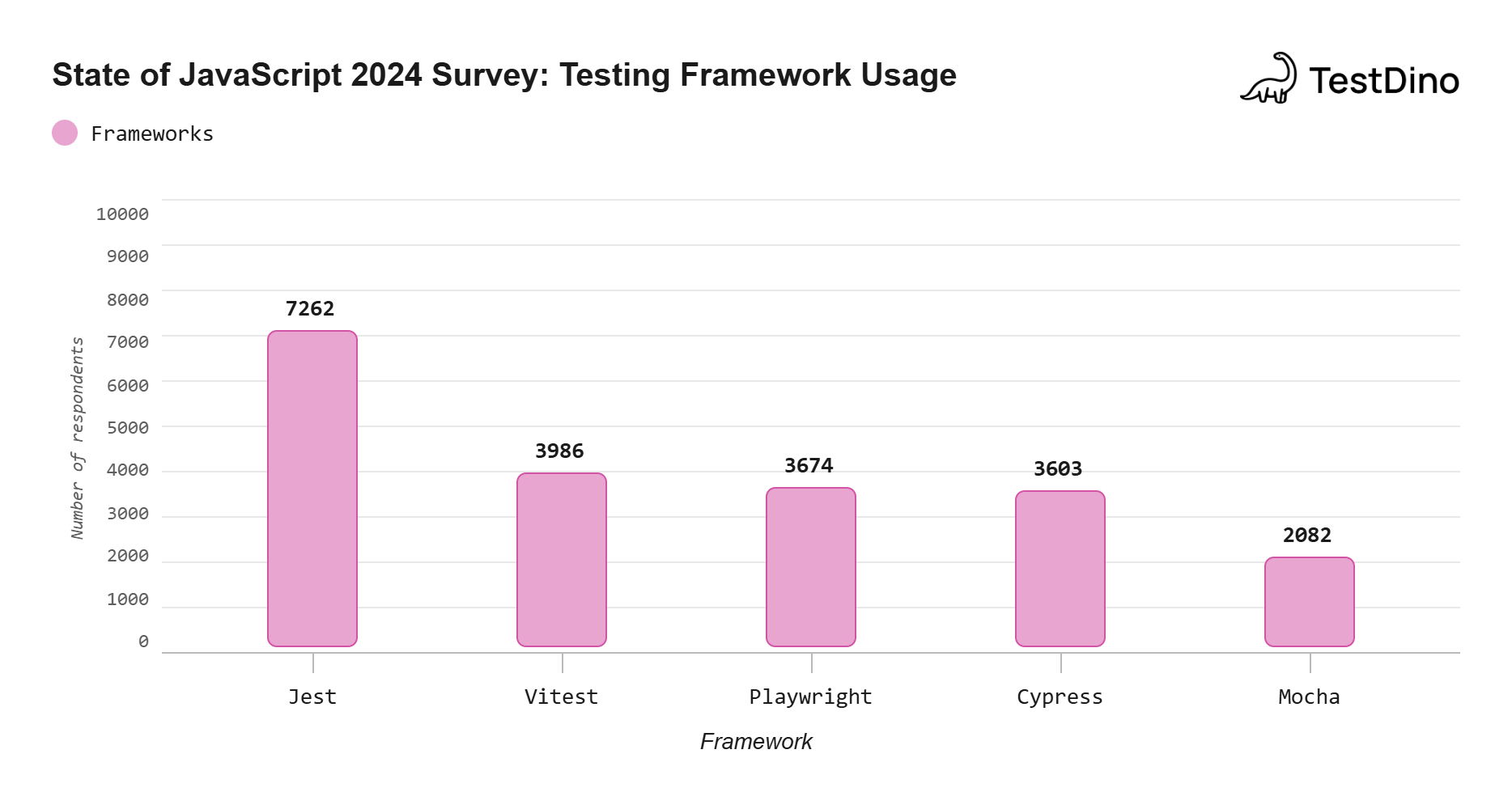
Source: State of JavaScript 2024 Survey (stateofjs.com)
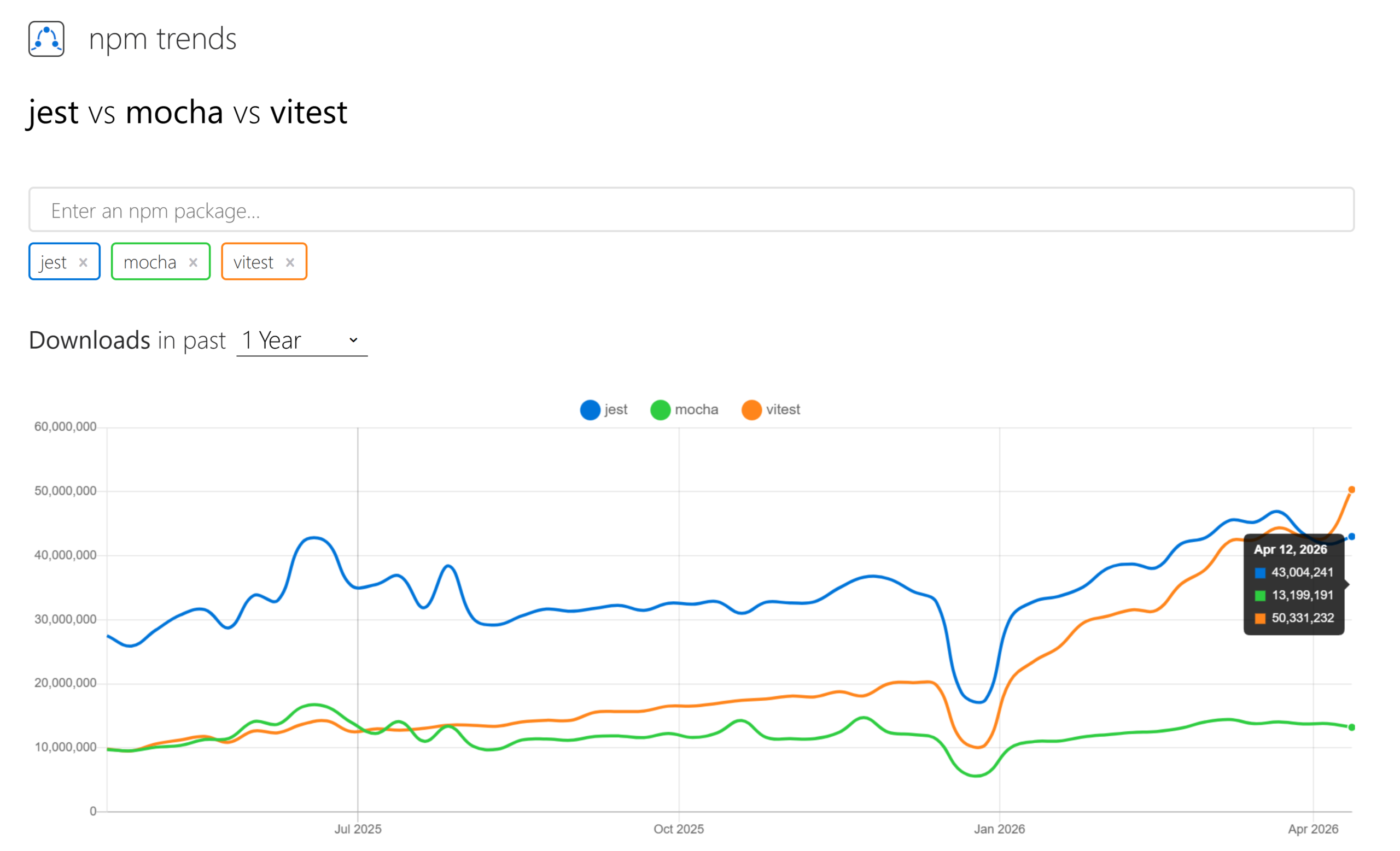
The trend behind these numbers matters more than the raw counts. Jest's usage has plateaued. Vitest's has grown over 400% since 2023. Mocha continues a steady decline year over year. The testing framework market data from npm confirms this same trajectory.
Note: Vitest's API is designed to be Jest-compatible. If you're migrating from Jest, most test files require only an import change at the top of the file. The rest of the test logic usually stays the same.
One trade-off most comparison guides miss: Jest's moduleNameMapper and custom transform pipeline is battle-tested for complex monorepo setups with shared packages and path aliases.
Vitest handles this through Vite's resolve.alias, which works differently. If your monorepo has 20+ packages with cross-references, test the migration on a representative package before committing to a full switch.
End-to-end JavaScript testing frameworks
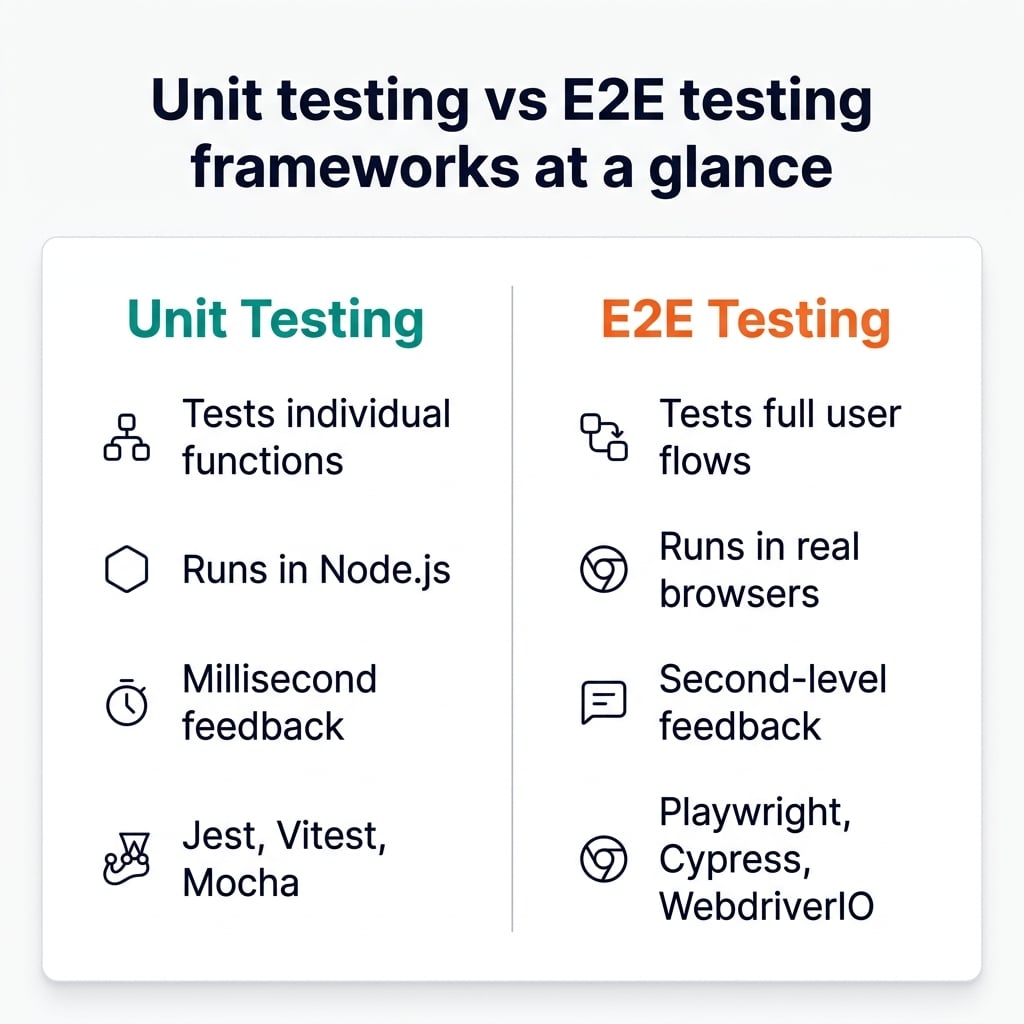
Unit tests verify individual pieces work. E2E tests verify the whole application works the way a real user would interact with it. Two browser testing frameworks dominate this category in 2026, and the gap between them has narrowed significantly.
Playwright (v1.50+)
Playwright is developed by Microsoft and supports Chromium, Firefox, and WebKit through a single API. Its auto-waiting mechanism automatically waits for elements to be actionable before interacting with them, which eliminates an entire category of flaky tests that plague other frameworks.
Key capabilities:
-
Cross-browser testing across all three engines from a single test file
-
Built-in Trace Viewer for post-mortem debugging of failures
-
Parallel execution through isolated browser contexts
-
Native API testing without launching a browser
-
AI-powered codegen for rapid test scaffolding
const { test, expect } = require('@playwright/test');
test('user can log in', async ({ page }) => {
  await page.goto('https://demo.app/login');
  await page.locator('#email').fill('[email protected]');
  await page.locator('#password').fill('password123');
  await page.locator('button[type="submit"]').click();
  await expect(page).toHaveURL('/dashboard');
});
According to a detailed Playwright vs Selenium comparison, Playwright communicates directly with browser engines over the DevTools Protocol, bypassing the WebDriver layer entirely. This results in faster and more reliable test execution.
The gotcha most teams hit: Playwright's fixture system is powerful but has a learning curve. If you're coming from Cypress, expect to spend time understanding test.extend(), worker-scoped fixtures, and how test isolation works through browser contexts rather than page reloads.
The adoption numbers tell the story. Playwright (3,674 users) has nearly caught up with Cypress (3,603 users) in the State of JS 2024 survey, and npm download data shows Playwright has already pulled ahead.
Cypress (v14.x)
Cypress runs inside the browser alongside your application code. This architecture enables its signature time-travel debugging feature, where you can hover over any command in the test log and see the exact DOM snapshot at that point.
Key capabilities:
-
Time-travel debugging with visual command-by-command snapshots
-
Automatic reloading on file save
-
Built-in screenshot and video capture on failure
-
Component testing support for React, Vue, and Angular
describe('Login', () => {
  it('should log the user in', () => {
    cy.visit('/login');
    cy.get('#email').type('[email protected]');
    cy.get('#password').type('password123');
    cy.get('button[type="submit"]').click();
    cy.url().should('include', '/dashboard');
  });
});
For teams weighing Cypress vs Playwright for component testing, the choice often comes down to browser coverage and test isolation architecture. Cypress historically supported only Chromium-family browsers, and its Firefox and WebKit support remains experimental.
The reality: Cypress cannot natively handle multi-tab workflows, cross-origin iframes, or file download verification without workarounds. If your application opens links in new tabs or embeds third-party iframes, you'll need plugins or custom commands to cover those flows.
Other notable E2E tools
- WebdriverIO (v9.x): Supports both web and mobile testing (via Appium) under a single API. Strong choice for teams testing across web and native mobile in the same codebase.
- TestCafe: Uses script injection instead of WebDriver, meaning no browser plugins are required. Simpler setup, but a smaller community and slower release cadence than Playwright or Cypress.
Tip: Many high-performing teams use a "split strategy": Vitest for fast unit and integration tests, and Playwright for critical end-to-end user flows. This gives you millisecond feedback on logic and full browser coverage on user journeys.
| Framework | GitHub Stars (approx.) | First Release | Primary Use Case |
|---|---|---|---|
| Jest | 44,000+ | 2014 | Unit / Integration |
| Vitest | 13,000+ | 2021 | Unit / Integration |
| Mocha | 22,000+ | 2011 | Unit / Integration |
| Playwright | 68,000+ | 2020 | E2E / Browser |
| Cypress | 47,000+ | 2017 | E2E / Browser |
| WebdriverIO | 9,000+ | 2012 | E2E / Mobile |

How to choose the right framework for your project
There's no single "best" framework. The right choice depends on your project stage, your team's experience level, and which layer of the testing pyramid you're covering.
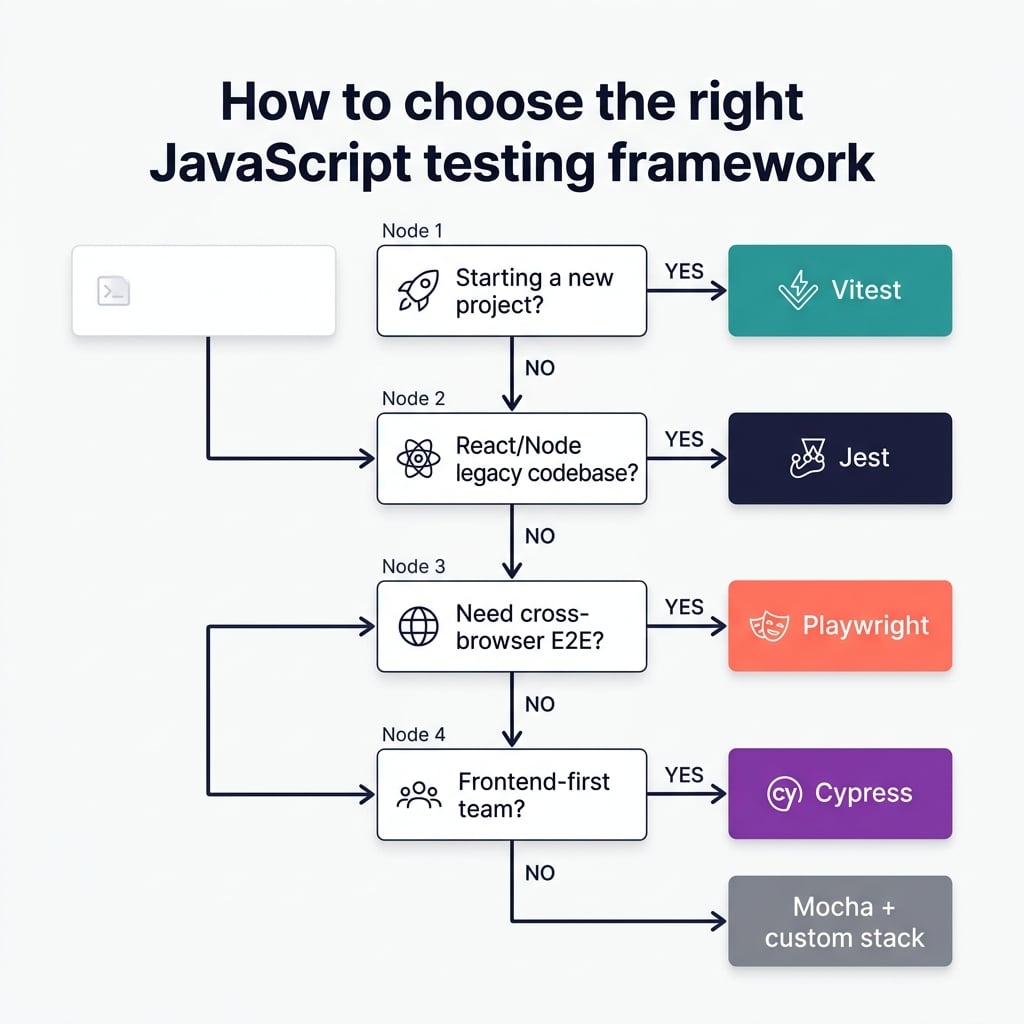
Here's a practical decision guide:
Choose Vitest if:
-
You're starting a new project or migrating to Vite
-
TypeScript and ESM support must work without additional plugins
-
Execution speed is a top priority for developer experience
Choose Jest if:
-
You're working in an established React or Node.js monorepo
-
You rely heavily on snapshot testing or have custom Jest transforms
-
You need the largest ecosystem of plugins and community answers
Choose Mocha if:
-
You want full control over every library in your testing stack
-
Your project has niche requirements that batteries-included frameworks can't address
Choose Playwright if:
-
You need cross-browser E2E testing across Chromium, Firefox, and WebKit
-
You want built-in test reporting, tracing, and debugging tools
-
You're building complex flows involving multiple tabs, iframes, or file downloads
Choose Cypress if:
-
Your team is frontend-focused and values fast, visual debugging
-
You want the lowest barrier to entry for writing E2E tests
-
Your application primarily targets Chromium-based browsers
Note: The shift from Mocha toward Vitest as the default for new projects has been a consistent testing framework trend since 2023. If you're starting fresh, Vitest is the safer long-term bet.
Setting up your first test with each framework
Below are quick-start guides for the three most common frameworks. Each example runs in under 2 minutes from a fresh project directory. All examples assume Node.js 20 or later.
Vitest setup
npm create vite@latest my-app -- --template vanilla
cd my-app
npm install -D vitest
Add a test script to package.json:
{
  "scripts": {
    "test": "vitest"
  }
}
Create your source file and test file:
export function greet(name) {
  return `Hello, ${name}!`;
}
import { describe, it, expect } from 'vitest';
import { greet } from './utils';
describe('greet', () => {
  it('returns a greeting with the name', () => {
    expect(greet('World')).toBe('Hello, World!');
  });
});
Run it:
npm test
Jest setup
npm init -y
npm install -D jest
{
  "scripts": {
    "test": "jest"
  }
}
Create the source file:
function sum(a, b) {
  return a + b;
}
module.exports = sum;
Create the test file:
const sum = require('./sum');
test('adds two numbers', () => {
  expect(sum(2, 3)).toBe(5);
});
npm test
Common Understanding: If you're using ESM (import/export) in your project, Jest requires either the --experimental-vm-modules flag or a Babel/SWC transform. Vitest handles ESM natively, which is one reason teams on modern stacks prefer it.
Playwright setup
npm init playwright@latest
This interactive command scaffolds everything: the config file, example tests, and a GitHub Actions CI workflow. Then run:
npx playwright test
The Playwright framework setup guide covers advanced configuration like custom reporters, sharding for parallel CI runs, and integration with test management platforms.
When test failures start increasing across your CI pipeline, the framework itself is rarely the root cause. The issue is usually in how tests are structured, how flaky tests are tracked, and whether teams have visibility into failure patterns over time. That's where a tool like TestDino helps by surfacing trends across runs, grouping errors by root cause, and flagging regressions automatically.
E2E test performance benchmarks from production teams show that a well-optimized Playwright suite can run 200+ tests in under 3 minutes with proper sharding and debugging strategies.
Conclusion
The JavaScript testing frameworks ecosystem in 2026 is mature, competitive, and well-segmented. You don't need to evaluate every option. You need to pick the right tool for each layer of your testing pyramid.
For unit and integration tests, Vitest is the strongest choice for new projects, and Jest remains the safe choice for existing codebases. For end-to-end tests, Playwright gives you the widest browser coverage and most powerful debugging tools, while Cypress offers the fastest path to getting your first E2E test passing.
The framework matters, but what matters more is having visibility into your test results over time. Tracking pass rates, spotting flaky patterns, and understanding failure trends across hundreds of CI runs is what turns a test suite from a checkbox into a reliable quality signal. That's exactly what TestDino is built for.
Pick your stack, write your first ten tests, and build from there. The best testing framework is the one your team actually uses.
FAQs
Table of content
Flaky tests killing your velocity?
TestDino auto-detects flakiness, categorizes root causes, tracks patterns over time.
Follow Us