
Top Test Management Tools in 2026

Discover the top test management tools in 2026, compare features, pros, and use cases, and choose the best platform for automation, CI/CD, and teams.

User

Pratik Patel

Jan 8, 2026

Top Test Management Tools in 2026

Software development in 2026 feels like a high-speed race where release cycles never slow down, and QA teams depend on powerful test management tools to avoid chaos as automation testing and AI redefine the rules.

Every sprint moves faster than the last, and only teams with strong software testing Workflows keep quality from slipping through the cracks.

With the increased speed of CI/CD pipelines and higher complexity of test environments, companies rely on test management tools to keep pace with an organised, visible, and predictable testing life cycle.

Without the tool, planning, traceability, and defect tracking are practically impossible tasks in today's fast-moving development ecosystem.
Why Test Management Tools Matter in 2026

Test management tools in 2026 are crucial for QA teams to handle continuous testing and automation-heavy pipelines efficiently, ensuring every test manual or automated is tracked and analysed.

  • Automating test reporting, syncing data, and generating quality dashboards saves time and reduces errors in fast-paced release cycles.
  • AI-powered test management tools predict high-risk modules, detect flaky tests, and suggest missing test coverage to boost software quality.
  • Centralised test management ensures better visibility, faster regression detection, and streamlined collaboration across QA and development teams.

Top 5 Test Management Tools in 2026

Below is the fully expanded section covering the top test management tools in 2026, each explained with deeper insights, examples, pros, cons, and technical use cases.

1. TestDino

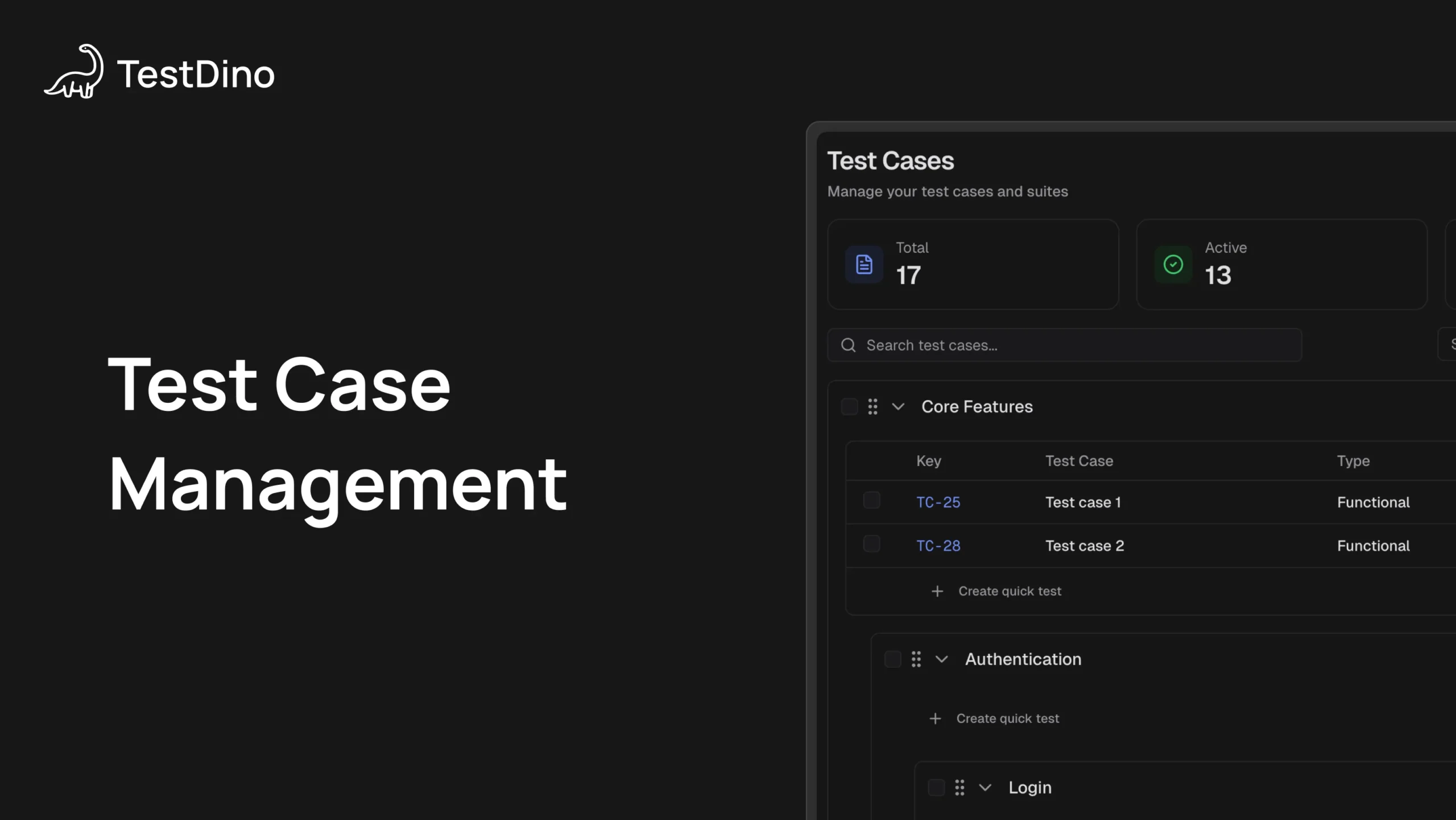
TestDino is a centralized test reporting and analytics platform designed for teams managing large volumes of automated and manual tests.

It focuses on AI-powered failure analysis, flaky test detection, and deep visibility across branches, environments, and CI workflows.

TestDino is commonly adopted when teams struggle with noisy test failures, reruns, and poor root-cause visibility.

Its reporting emphasizes actionable insights rather than raw pass/fail summaries.

Key Features:

  • Management of manual and automated test cases
  • Playwright-native reporting with zero setup and full artifact capture
  • AI-powered failure classification (bug vs UI change vs flaky test)
  • Cross-run AI insights to detect persistent vs emerging failures
  • Automatic flaky test detection, tracking, and flakiness trends
  • Built-in Playwright Trace Viewer and visual diff debugging
  • Smart CI re-runs (re-run only last-failed tests across pipelines)
  • Pull request–level test intelligence with historical context
  • Branch- and environment-aware test analytics
  • Role-based dashboards for QA, developers, and managers

Pros:

  • Combines test case management and execution analytics in one platform.
  • Playwright-native design provides unmatched depth for modern automation workflows.
  • AI-driven insights reduce noise and accelerate root-cause analysis.
  • Strong CI/CD and pull request integration improves developer feedback loops.
  • Excellent scalability for large, automation-heavy regression suites.

Cons:

  • Optimized primarily for Playwright-based automation.
  • Advanced enterprise compliance reporting is still evolving as the platform matures.

2. TestRail

TestRail Alternatives, TestRail Review, TestRail Comparison, TestRail vs TestDino Company

TestRail is a scalable, cloud-based test management tool widely used by QA teams to orchestrate large volumes of test cases, manual and automated, in one centralized system. It brings structure and traceability to software testing projects so teams can manage regression cycles and functional test suites with clarity.

Key Features:

  • AI-driven test prioritization predicts the most critical tests for upcoming releases, helping teams focus on high-risk areas first.
  • AI-driven test prioritization predicts the most critical tests for upcoming releases, helping teams focus on high-risk areas first.
  • AI-driven test prioritization predicts the most critical tests for upcoming releases, helping teams focus on high-risk areas first.

Pros:

  • Highly flexible and customizable: suitable for both small teams and large enterprises managing tens of thousands of test cases.
  • Excellent automation support: manual and automated results can live side-by-side, making regression testing smoother.
  • Great for cross-team collaboration and traceability between requirements, test cases, and defects.

Cons:

  • Because of its depth, new users may require onboarding and some learning curve before exploiting advanced features fully.
  • For very small teams doing only light manual testing, the tool may feel overkill or complex.

3. Zephyr Enterprise

Zephyr Enterprise is a test management tool built for teams using Jira integration and Agile or SAFe workflows. It helps teams tie test cases, test cycles, and defects directly to user stories and sprints, keeping QA tightly aligned with development planning and execution.

Key Features:

  • Native Jira integration, test cycles, and defect tracking live alongside backlog and sprint boards.
  • Real-time dashboards and test execution views that update as manual or automated tests complete.
  • Support for BDD workflows, enabling teams to write behavior-driven functional testing scenarios and link them to user stories.

Pros:

  • Seamless Jira workflow compliance makes Zephyr ideal for Agile teams already embedded in Jira.
  • Strong visibility into sprint-based testing and regression cycles.
  • Good mix of manual + automated testing support with clear traceability from requirements to defects.

Cons:

  • Performance may degrade when managing thousands of test cases or large regression suites.
  • Requires familiarity with Jira; teams not using Jira may find it less useful.
  • For heavy automation-driven CI/CD environments, its automation support is solid but not as advanced as full-featured enterprise tools.

4. qTest by Tricentis

qTest is an enterprise-grade test management tool designed for large organizations with robust automation needs and complex testing workflows. It is built to support continuous testing, large-scale regression testing, and cross-team collaboration across development, QA, and DevOps.

Key Features:

  • Advanced AI-powered analytics to identify risky modules, flaky tests, and slow-running automation suites before release, reducing unexpected defects.
  • Seamless integration with CI/CD pipelines via tools like Jenkins, GitHub Actions, and integration with automation suites such as Tricentis Tosca.
  • Enterprise-scale organization: supports thousands of simultaneous test cases, multiple projects, and complex traceability across releases.

Pros:

  • Excellent for heavy automation and continuous integration environments, ideal for complex, regulated software.
  • Promotes cross-team collaboration with shared test assets, audit logs, and traceability across requirements, tests, and defects.
  • Strong reporting and analytics for regression testing, functional testing, and release validation.

Cons:

  • The tool’s power comes with complexity; it requires significant infrastructure and setup effort.
  • Smaller teams may find its enterprise-level capabilities unnecessary or overly complex for their needs.

5. X-ray Test Management for Jira

Xray is a Jira-native test management tool that supports manual testing, automated testing, and BDD (Behavior-Driven Development) workflows. It enables teams to manage end-to-end software testing inside Jira from requirements to defects, making it a good choice for development teams deeply embedded in Jira.

Key Features:

  • Complete traceability from requirements/user stories to test cases, test runs, and defects.
  • Support for BDD frameworks (e.g., Cucumber), enabling teams to write behavior-driven functional tests directly in Jira.
  • Integration with CI/CD pipelines and automation frameworks so automated test results feed back into Jira test runs.

Pros:

  • Ideal for teams using Jira heavily:Everything stays in one place, reducing context switching.
  • Strong BDD support: Useful for behavior-driven functional testing and collaboration between QA, dev, and product teams.
  • Simplifies test planning and execution for Agile teams, blending test management and issue tracking.

Cons:

  • Performance may lag when dealing with very large test suites or data-heavy projects.
  • Non-Jira teams may find it inconvenient or redundant.
  • For very automation-heavy workflows, some advanced automation analytics might be limited compared to enterprise-grade tools.

How to Choose the Right Test Management Tool

When selecting the right test management tool for your team, consider factors such as release frequency, automation maturity, integration needs, and project scale. Here’s a guide to help teams make the best choice:

High Automation & DevOps Environments:

  • Teams running heavy automation and CI/CD pipelines should choose tools like TestRail or Testmo.
  • These tools excel at managing regression testing, tracking automated results, and providing dashboards for fast decision-making.

Jira-Centric Teams:

  • Teams using Jira as their central development platform benefit most from Zephyr or Xray.
  • These tools offer seamless Jira integration, support functional testing, and provide traceability from user stories to defects.

Budget-Conscious Teams:

  • Smaller teams or projects with limited budgets can consider Kualitee or ReQTest.
  • These test management tools deliver core features such as test case management, defect tracking, and basic reporting without unnecessary complexity.

Enterprise & Compliance-Heavy Teams:

  • Organizations with strict regulatory requirements or large-scale testing projects should look at PractiTest or qTest.
  • They provide robust reporting, end-to-end software testing traceability, and audit trails to support compliance and governance.

Additional Considerations:

  • Evaluate support for manual and automated testing.
  • Check integration capabilities with your CI/CD pipeline, test automation frameworks, and issue tracking tools.
  • Consider scalability for managing large regression suites or multi-team projects.

By aligning your team’s functional testing workflows, automation maturity, and project requirements with the right test management tool, you can improve traceability, speed up release cycles, and maintain high-quality software delivery.

Best Practices for Test Management in 2026

Effective test management ensures faster, reliable releases in 2026. Following best practices keeps functional and regression testing organized, traceable, and actionable.

Early Test Planning

  • Plan tests at the start of the SDLC.
  • Helps catch defects early and ensures functional testing aligns with requirements.

Requirements Mapping

  • Link every test case to a requirement.
  • Maintains traceability and full coverage for regression testing.

Automation Result Sync

  • Regularly sync automated test outcomes into the test management tool.
  • Preserves historical data and improves reporting accuracy.

Dashboard & Trend Review

  • Review dashboards and metrics each sprint.
  • Tracks quality trends and highlights issues quickly.

Traceability to Defects

  • Connect requirements → test cases → defects.
  • Simplifies audits and supports compliance in enterprise environments.

CI/CD Integration

  • Connect test management tools with pipelines and automation frameworks.
  • Provides real-time visibility for functional and regression testing.

Test Case Quality

  • Update and refine test cases regularly.
  • Reduces duplication and improves test efficiency.

Collaborative Workflows

  • Share dashboards and enable team collaboration.
  • Keeps QA, development, and product teams aligned for faster defect resolution.

Conclusion

In 2026, choosing the right test management tools is essential for efficient software testing and seamless functional and regression testing. These tools help teams manage test cases, track defects, and gain actionable insights through dashboards and reports.

Following best practices like early test planning, requirements mapping, and automation result syncing ensures better traceability and fewer defects. Integrating the right test management tools improves collaboration, accelerates releases, and enhances overall software quality.

Explore the best test management tools today to streamline your testing workflows and boost software quality 🚀

FAQs

Test management tools help teams organize, plan, and track functional and regression testing activities. They ensure traceability, improve collaboration, and provide actionable insights through dashboards and reports.

Get started fast

Step-by-step guides, real-world examples, and proven strategies to maximize your test reporting success