Selenium Market Share in 2026: Usage Stats & Enterprise Adoption
Selenium market share in 2026 explained with enterprise adoption signals, multi-ecosystem download trends, GitHub health, hiring demand, and comparisons to Playwright and Cypress.
Looking for Smart Playwright Reporter?
It's not dead. But its role is changing.
Selenium's npm package gets about 2.1 million weekly downloads. Its Python package pulls 50 million downloads per month on PyPI. It still has over 10,000 active job postings on LinkedIn in the US alone.
The question isn't whether teams still use Selenium. They clearly do. The real question is how its market share is shifting as Playwright's adoption rate climbs and newer frameworks take over new projects.
This article breaks down every signal that matters: GitHub metrics, cross-ecosystem downloads, enterprise adoption, job market data, and how Selenium compares to Playwright and Cypress in real benchmarks.
Enterprise adoption data
How many companies use Selenium?
2 independent trackers give us verified company counts:
| Source | Companies Using Selenium | Selenium Market Share (%) | Category |
|---|---|---|---|
| 6sense, 2025 | 55,785+ | 25.39 | Testing & QA |
| Enlyft, 2026 | 63,549 | 26.12 | Software Testing Tools |
The difference reflects how each platform defines its category and the breadth of its tracking methodology.
For context, Playwright is used by 4,484 verified companies as of mid-2025. Selenium's install base is roughly 12x larger by verified company count. That gap explains why enterprise migration is slow even when newer tools offer clear technical advantages.
Who uses Selenium: Industry breakdown
According to Enlyft, the top industries using Selenium are:
- Information Technology and Services - 26% of Selenium's customer base
- Computer Software - 17%
- Financial Services - 5%
The remaining 52% spreads across healthcare, education, manufacturing, retail, and government.
Company size distribution
Selenium's users skew toward mid-size companies:
| Company Size (Employees) | Companies Using Selenium |
|---|---|
| 100 - 249 | 15,367 |
| 20 - 49 | 11,954 |
| 1,000 - 4,999 | 6,473 |
| 50 - 99 | ~5,000+ |
| 10,000+ | ~3,000+ |

Tip: If you're evaluating which testing framework fits your org, company size matters. Larger enterprises tend to keep Selenium longer because of existing Java infrastructure. Smaller, JS-first teams often go straight to Playwright. See our 3-way framework comparison for a detailed breakdown.
Geographic distribution
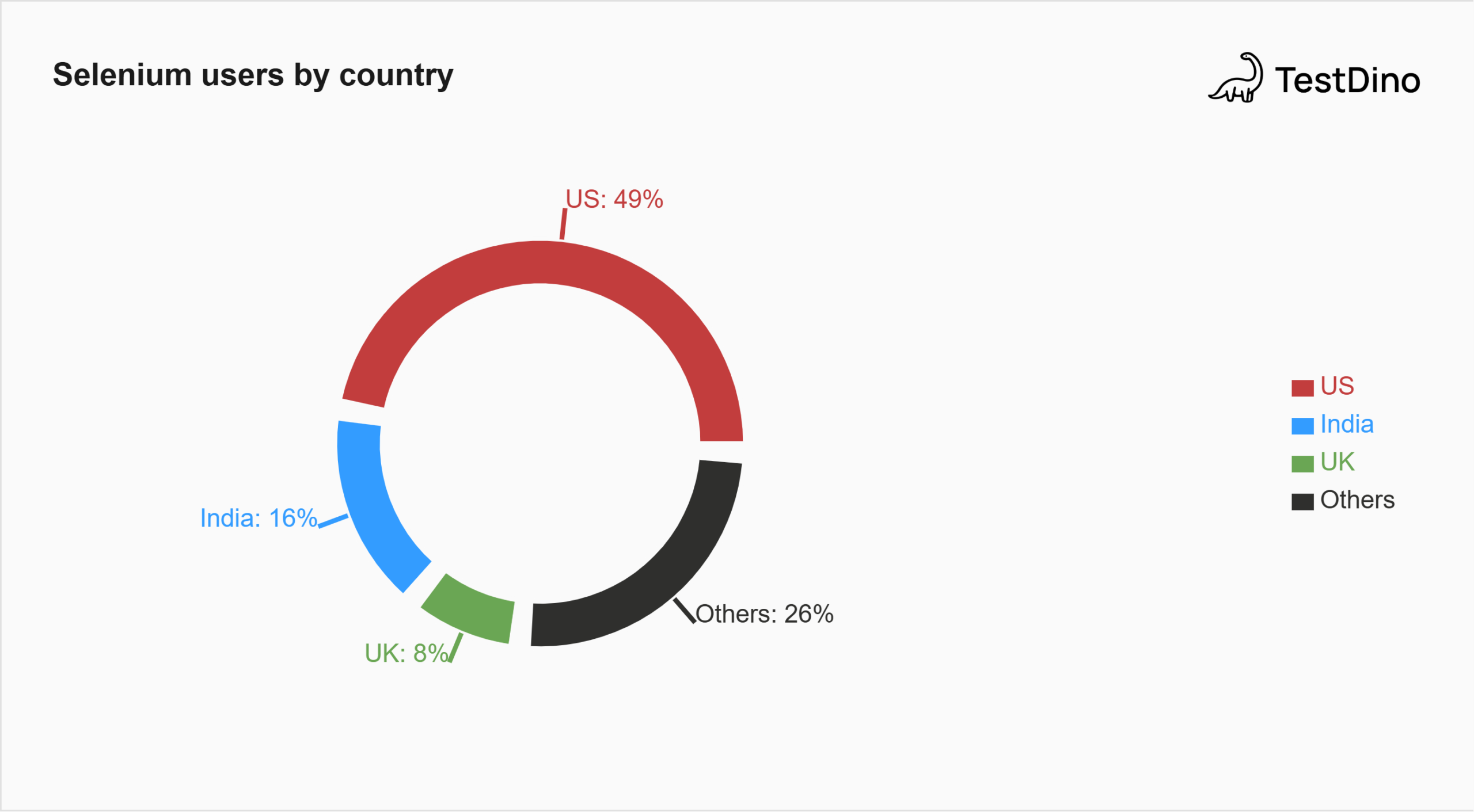
The US leads Selenium adoption, followed by India and the UK:
| Country | Companies | Share (%) |
|---|---|---|
| United States | 20,724 | 49.37 |
| India | 6,833 | 16.28 |
| United Kingdom | 3,523 | 8.39 |
| Rest of World | ~24,705 | 26.0 |
India's strong representation reflects the country's large QA outsourcing industry, where Selenium + Java remains the default stack for service companies like TCS, Infosys, and Wipro.
GitHub metrics & community data
The official Selenium GitHub repository shows verified community stats as of February 2026:
- GitHub Stars: 34,000+
- Forks: 8,600+
- Contributors: 675
- Total Releases: 225
- Latest Version: v4.40.0 (January 18, 2026)
- Primary Language: Java
- Dependent Packages: 4,770+
- Dependent Repositories: 2,540+
Framework comparison: GitHub stats
| Metric | Selenium | Playwright | Cypress |
|---|---|---|---|
| GitHub Stars | 34,000+ | 80,100+ | 49,400+ |
| Forks | 8,600+ | 4,700+ | 3,400+ |
| Contributors | 675 | 662+ | 517 |
| Total Releases | 225 | 154+ | N/A |
| Primary Language | Java | TypeScript | TypeScript |
| Initial Release | 2004 | 2020 | 2014 |
2 things stand out:
- Selenium has the most forks (8,600+) and contributors (675) of any testing framework on GitHub. This reflects 2 decades of community investment and the sheer number of custom Selenium wrappers, integrations, and extensions built across the ecosystem.
- Playwright leads in stars (80,100+) by a wide margin. Stars reflect current developer enthusiasm. The gap here shows that while Selenium's existing community is massive, new developer attention is flowing toward Playwright.
Note: GitHub stars measure popularity and interest, not production usage. Selenium's lower star count relative to Playwright doesn't mean fewer companies use it. Enterprise Java teams, Selenium's core audience, are less likely to star open-source repos than the JavaScript developer community.
Selenium continues to receive regular releases. The latest release, v4.41.0, shipped February 20, 2026, with active development on BiDi (bidirectional) protocol support, improved Selenium Manager, and continued language binding updates across Java, Python, .NET, Ruby, and JavaScript (Selenium Downloads, 2026).
Download data: The full ecosystem picture
This is where most analyses of the Selenium market share go wrong. They look at npm alone and declare Selenium dead. But Selenium's real footprint spans 4 package managers.
npm (JavaScript Ecosystem)
The selenium-webdriver npm package gets approximately 2.1 million weekly downloads (npm trends, Feb 2026).
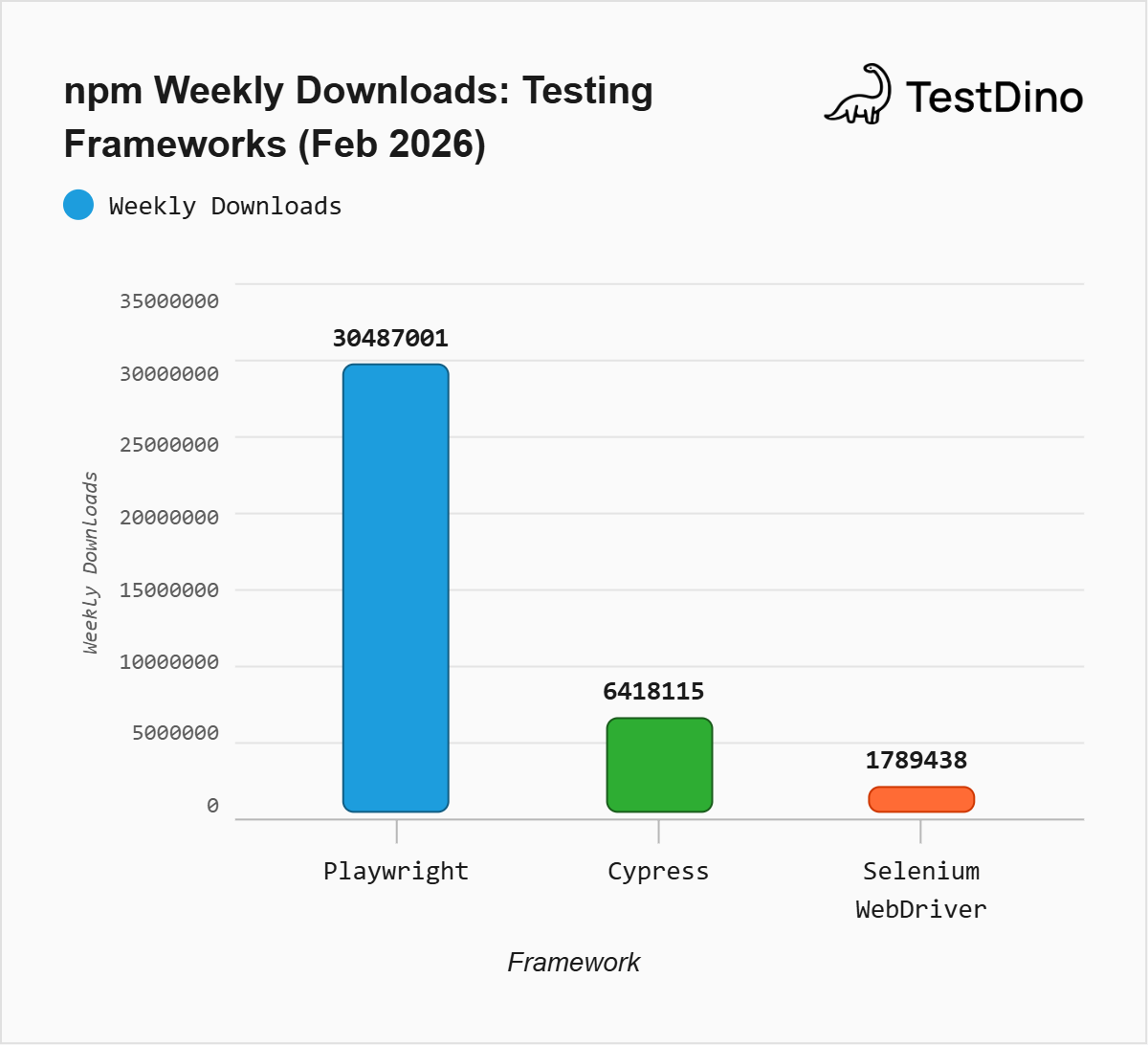
Compared to the other major frameworks:
| Package | Weekly Downloads | GitHub Stars |
|---|---|---|
| playwright | 30,487,001 | 80,158 |
| cypress | 6,418,115 | 49,461 |
| selenium-webdriver | 1,789,438 | 34,000+ |
On npm alone, Playwright downloads 12x as much as Selenium. Cypress downloads 3x more. This is real, and it reflects the JavaScript ecosystem's shift toward newer tools.
But npm tells only part of the story.
PyPI (Python Ecosystem)
The selenium Python package gets massive download volume:
- Last day: ~2 million downloads
- Last week: ~12 million downloads
- Last month: ~50.5 million downloads
That's 50 million monthly PyPI downloads for Selenium. No other browser automation package comes close in the Python ecosystem.
Maven (Java Ecosystem)
Selenium's Java bindings (selenium-java) are hosted on Maven Central and consistently rank among the most downloaded testing artifacts. Maven Central does not publicly expose total download counts like npm and PyPI. Still, Selenium's position as the default Java browser automation tool means its Maven usage likely exceeds its npm numbers significantly.
Java remains the #1 language for Selenium usage. Every Java-based enterprise testing setup, from custom frameworks built on TestNG and JUnit to robot framework integrations, depends on Maven's Selenium artifacts.
NuGet (.NET Ecosystem)
The latest Selenium NuGet release is v4.40.0, released January 18, 2026 (Selenium Downloads). The .NET Selenium community is smaller than Java and Python but still active, particularly in Microsoft-stack enterprises.
What this means
Tip: If someone tells you "Selenium downloads are declining," ask which ecosystem they mean. On npm, yes, selenium-webdriver has plateaued while Playwright surges. But on PyPI, Selenium still pulls 50 million downloads a month. The total picture looks very different from the npm-only view.
Job market data
Job postings are one of the clearest signals of real-world demand. Here's what the data shows as of February 2026:
US job postings by platform
| Platform | "Selenium" Jobs | Source |
|---|---|---|
| 10,000+ | LinkedIn Jobs | |
| Indeed (all Selenium) | 8,800+ | Indeed |
| Indeed (Selenium Tester) | 2,818 | Indeed |
India's job market
India's largest job board, Naukri, shows 11,909 Selenium job vacancies in February 2026. This makes sense given India's IT services sector, where Selenium is the standard testing tool at companies like TCS, Capgemini, Infosys, and Wipro.
Selenium vs Playwright job comparison
This is where Selenium's position becomes clearest. Despite all the buzz around Playwright, the job market still overwhelmingly favors Selenium experience:
| Search Term | LinkedIn (US) | Estimated Ratio |
|---|---|---|
| Selenium | 10,000+ | Baseline |
| Playwright | ~4,000-5,000 | ~0.4-0.5x |
| Cypress | ~3,000-4,000 | ~0.3-0.4x |
Note: Job posting numbers change daily and vary based on search methodology. The key takeaway is directional: Selenium still leads in raw job volume, though Playwright postings are growing faster quarter over quarter.
For QA engineers evaluating their career path, this data means Selenium skills remain valuable, especially in enterprise Java environments. But Playwright expertise is increasingly in demand among startups and modern engineering teams. If you're planning to add Playwright to your skillset, our Playwright cheatsheet is a good starting point.
Selenium vs Playwright vs Cypress: Performance benchmarks
Speed and reliability are the main reasons teams migrate from Selenium. Here's what independent benchmarks show:
Stability and flakiness
According to a 2025 academic survey published in the Journal of Information and Software Technology (ScienceDirect), the top challenges Selenium users face are:
- Assertability - difficulty writing reliable assertions
- Asynchrony - handling dynamic web elements with unpredictable timing
- Brittleness - tests breaking due to minor UI changes rather than actual bugs
The same study found that no single Selenium-based E2E framework dominates.
- WebDriverIO scored highest (2.09/5 average importance)
- Followed by SeleniumBase (1.7)
- Then, Selenide (1.69)
So, most teams build custom wrappers.
Playwright addresses many of these pain points through auto-waiting, built-in web-first assertions, and direct browser protocol communication. For teams dealing with flaky test issues, the architecture difference is significant.
Feature comparison
| Capability | Selenium | Playwright | Cypress |
|---|---|---|---|
| Browser Support | All major (via WebDriver) | Chromium, Firefox, WebKit | Chromium-based primarily |
| Language Support | 7+ languages | 4 languages | JavaScript only |
| Mobile Testing | Via Appium/Grid | Built-in device emulation | Limited emulation |
| API Testing | Separate tools needed | Built-in | Plugin required |
| Auto-wait | Manual | Native | Native |
| Parallel Execution | Grid configuration | Built-in | Cloud required |
| Protocol | WebDriver (HTTP) | CDP/BiDi (direct) | In-browser |
The global automation testing market
Selenium market share exists within a rapidly growing industry. Multiple research firms track the global automation testing market, and while their numbers differ, the direction is consistent: fast, double-digit annual growth.
| Research Firm | 2024/2025 Value | Projected Value | CAGR |
|---|---|---|---|
| Precedence Research | $35.52B (2024) | $169.33B by 2034 | 16.90% |
| Grand View Research | $25.43B (2022) | $92.45B by 2030 | 17.30% |
| Polaris Market Research | $36.44B (2025) | $124.61B by 2034 | 14.60% |
| MarketsandMarkets | N/A | $55.2B by 2028 | 14.50% |
| Fortune Business Insights | $20.60B (2025) | $84.22B by 2034 | 16.84% |
The variance reflects different market definitions and methodologies, but all firms agree on the trajectory: the market is growing at 14-17% annually.
What's driving growth
The drivers behind this expansion directly affect Selenium's market position:
- CI/CD adoption: 89.1% of QA teams now use CI/CD pipelines (ThinkSys, 2026), and testing frameworks must integrate smoothly into these workflows.
- AI-augmented testing: Gartner estimates 70% of enterprises will adopt AI-augmented testing by 2028, up from 20% in early 2025.
- Multi-framework reality: 74.6% of QA teams now use 2 or more automation frameworks simultaneously. Selenium often coexists with Playwright in the same org.
Note: The "multi-framework" stat is important. Most large teams aren't choosing Selenium OR Playwright. They're running both. Legacy test suites stay on Selenium while new projects may start with Playwright.
Selenium's developer survey presence
State of JS survey (2024/2025)
The State of JavaScript 2024 survey provides JavaScript-specific data on testing tool usage and sentiment. Key findings:
- Playwright achieved a 94% "would use again" retention rate, the highest of any E2E testing tool
- A majority of respondents had heard of Selenium but not used it recently
- The survey noted a general decline in positivity across all testing tools over time, as developers' expectations grow
The State of JS 2025 survey continued tracking Selenium alongside Playwright, Cypress, and newer runners. Respondents averaged 4.4 testing tools used, suggesting the testing tool market remains fragmented.
Note: The State of JS survey only captures JavaScript developers. Since Selenium's core user base is Java and Python, this survey structurally underrepresents Selenium's actual usage. Developer surveys like JetBrains Developer Ecosystem provide a more language-diverse view.
Academic research
A 2025 peer-reviewed survey on Selenium testing, published in the Journal of Information and Software Technology, collected 88 complete responses from professional Selenium users. Key findings:
- Selenium is used primarily for regression testing and functional testing
- The Page Object Model (POM) is the dominant design pattern
- Top challenges: assertability, asynchrony, and brittleness
- No single Selenium wrapper framework dominates; many teams build custom solutions
- AI integration in Selenium testing is emerging, but not yet widespread
Selenium's evolving role: What the data actually says
Let's put all the signals together:
| Signal | Direction | What it Means |
|---|---|---|
| Enterprise company count (55K-63K) | Stable/growing | Selenium's installed base remains massive |
| npm downloads (~2.1M/week) | Plateaued | JavaScript teams prefer Playwright/Cypress |
| PyPI downloads (~50M/month) | Strong | Python Selenium usage is substantial |
| Job postings (10K+ US) | Stable | Employers still require Selenium skills |
| GitHub stars (34K) | Slow growth | New developer enthusiasm favors Playwright |
| Active development (v4.40.0) | Active | Selenium 4.x with BiDi support is modern |
| Developer sentiment (State of JS) | Declining | JS devs increasingly prefer alternatives |
| Academic research (2025) | Active | Selenium remains the most-studied testing tool |
New projects increasingly choose Playwright for its speed and modern architecture. But existing Selenium test suites, numbering in the hundreds of thousands across enterprises, don't disappear overnight. Migration is expensive, risky, and often unnecessary for stable suites.
The most common pattern in 2026 is dual-framework: Selenium for legacy suites, Playwright for new work.
If your team is running this hybrid setup, a unified test reporting becomes critical for maintaining visibility across both stacks.
FAQs

Jashn Jain
Developer Advocate


![What is the Accessibility Tree_ How Playwright, Cypress, and Selenium Use It Differently [2026]](/_next/image?url=https%3A%2F%2Fcms.testdino.com%2Fwp-content%2Fuploads%2F2026%2F03%2FWhat-is-the-Accessibility-Tree_-How-Playwright-Cypress-and-Selenium-Use-It-Differently-2026.webp&w=3840&q=75)