
Cypress Market Share in 2026: npm, GitHub, and Enterprise Data
Cypress remains stable but growth has plateaued, while Playwright is growing fast and leading most new adoption in testing.

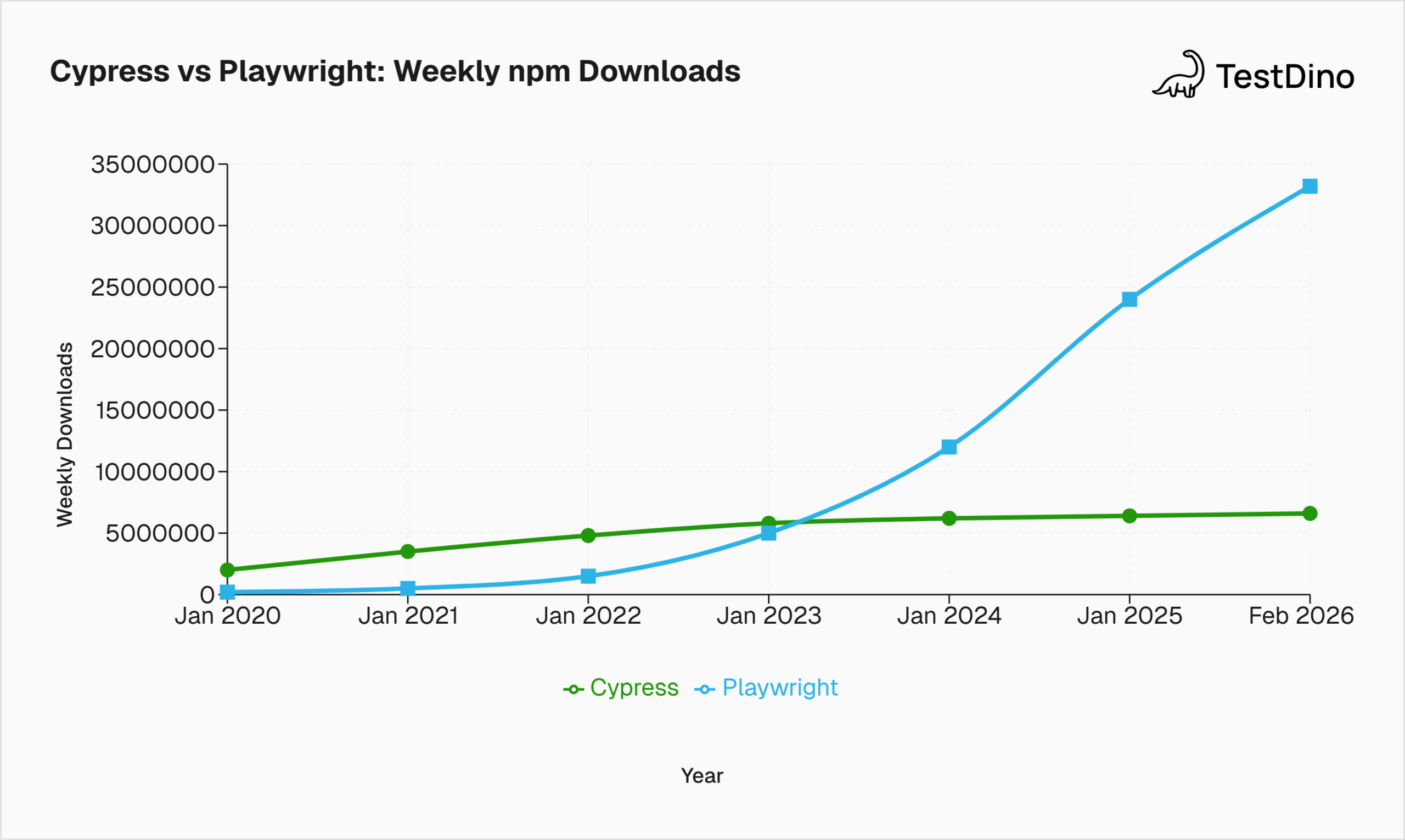
Cypress pulls roughly 6.6 million weekly npm downloads as of February 2026. That's stable. It hasn't crashed. But it also hasn't grown.
Compare that to Playwright's 33 million weekly downloads on the same date, and the picture gets clearer. Cypress still holds a meaningful share of the JavaScript testing market. But it's no longer the fastest-growing option.
The testing framework market has shifted over the past two years. This article breaks down every verifiable data point on the Cypress market share in 2026. GitHub metrics, npm trends, enterprise adoption, geographic spread, survey data, framework comparisons, and what it all means for teams evaluating their test stack.
If you're deciding between Cypress, Playwright, or Selenium, the numbers here will help you make that call based on data, not opinions. If you're already running Cypress, the benchmark comparisons and market share data for Playwright will show you exactly where each framework stands right now.
GitHub metrics & community data
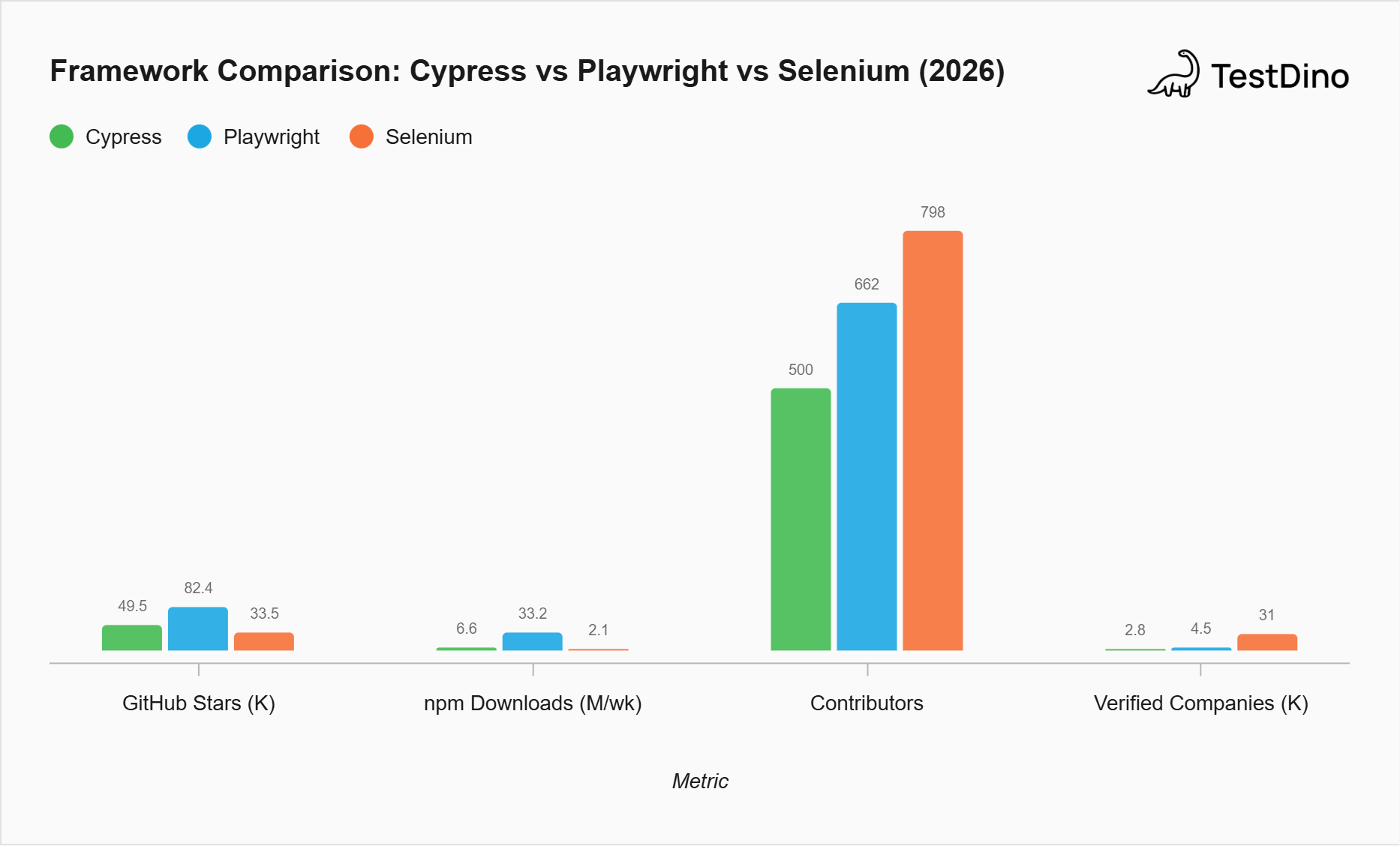
The official Cypress GitHub repository provides verified community metrics as of February 2026:
-
GitHub Stars: 49,500+
-
Forks: 3,300+
-
Contributors: 500+
-
Latest Version: v15.10.0 (February 2026)
-
Primary Language: TypeScript
-
License: MIT
How Cypress compares on GitHub
|
Metric |
Cypress |
Playwright |
Selenium |
|---|---|---|---|
|
GitHub Stars |
49,500+ |
82,400+ |
33,500+ |
|
Forks |
3,300+ |
4,700+ |
8,600+ |
|
Contributors |
500+ |
662 |
798 |
|
Latest Version |
v15.10.0 |
v1.58.2 |
v4.27+ |
|
Primary Language |
TypeScript |
TypeScript |
Java |
|
Initial Release |
2014 (public 2017) |
2020 |
2004 |
Sources: GitHub Cypress, GitHub Playwright, GitHub Selenium (Feb 2026)
What the GitHub data tells us:
Playwright now leads Cypress in stars by 66%. Two years ago, this gap was much smaller. Cypress stars have been climbing slowly, adding roughly 200-400 per month. Playwright has been gaining 800+ per month. The momentum gap is visible.
Selenium's fork count (8,600+) dwarfs both Cypress and Playwright. This reflects Selenium's age and enterprise footprint across multiple language ecosystems, not necessarily more active use.

Tip: GitHub stars are a signal of interest, not necessarily production usage. Selenium's 33,500 stars undercount its real adoption because Java and Python developers don't always star npm-ecosystem tools.
npm download trends
npm downloads are the most consistent, public proxy for JavaScript framework adoption. They include CI/CD installs and automated builds, so they skew higher than actual unique users. But the numbers are comparable across tools.
Current weekly downloads (February 2026)
|
Package |
Weekly Downloads |
Trend (YoY) |
|---|---|---|
|
playwright |
~33.2M |
Growing (+40%+) |
|
cypress |
~6.6M |
Flat (~0%) |
|
selenium-webdriver |
~2.1M |
Declining |
|
puppeteer |
~6.3M |
Flat |
|
webdriverio |
~1.3M |
Flat |
Source: npmtrends.com (Feb 2026)
The Cypress download timeline
Here's how Cypress npm downloads have evolved:
- 2019-2020: Cypress grew rapidly, reaching ~3-4M weekly downloads. It was the default recommendation for modern JS testing.
- 2021-2022: Peak growth period. Downloads climbed to ~5-6M weekly. Cypress was widely seen as the successor to Selenium for frontend teams.
- 2023-2024: The plateau begins. Downloads stabilized between 5.5-6.5M weekly. Playwright started gaining momentum fast.
- 2025-2026: Cypress holds at ~6.5M. Playwright crossed 20M in mid-2025 and hit 33M by early 2026. The gap widened significantly.
Note: Cypress downloads haven't declined. They've plateaued. In a market growing as fast as test automation, flat growth means losing relative market share even while absolute usage holds steady.
What drove the plateau?
Several factors contributed:
-
Playwright's rise. Microsoft-backed, open-source, with multi-browser support out of the box. Playwright's built-in parallel execution and cross-browser testing addressed gaps that Cypress users had long requested.
-
Browser support limitations. Cypress historically focused on Chromium. Firefox support arrived late. WebKit/Safari support is still experimental. For teams needing full cross-browser coverage, this was a dealbreaker.
-
JavaScript-only restriction. Cypress only supports JavaScript and TypeScript. Teams with Java, Python, or .NET stacks couldn't use it. Playwright supports JS, Python, Java, and .NET.
-
The layoffs. Cypress.io's January 2023 layoffs created uncertainty. While the company stabilized, some teams accelerated evaluations of alternatives.
Enterprise adoption data
Verified company usage
Enlyft tracks 2,758 verified companies using Cypress. 6sense reports 6,659 companies adopted Cypress in the browser testing category during 2024.
Cypress's own Crunchbase profile states that it has over 3,700 customers across 78 countries and 65 industries, with over 5 billion tests recorded through Cypress Cloud.
Company size distribution
|
Company Size |
Percentage of Cypress Users |
|---|---|
|
Small (<50 employees) |
24% |
|
Medium (50-1,000 employees) |
46% |
|
Large (>1,000 employees) |
28% |
Source: Enlyft
The takeaway: Cypress is most popular with mid-size companies. Nearly half its verified user base falls in the 50-1,000 employee range. This aligns with Cypress's strength as a developer-friendly, quick-to-set-up tool that works well for frontend teams without the overhead of Selenium Grid configurations.
Revenue distribution
|
Revenue Range |
Percentage |
|---|---|
|
Small (<$50M) |
46% |
|
Medium ($50M-$1B) |
18% |
|
Large (>$1B) |
31% |
Source: Enlyft
Industry breakdown
Top industries using Cypress, per Enlyft:
-
Information Technology & Services (24%)
-
Computer Software (21%)
-
Internet (6%)
-
Financial Services (6%)
-
Other (43%)
Geographic distribution
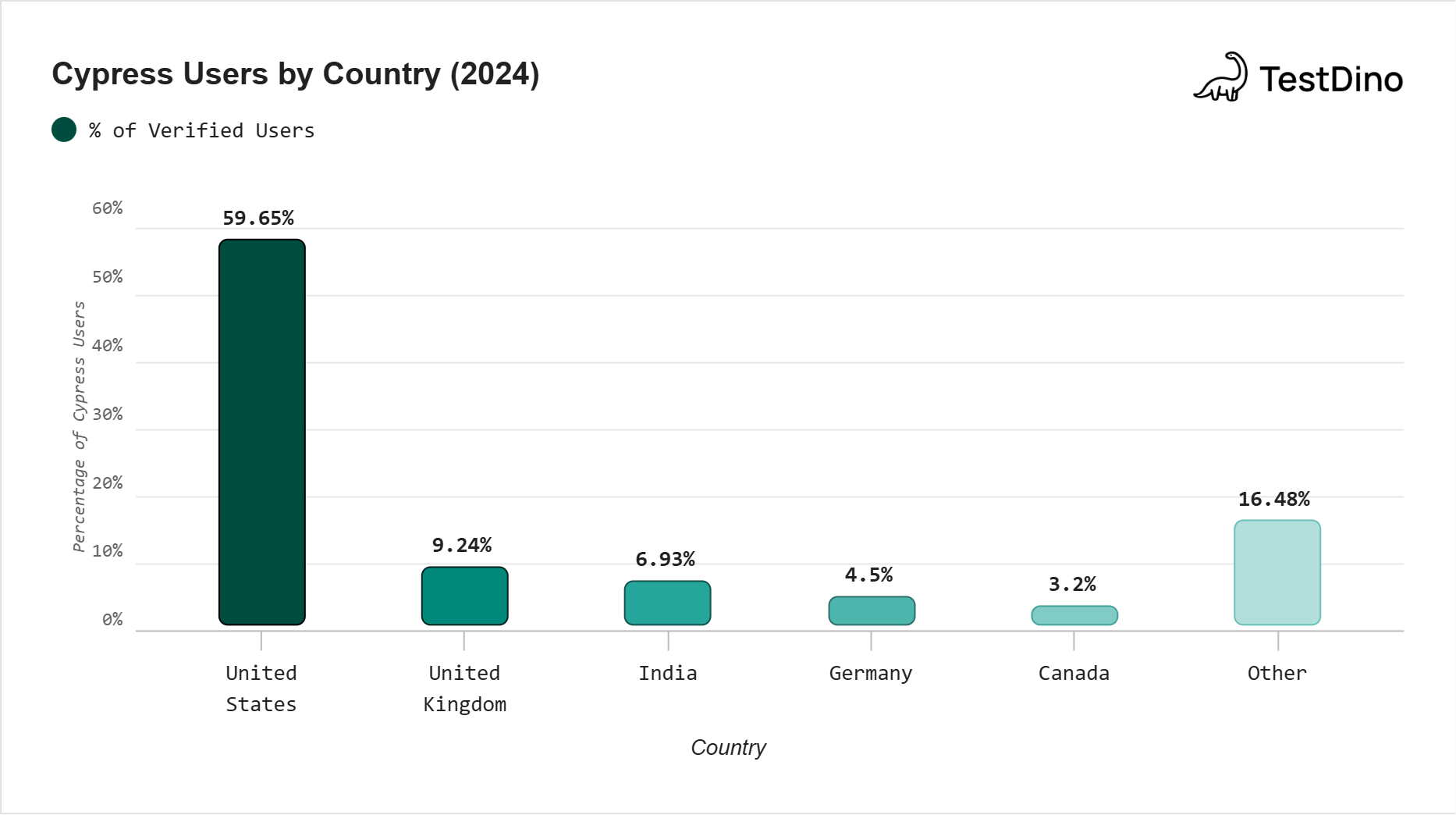
6sense reports the following regional spread:
|
Country |
Percentage of Cypress Users |
|---|---|
|
United States |
59.65% |
|
United Kingdom |
9.24% |
|
India |
6.93% |
|
Other |
24.18% |
Nearly 60% of Cypress users are in the US. This heavy North American concentration is notable. Compare it to Playwright, which shows stronger distribution across Germany, India, and the UK based on GitHub contribution patterns.
Developer survey data
State of JS 2025
The State of JS 2025 survey is one of the most cited sources for JavaScript ecosystem trends. The testing section shows clear shifts.
Key findings for Cypress:
-
Cypress usage remained largely flat from 2024 to 2025
-
Playwright gained +14 percentage points in usage year-over-year, the largest increase of any testing tool alongside Vitest (State of JS 2025 Libraries)
-
Cypress's satisfaction ratio has declined slowly since its 2020 peak, when it was the highest-rated E2E testing tool
The satisfaction trend matters. In 2020, Cypress topped satisfaction among E2E frameworks. By 2024, Playwright had overtaken it in retention rate (94% for Playwright). Cypress's satisfaction didn't collapse. It just didn't keep pace as Playwright solved pain points that Cypress users had been requesting.
JetBrains developer ecosystem survey
The JetBrains Developer Ecosystem 2024 survey, covering 23,262 developers globally, found that Cypress was used by 15% of JavaScript developers for testing. Jest led at 40%, with Mocha, Vitest, and Playwright each around 10% (JetBrains WebStorm Blog).
The 2025 edition surveyed 24,534 developers. While specific Cypress numbers from the 2025 report require deeper data exploration, the broad trend across both JetBrains and State of JS surveys points in the same direction: Playwright is gaining, Cypress is holding, and Selenium is slowly declining in the JavaScript ecosystem.
Broader market position
|
Framework |
npm Market Share (by downloads) |
Survey Adoption |
|---|---|---|
|
Playwright |
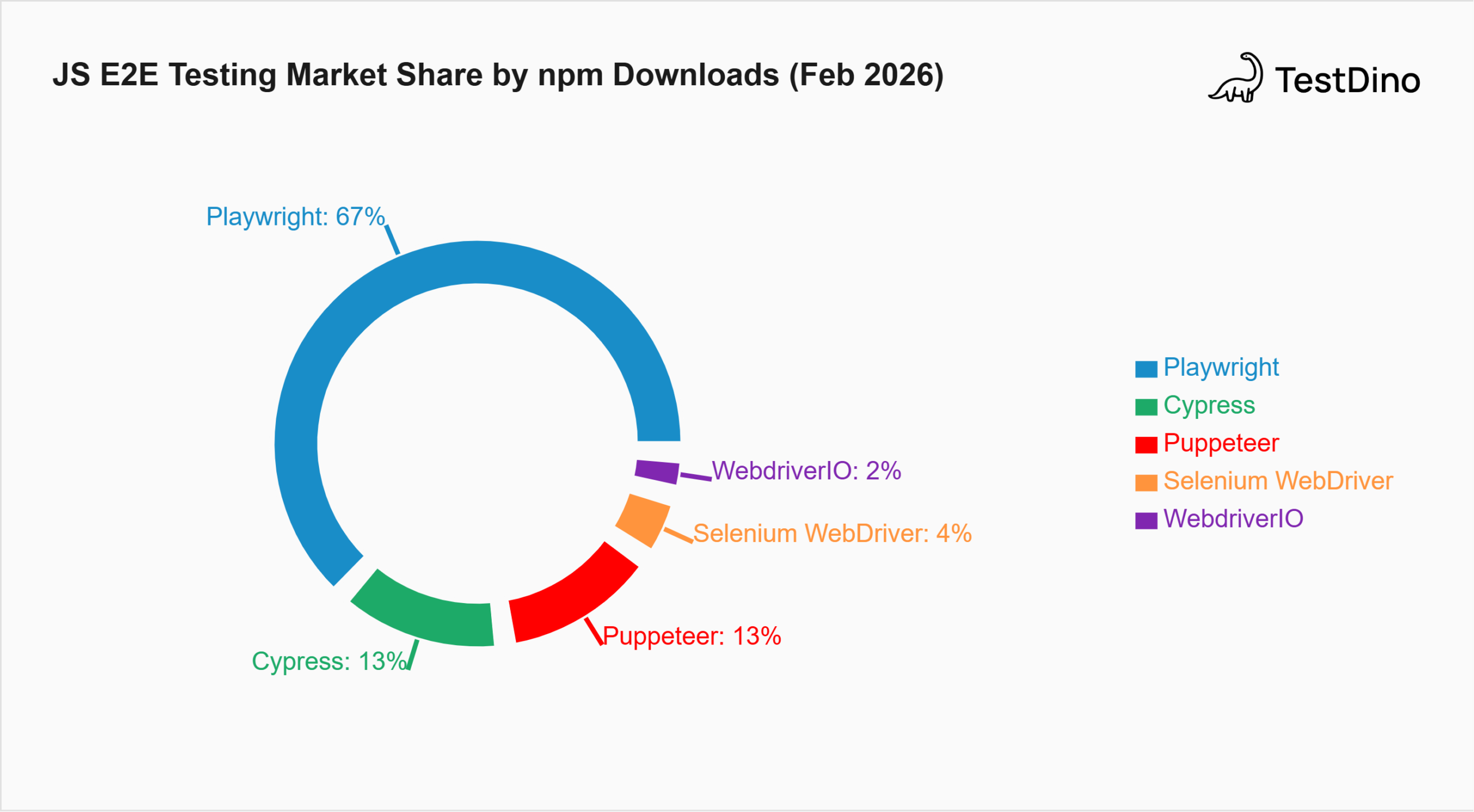
~33.2M/week (~70%) |
Growing fast |
|
Cypress |
~6.6M/week (~14%) |
Stable |
|
Puppeteer |
~6.3M/week (~13%) |
Stable (non-testing focus) |
|
Selenium (JS) |
~2.1M/week (~4%) |
Declining in JS |
Note: These percentages reflect only npm downloads. Selenium's true market presence is much larger when counting Java (Maven) and Python (PyPI) installs, which npm data misses entirely. And Puppeteer downloads include non-testing uses.
Cypress vs Playwright: Head-to-head comparison
This is the comparison most teams are making right now. Here's how the two frameworks stack up across verifiable metrics.
Adoption Metrics
|
Metric |
Cypress |
Playwright |
|---|---|---|
|
npm Weekly Downloads |
~6.6M |
~33.2M |
|
GitHub Stars |
49,500+ |
82,400+ |
|
Verified Companies |
2,758+ (Enlyft) |
4,484+ (TestDino analysis) |
|
Total Funding |
$54M+ |
N/A (Microsoft-backed) |
|
Revenue |
$17.8M (2024 est.) |
N/A (open-source, Microsoft) |
Technical capability comparison
|
Feature |
Cypress |
Playwright |
|---|---|---|
|
Browser Support |
Chromium, Firefox (experimental WebKit) |
Chromium, Firefox, WebKit |
|
Language Support |
JavaScript, TypeScript only |
JS, Python, Java, .NET |
|
Mobile Testing |
Device emulation |
Device emulation + more |
|
API Testing |
Plugin required |
Built-in |
|
Multi-tab Support |
Not supported natively |
Supported |
|
Parallel Execution |
Via Cypress Cloud (paid) |
Built-in (free) |
|
Auto-wait |
Native |
Native |
|
Network Interception |
Native (cy.intercept) |
Native |
|
Component Testing |
Built-in (React, Angular, Vue, Svelte) |
Built-in |
|
AI Features |
cy.prompt() (v15+), Cypress Cloud AI |
Playwright Agents, Codegen |
Tip: Speed isn't everything. Cypress's developer experience, especially the interactive Test Runner with time-travel debugging, remains a strong differentiator for frontend-focused teams. The right choice depends on your specific needs.
Where Cypress still wins
Cypress isn't losing on every front. It maintains clear advantages in specific areas:
-
Developer Experience. The interactive Test Runner, time-travel debugging, and real-time reloading during test development are still best-in-class for rapid frontend iteration.
-
Component Testing. Cypress's component testing support for React, Angular, Vue, and Svelte is mature and well-integrated. While Playwright now offers component testing too, Cypress had a head start.
-
Cypress Cloud. The paid cloud service offers test analytics, parallel orchestration, and AI-powered error summaries. For teams willing to pay, it provides a polished CI workflow.
-
Community & Ecosystem. A large plugin ecosystem, extensive documentation, and strong community support.
-
cy.prompt() and AI. Cypress v15 introduced natural-language test authoring and self-healing tests, signaling an investment in AI features.
Cypress.io: The company behind the framework
Funding & business model
|
Year |
Event |
Amount |
|---|---|---|
|
2015 |
Founded in Atlanta |
- |
|
2015 |
Early financing |
$600K |
|
2018 |
Series A |
$10M+ |
|
2020 |
Series B |
$40M |
|
2023 |
Layoffs (January) |
- |
|
2024 |
Revenue (est.) |
$17.8M |
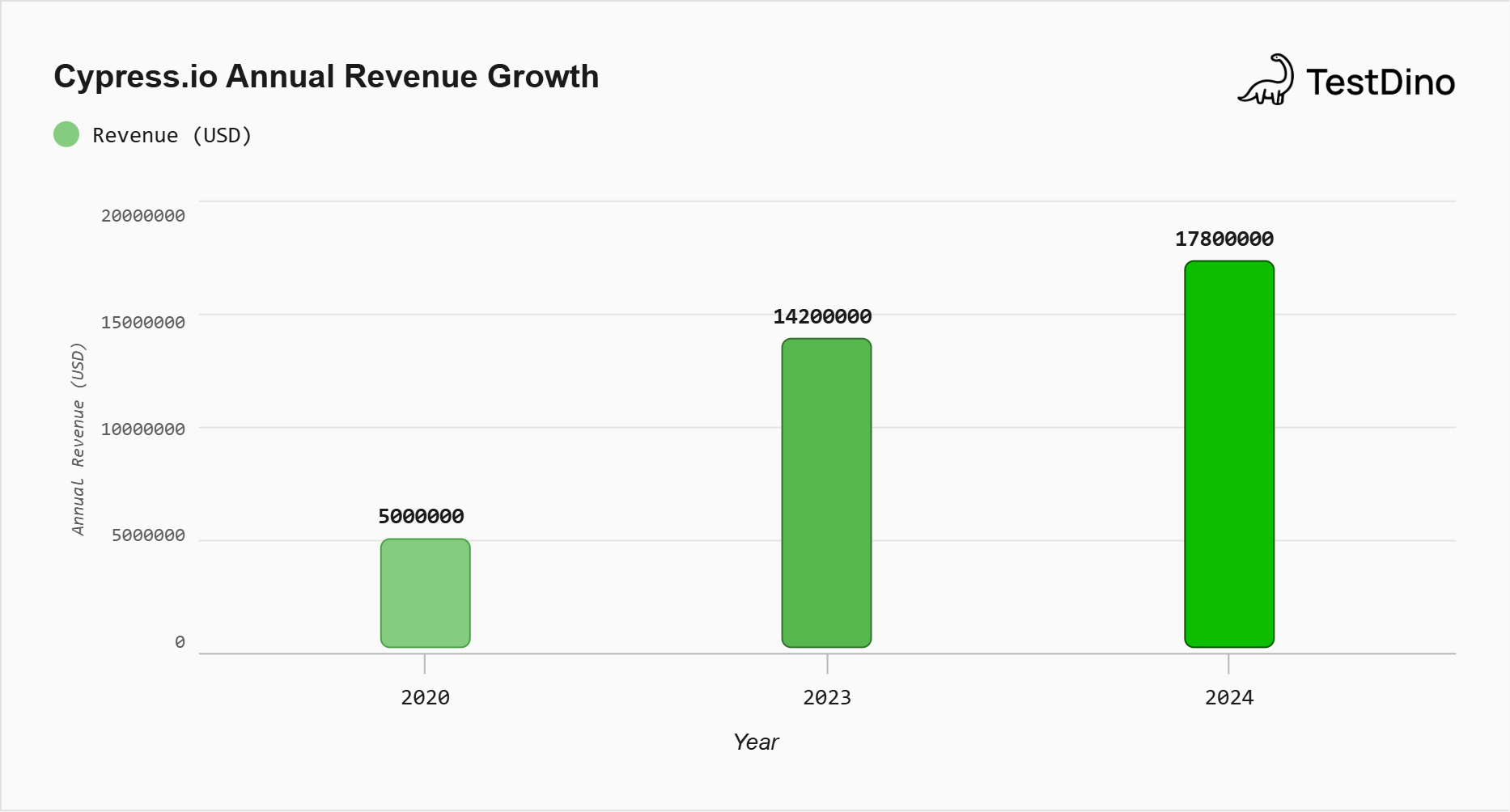
The business model is open-core. The Cypress test runner is open-source and free. Revenue comes from Cypress Cloud, which offers parallelization, test replay, analytics, UI coverage, and AI features. The cloud product is what generated the $17.8M in estimated 2024 revenue.
The January 2023 layoffs
Cypress.io reduced its workforce in January 2023. The company cited economic pressures and the need to "operate with discipline to navigate uncertain times." The layoffs aligned with broader tech industry restructuring during that period.
Post-layoffs, the company stabilized with approximately 94 employees and refocused on product innovation, including Cypress Studio, cy.prompt(), and AI-powered features in Cypress Cloud.
Latest product updates (v15)
Cypress v15, released in mid-2025, brought several notable updates:
-
cy.prompt(): Natural language test authoring directly in the test runner. Powered by AI.
-
Cypress Studio: Record interactions via UI and auto-generate test code.
-
Self-healing tests: AI-assisted test maintenance when selectors change.
-
Node.js 20/22/24 support. Dropped Node.js 18.
-
Upgraded Electron/Chromium engine for faster, more stable test runs.
-
Cypress.env() deprecation in favor of cy.env() and Cypress.expose() for better security.
Where Cypress fits in the testing market
Market position summary
Cypress occupies a specific niche in the 2026 testing market:
- Best for: Frontend-focused JavaScript teams, React/Vue/Angular SPAs, rapid prototyping of tests, teams that value DX above cross-browser breadth
- Less suited for: Multi-language teams, Safari-critical testing, teams needing free parallel execution, projects requiring multi-tab or cross-origin workflows
The broader automation testing market reached USD 35.52 billion in 2024 and is projected to grow to USD 169.33 billion by 2034, at a 16.90% CAGR. Within this expanding market, Cypress has carved out a loyal segment even as Playwright captures most of the new growth.
Testing tool market share (software testing category)
Enlyft reports Cypress at 1.13% of the overall software testing tools market. This low percentage reflects the size of the category, which includes everything from Selenium and JMeter to enterprise tools like HP UFT and Tricentis. Among modern JavaScript E2E frameworks specifically, Cypress's share is significantly higher.
What this means for teams
If you're currently using Cypress
Don't panic. Cypress isn't dying. The framework is actively maintained. Revenue is growing. New features like cy.prompt() show continued investment. Your tests still work.
But watch for these signals:
-
CI costs. If you're paying for Cypress Cloud parallelization and Playwright offers it for free, calculate the savings.
-
Safari testing gaps. If you need WebKit coverage and Cypress's support remains experimental, that's a practical limitation.
-
Speed. If your CI pipeline is bottlenecked by test execution time, the 2.4x speed difference matters.
Teams using any framework should invest in proper test reporting and failure analysis. Regardless of whether you run Cypress or Playwright, understanding failure patterns, flaky test trends, and execution time metrics keeps your suite healthy.
If you're starting a new project
The data points toward Playwright for most new greenfield projects in 2026. The npm growth rate, multi-language support, free parallel execution, and Microsoft backing make it the safer bet for long-term adoption.
Choose Cypress if:
-
Your team is exclusively JavaScript/TypeScript
-
You value the interactive Test Runner and time-travel debugging above all
-
You're building a frontend-heavy SPA and don't need Safari testing
-
Your team already knows Cypress well
Choose Playwright if:
-
You need cross-browser support including Safari/WebKit
-
You want free parallel execution and sharding
-
Your team works in multiple languages (Python, Java, .NET)
-
CI speed is a top priority
-
You want stronger AI and MCP integration support
Note: Framework choice matters less than framework execution. A well-maintained Cypress suite with good reporting outperforms a poorly maintained Playwright suite every time. Focus on test health metrics regardless of your choice.
FAQs

Jashn Jain
Developer Advocate

![What is the Accessibility Tree_ How Playwright, Cypress, and Selenium Use It Differently [2026]](/_next/image?url=https%3A%2F%2Fcms.testdino.com%2Fwp-content%2Fuploads%2F2026%2F03%2FWhat-is-the-Accessibility-Tree_-How-Playwright-Cypress-and-Selenium-Use-It-Differently-2026.webp&w=3840&q=75)