
Is Selenium Dead in 2026? The Data Says Otherwise
Selenium isn’t dead, it still dominates multi-language and enterprise testing. But for new modern projects, especially in JS/TS, Playwright is often the smarter default.
"Selenium is dead." You may have encountered this claim repeatedly on X, LinkedIn, or various blogs.
It's a popular take. And it's wrong.
Not because Selenium is the best tool for every job. It isn't. Playwright is faster, lighter on CI resources, and has better built-in tooling. We've covered that in our performance benchmarks and framework comparison.
But "faster" and "dead" aren't the same thing. The data tells a very different story from the hot takes. Selenium's market share looks different depending on whether you measure one ecosystem or all of them.
Here are 3 signals that actually matter:
-
Job postings
-
Cross-ecosystem downloads
-
Enterprise reality
Signal 1: The Job Market Still Runs on Selenium
If Selenium were dead, companies would stop hiring for it. They haven't.
As of February 2026, a search for "Selenium" on Indeed returns 8,800+ automation testing jobs in the United States. LinkedIn shows 10,000+ Selenium-related positions. ZipRecruiter lists hundreds of Java+Selenium roles alone, with salaries ranging from $42-$76/hour.
For comparison, "Playwright" on Indeed returns approximately 1,200 results when searched as an exact match (and many of those are theater jobs, not software testing). Even "QA Automation Playwright" returns around 10,000 results, roughly on par with Selenium.
Here's the split in context:
| Search Term | Indeed Results (Feb 2026) | LinkedIn Results |
|---|---|---|
| "Automation Testing Selenium" | ~8,800 | 10,000+ |
| "QA Automation Playwright" | ~10,200 | 85,000+* |
| "Selenium" (exact) | ~1,800 | 10,000+ |
| "Playwright" (exact) | ~1,200 | 85,000+* |
*LinkedIn results for "Playwright" are heavily contaminated with theater/writing roles.
The numbers are closer than the narrative suggests. Playwright is growing fast in job postings, absolutely. But Selenium hasn't collapsed. The QA job market in 2026 reflects a period where both tools coexist, with Selenium still deeply embedded in enterprise hiring pipelines.
Note: Job postings are a lagging indicator. They reflect what companies currently use, not what they're evaluating. New project decisions increasingly favor Playwright, but existing Selenium suites need maintenance, migration, and talent for years to come.
One pattern worth watching: the automation vs. manual split in QA has shifted heavily. Roughly 80% of QA job postings now emphasize automation skills, with only 15-20% focused on manual testing. Even manual QA roles increasingly ask for automation knowledge as a "nice to have." This shift benefits both Selenium and Playwright, since both require automation skills, but it means the total pool of automation-relevant jobs is larger than ever.
Signal 2: Downloads Tell a Different Story When You Count All Ecosystems
This is where the "is Selenium dead" narrative falls apart most clearly.
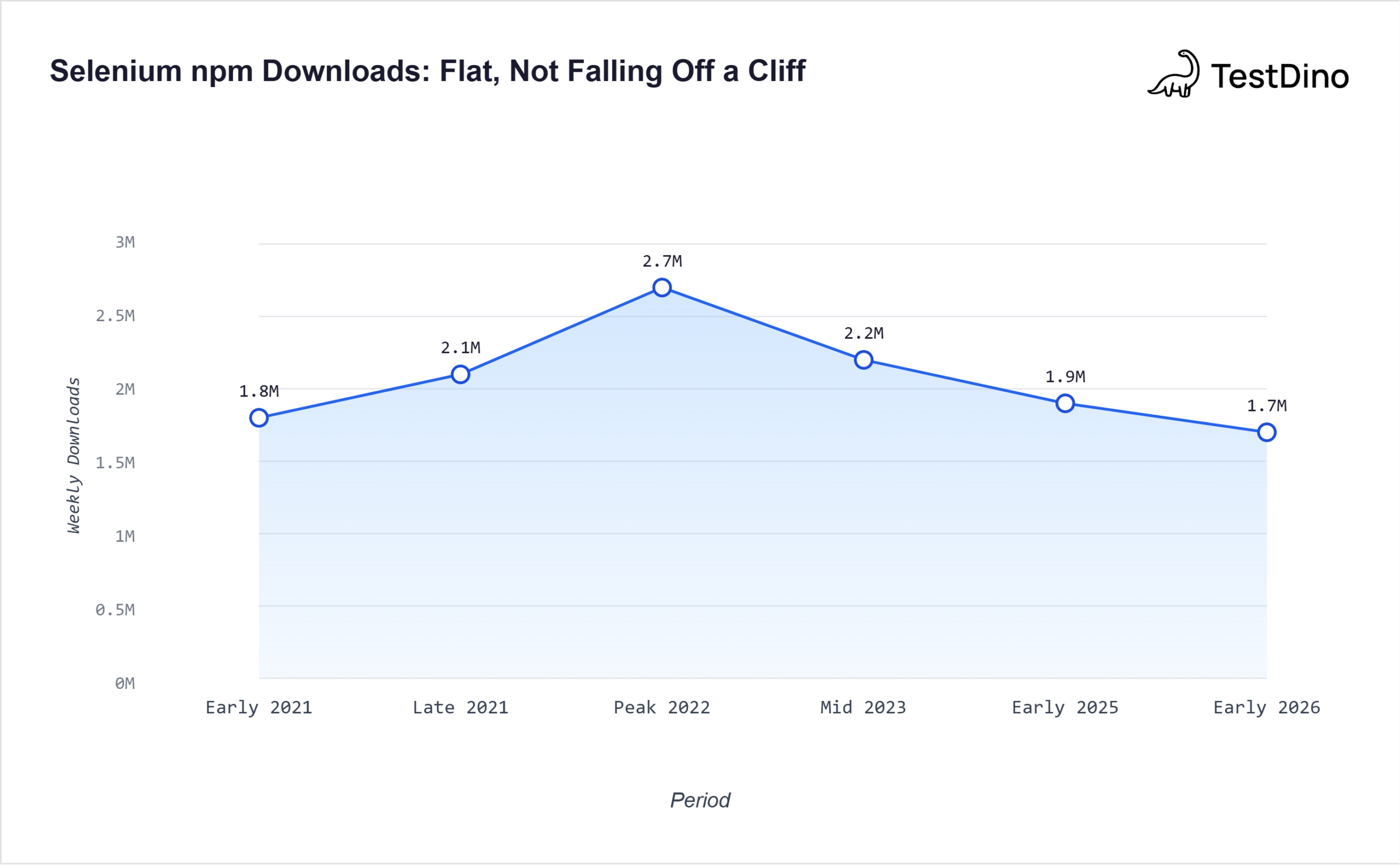
The tech blog version goes like this: Playwright has 35M npm weekly downloads. Selenium WebDriver has 2.1M. Playwright wins by 17x. Case closed.
But npm only captures JavaScript. Selenium's primary ecosystems are Java and Python.
| Ecosystem | Package | Downloads | Frequency |
|---|---|---|---|
| PyPI (Python) | selenium | 50.5 million | Per month |
| npm (JavaScript) | selenium-webdriver | ~2.1 million | Per week (~9M/month) |
| Maven (Java) | selenium-java | Active (4,770 dependent packages) | Per Maven Central |
| NuGet (.NET) | Selenium.WebDriver | Active | Per release |
Selenium's Python package alone pulls 50 million downloads per month. That's roughly 12 million per week, which is 6x the npm selenium-webdriver number, and it doesn't even include Java or .NET usage.
When you add Maven (where Selenium is the default browser automation tool for Java shops running TestNG or JUnit) and NuGet, Selenium's total install footprint across all ecosystems is massive. It dwarfs its npm number.
The npm-only view is misleading because it measures one slice of a multi-language ecosystem. It would be like judging React's adoption by only counting Python downloads. The data doesn't show a dead framework. It shows a framework whose largest user base doesn't install packages through npm.
Signal 3: Enterprise Reality and the Multi-Language Factor
Large enterprises don't switch frameworks quickly. They have hundreds of thousands of tests written in Java with Selenium, TestNG, and JUnit. Those suites represent years of investment.
Several factors keep Selenium firmly in place at these organizations:
Language flexibility. A bank with QA teams writing tests in Java, Python, and C# can use Selenium across all of them. Playwright covers 4 languages. Cypress covers 1. For polyglot enterprises, Selenium is still the only framework that fits everywhere.
Legacy browser requirements. Some regulated industries (finance, healthcare, government) still need to test against older browser configurations. Selenium's W3C WebDriver protocol and browser compatibility support scenarios that modern frameworks don't prioritize.
Ecosystem depth. Selenium has 675 contributors, 33,900+ GitHub stars, and 354,000+ repositories using it. Its Stack Overflow tag has nearly 30,000 questions with answers. When something breaks at 2 AM, the odds of finding a solution for a Selenium problem are higher than for any other testing framework.
Active development. Selenium is not abandoned. In 2025, the project shipped 12 releases, with version 4.40.0 dropping in January 2026 and the latest version 4.41.0 in February 2026. BiDi protocol support, Selenium Manager for automatic driver management, and improved Grid architecture are all active areas of work.

Tip: If you see a "Selenium is dead" post, check the release history. A project that ships 12+ releases per year, has 675 active contributors, and hits 50 million monthly PyPI downloads is not dead by any measure. It may not be growing as fast as Playwright, but those are different conversations.
What's Actually Happening: Selenium's Role Is Evolving
The accurate version of the narrative isn't "Selenium is dead." It's "Selenium's role has changed."
Here's the pattern playing out across the industry in 2026:
-
New projects: ~75% choose Playwright or Cypress for greenfield JavaScript/TypeScript work
-
Existing suites: Selenium continues running because the migration cost is high, and the suite works
-
Enterprise Java/Python shops: Selenium remains the default for teams outside the JS ecosystem
-
Mixed environments: Teams run Selenium for legacy and Playwright for new work simultaneously
This is a coexistence pattern, not a replacement pattern. The CodeMe5 channel (38.7K subscribers), which tracks QA job market trends, observed a similar dynamic: Playwright has surpassed Cypress in job postings, but Selenium remains in demand for companies with legacy codebases. The typical scenario is that new projects within a company adopt Playwright while the existing Selenium suite keeps running.
The smarter question isn't "Is Selenium dead?" It's "which tests should stay on Selenium, and which should move?"
What to Do If You're Deciding Today
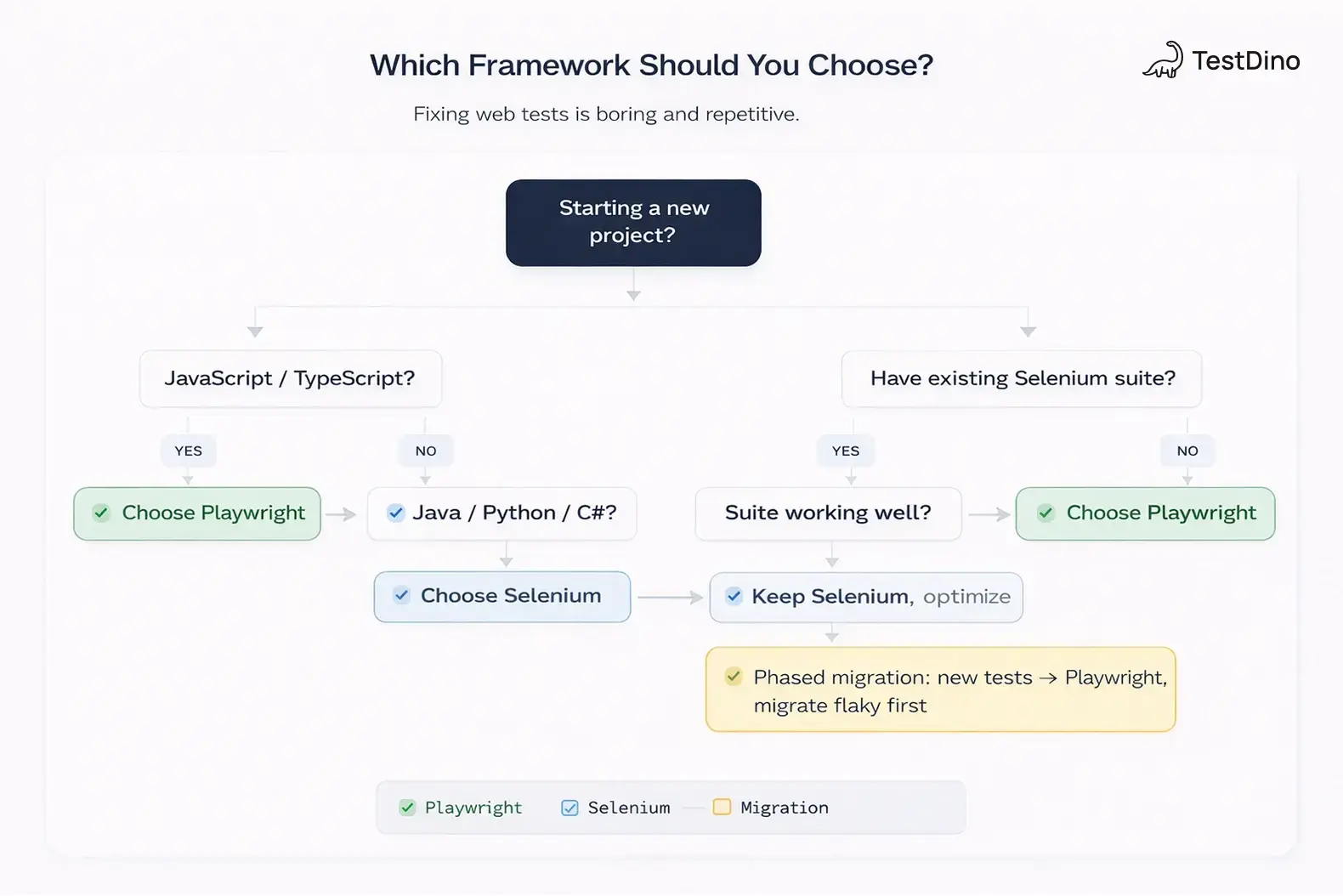
If you're evaluating frameworks right now, here are 2 clear paths based on what the data supports.
Path 1: Keep Selenium Where It's Strong
Selenium still makes sense when:
-
Your team writes tests in Java, Python, or C# and doesn't plan to switch
-
You have a large existing Selenium suite that works (even if it's slow)
-
You need legacy browser or driver support that Playwright doesn't cover
-
Your organization has Selenium expertise, and the migration cost is high
In this case, invest in making your Selenium suite better, not replacing it. Reduce flakiness with explicit waits and better locator strategies. Upgrade to Selenium 4+ with BiDi protocol for better performance. Use Selenium Grid for parallel execution.
Path 2: Adopt Playwright Where It's Strong
Playwright is the better choice when:
-
You're starting a new project in JavaScript or TypeScript
-
Speed and CI cost reduction are top priorities
-
You need built-in parallel execution without paid services
-
Cross-browser testing (Chromium, Firefox, WebKit) is a requirement
-
Your team values modern tooling: auto-waiting, Trace Viewer, and built-in assertions
For teams migrating from Selenium, the recommended approach is phased: new tests in Playwright, the highest-flake Selenium tests migrated first, and both suites run in parallel during transition. The migration guide covers this step-by-step.
Tip: Migrate gradually. Write new tests in Playwright while running your Selenium suite. Prioritize migrating the flakiest Selenium tests to improve stability. Retire Selenium coverage feature-by-feature as Playwright coverage grows.
You can also check these skills (for AI agents), open sourced by the TestDino team, to migrate your Selenium tests to Playwright (JS/TS version).
Conclusion
Selenium isn't dead. It's still pulling 50 million PyPI downloads per month, still appearing in 8,800+ US job postings, still shipping monthly releases, and still running in enterprises that measure their test suites in hundreds of thousands of tests.
What has changed is the direction of new adoption. Playwright has won the JavaScript/TypeScript greenfield market. For new projects in 2026, the data points to Playwright. But the existing Selenium installed base is so large that it will remain a significant part of the testing industry for years.
The practical response isn't to pick a side. It's to pick the right tool for each situation and keep your reporting and analytics consistent across both.
Frequently Asked Questions

Jashn Jain
Developer Advocate



![What is the Accessibility Tree_ How Playwright, Cypress, and Selenium Use It Differently [2026]](/_next/image?url=https%3A%2F%2Fcms.testdino.com%2Fwp-content%2Fuploads%2F2026%2F03%2FWhat-is-the-Accessibility-Tree_-How-Playwright-Cypress-and-Selenium-Use-It-Differently-2026.webp&w=3840&q=75)