State of test automation in 2026
Discover the latest test automation trends for 2026, including AI, codeless frameworks, shift-left strategies, and more. Stay ahead in QA and DevOps.

Test automation in 2026 is no longer an experiment or a nice-to-have. Teams now lean on Test Automation, modern Automation Tools, and smart Automation Frameworks to keep up with delivery demands.
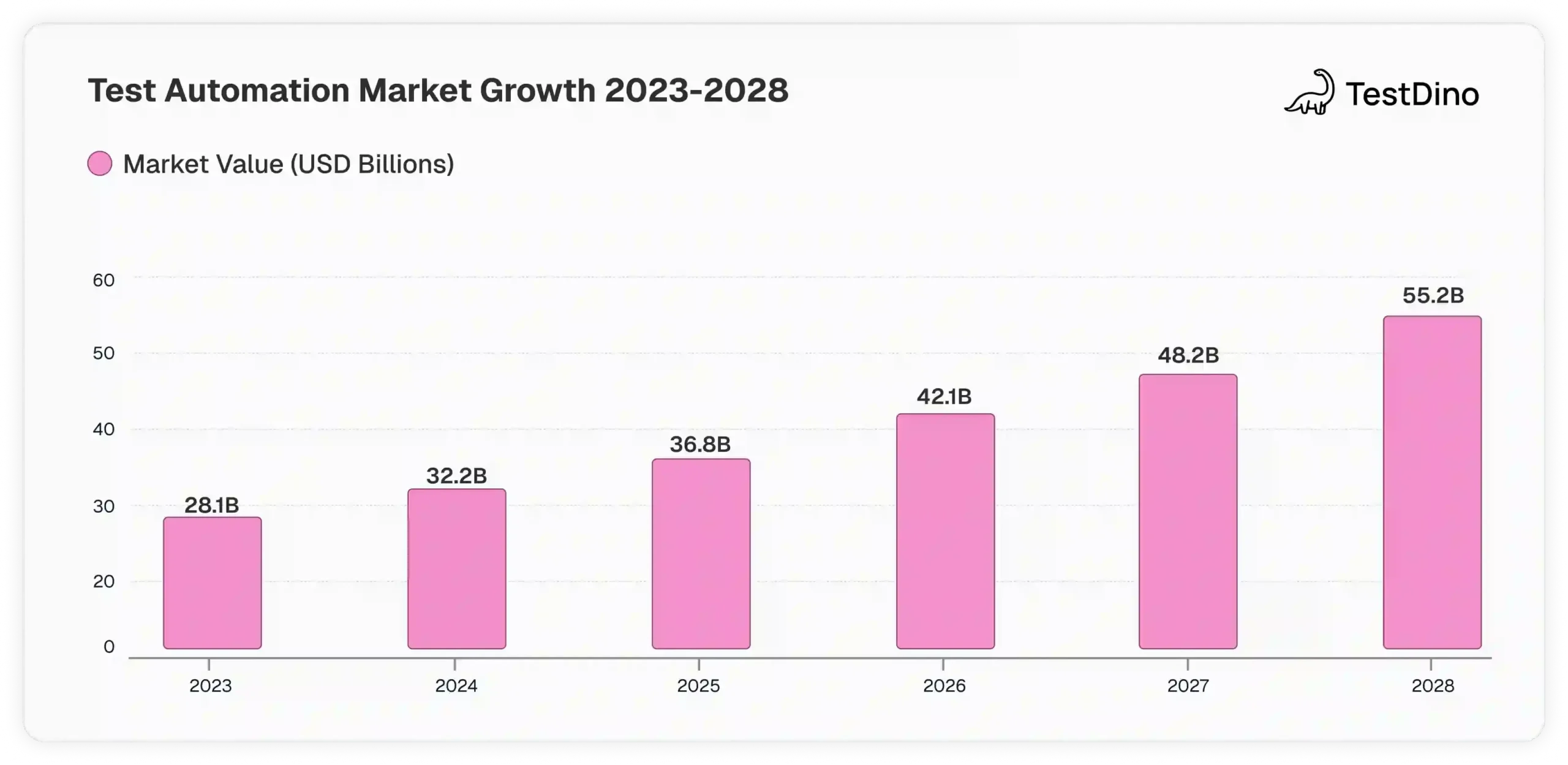
The global QA market is now above $41.5 billion. It is projected to reach $60.2 billion by 2029. The automation segment alone is set to nearly double, from $28.1 billion in 2023 to $55.2 billion by 2028.
At the same time, AI use has surged. McKinsey’s 2025 study found that 74% of enterprises use AI in testing. That is driving the rise of AI-Testing and smarter Self-healing features built into frameworks.
This report brings together verified data from MarketsandMarkets, Gartner, McKinsey, and GitHub. It shows how automation frameworks, AI tooling, cloud execution, and DevOps integration are changing software quality worldwide.
You may be picking a framework like Playwright, growing your automation coverage, or planning AI-based gains. Either way, the data here gives you the context for a clear strategy and sound decisions. That is especially true for teams using Continuous Integration and CI/CD pipelines.
1. Global Market Size and Growth
The test automation market is not just growing. It is exploding, and the numbers come from the industry's most trusted analysts. The surge in Automation Testing, paired with better Automation Frameworks, is speeding up adoption in every sector.
According to MarketsandMarkets research, the automation testing market was worth $28.1 billion in 2023. It is projected to reach $55.2 billion by 2028. That is close to doubling in just five years.
The wider software testing market is even bigger. It passed $54.68 billion in 2025. That figure covers both automated and manual testing in every industry, including Regression Testing, API-Testing, and Performance Testing.
Market Drivers
Three primary factors accelerate adoption
- Digital transformation mandates requiring faster release cycles
- Cloud migration initiatives demanding scalable testing infrastructure
- AI integration capabilities reducing maintenance overhead, especially within Automation Tools
These numbers reflect real enterprise spending, not hype. Companies are voting with their budgets. They choose automation to get ahead and to mature their E2E-Testing and Mobile Automation.
2. AI and Machine Learning in Testing
AI has moved from "interesting concept" to "must-have capability" in record time. The data backs this convincingly, especially with the rise of AI-Testing, intelligent predictions, and autonomous Self-healing test scripts.
McKinsey's State of AI 2025 report shows 74% of enterprises using AI in development and testing workflows, up from 41% in 2023.
Teams that use AI-driven testing report clear gains. Defect detection improves by 25–38% and release speed by 20–30%, depending on maturity. The gains are biggest when AI is tied into QA Ops pipelines and a well-tuned Automation Framework.
How AI is Changing QA Right Now
AI is changing testing in several practical ways. Test scripts can now self-heal. They update on their own when app elements change, so there is less manual upkeep.
These Self-healing tools work well with the modern Automation Frameworks used in enterprise pipelines.
In production, early adopters report 35–50% fewer broken tests per release from self-healing alone.
Large language models write test cases that add coverage without adding run time. Predictive analytics flag high-risk areas and trim Regression Testing suites, so fewer tests run twice.
In controlled pilots, LLM-written tests have added 22–30% more functional scenarios with no extra run time.
Predictive analytics can tell you which tests are most likely to find bugs before you run them. That helps teams decide what to run first.
A growing number of QA teams say predictive ranking is cutting redundant suite execution by 18–25%.
Smart test selection also cuts run time, often by 40–60%. The gains are largest in big regression suites where not every test needs to run.
These advances show how AI testing tools are changing QA. Teams cut maintenance effort by 30–45% while covering more complex cases. That includes API-Testing, Headless Testing, and dynamic E2E-Testing.
Agentic AI test platforms like BotGauge cut test upkeep. Their self-healing features adapt tests to app changes on their own.
The Reality Check
Still, AI testing has real limits in practice.
Accuracy is not perfect, so people still need to check the results. Even the best Automation Tools are not yet reliable enough to run fully on their own.
In industry benchmarks, AI classification accuracy still sits between 70–85%. That means a person must review the other 15–30% of cases.
Adding AI to an existing framework can also be hard and slow.
Surveys show 58% of teams struggle with integration, and 46% report that onboarding takes longer than expected because frameworks are not standardized.
AI systems also need cleaner data than most teams expect. That makes TestData Management a key practice for mature QA teams.
In deployments with noisy data or poorly labeled failures, accuracy drops by 20–25%, negating the benefits.
For these reasons, organizations must balance the potential of AI with the realities of implementation. The technology is powerful, but it is not a magic solution.
3. Framework and Tool Selection Trends
Picking the right test automation framework is now a strategic choice. Adoption signals across the community are stronger than ever.
Modern Automation Frameworks like Playwright, Selenium, and Cypress sit at the heart of most Automation Testing plans.
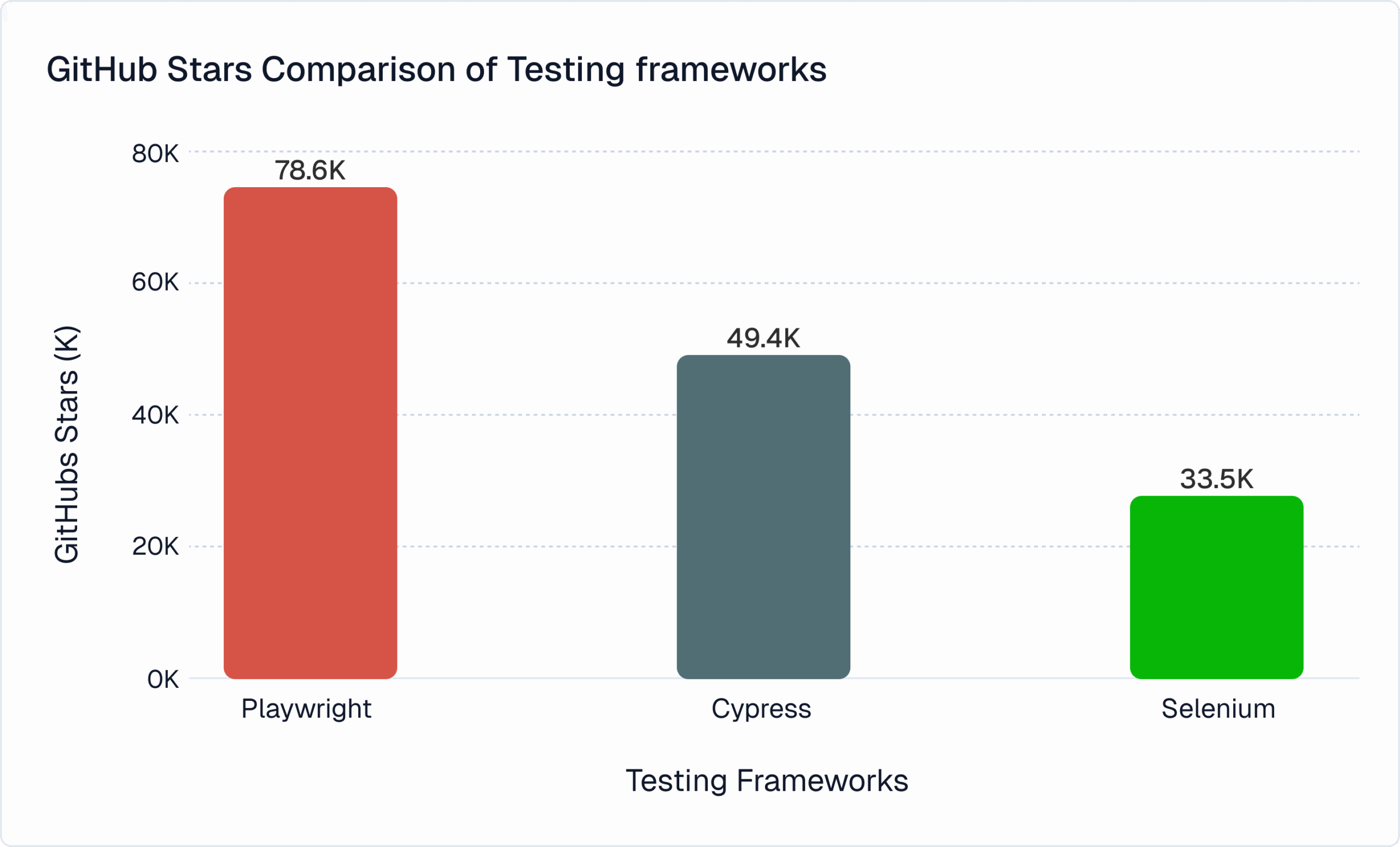
GitHub numbers give a clear picture of adoption. Playwright has over 79,700 stars, a sign of strong developer interest and an active community.
Framework Adoption Signals
| Framework | GitHub Stars | Primary Use Case | Key Advantage |
|---|---|---|---|
| Playwright | 80,100+ | Cross-browser testing | Modern API design |
| Selenium | 33,800+ | Web automation | Broad language support |
| Cypress | 49,500+ | JavaScript testing | Developer experience |
Beyond stars, npm download stats offer another signal
- Playwright downloads grew ~240% year-over-year
- Cypress usage saw ~130% growth
- Selenium remains steady due to large enterprise bases
Framework Selection Criteria
Organizations typically evaluate frameworks based on:
- Browser and platform coverage
- Language compatibility with internal dev teams
- CI pipeline integration and execution performance
- Ecosystem maturity, including plugins and community support
Surveys show 62% of teams put tooling that works cleanly with CI/CD first . And 58% want a mature ecosystem rather than one standout feature.
The right choice depends on specific requirements; there is no universal winner.
Modern Tool Ecosystem
Modern testing is not about picking one tool, but building an ecosystem. Teams rely on:
- Distributed execution platforms for scale
- Reporting and analytics for triage and debugging
- Test data management for consistent environments
- Monitoring and observability to validate system behavior
Recent studies indicate 71% of enterprises now use at least three specialized tools alongside their main automation framework.
That is what testing looks like today. It is coordinated, built in layers, and tied closely to CI workflows.
4. Codeless Testing Platforms
Codeless testing platforms are one of the fastest-growing segments. They help fill the shortage of skilled automation engineers.
According to Future Market Insights analysis, the codeless testing market was worth about $2.7 billion in 2025. It is projected to reach $11.4 billion by 2035. That is a CAGR of about 15.6%.
Codeless Capabilities
Modern tools offer visual test builders and drag-and-drop flows. They add record-and-playback with element recognition. Some even let you define tests in plain language.
They plug straight into CI/CD pipelines and support cross-platform testing. Often you no longer need to maintain separate codebases.
Target Users
Codeless platforms are simple, so they appeal to a wide group. That includes business analysts, manual testers moving into automation, small teams with no automation engineers, and teams that need quick prototypes.
But most orgs use codeless tools alongside code-based frameworks complex flows still require scripted tests.
This shift mirrors the wider growth in test automation. The global automation testing market is forecast to grow from $28.1 billion in 2023 to $55.2 billion by 2028 (CAGR ~14.5%)
5. Enterprise Strategies and DevOps Integration
Big companies keep spending on automation, but many still fall short in practice.
One study found 73% of test automation projects fail to deliver expected ROI, and 68% are abandoned within 18 months.
A major driver is that many teams still rely heavily on manual work. Katalon's 2025 survey shows 82% of testers use manual execution daily, and only ~45% automate regression.
The Coverage Gap
Many enterprises automate less than half of their test cases, even with modern tools. Several deeper problems cause this gap.
Technical debt often needs a lot of refactoring before automation can work well. Ongoing maintenance can also eat more than 20% of a team's time.
Skill gaps also hold teams back from more advanced automation. Dynamic apps are hard to cover fully, which slows progress even more.
According to Gartner Research , 30% of enterprises are expected to automate more than half of their network activities by 2026. That points to a wider push for deeper automation across the industry.
Shift-Left Testing Impact
Shift-left testing simply means testing earlier instead of waiting until the last stage. You catch issues when they're small, not when they've spread into the full system.
It saves time because the team doesn't have to unwind large chunks of work later.
Teams using shift-left report clear gains. Middleware research shows they see up to 40% fewer post-release bugs. Fixing problems early also avoids the 15–30× higher cost of fixing them in production.
Shift-left also speeds delivery. When devs and QA collaborate earlier, merges go smoother, feedback loops shrink, and releases move faster.
DevOps and CI/CD Integration
Key integration points include
- Pre-commit testing catching issues before merge
- Pull request validation ensuring quality standards
- Staging verification before production
- Production monitoring with synthetic testing
Advanced teams rely more and more on real-time analytics to make their testing faster and more reliable.
These tools track suite performance over time, spot flaky tests, and show coverage gaps. They also help you cut total run time.
With this data, teams can keep refining their testing strategy and improve quality.
6. Security and Cloud Testing
Automated security testing is now a top priority. Releases are faster, and cloud is at the center of everything.
The global security testing market is projected to grow from USD 14.5 B in 2024 to 43.9 B by 2029 (CAGR ~24.7%).
The wider application security market covers SAST, DAST, SCA, and cloud-security tools. It reached $13.64 B in 2025 and is forecast to hit $30.41 B by 2030.
Security Testing Automation
More teams now automate security testing to keep up with fast releases
- SAST - Analyzing source code for vulnerabilities
- DAST - Testing running applications
- SCA - Identifying vulnerable dependencies
- IaC scanning - Validating cloud configurations
Security Testing Methods
| Method | Automation Level | Primary Use | Frequency |
|---|---|---|---|
| SAST | High | Code vulnerability detection | Every commit |
| DAST | Medium | Runtime security testing | Daily/weekly |
| SCA | High | Dependency scanning | Every build |
| Penetration Testing | Low | Security audit | Quarterly |
Cloud Testing Infrastructure
Cloud testing continues to grow rapidly, driven by speed and scalability.
The global cloud-testing market is projected to reach $13.7 billion by 2032. That is up from $8.5 billion in 2024, a CAGR of around 6%.
This growth reflects the clear benefits seen in practice.
Cloud-based testing offers compelling advantages
- Elastic scalability matching test execution to demand (widely cited as cutting infrastructure wait time by 60–80%)
- Geographic distribution for latency testing
- Cost optimization through usage-based pricing (average infrastructure savings of 30–40% compared to static hardware)
- Rapid provisioning in minutes rather than days
Modern test infrastructure builds on this through infrastructure as code (IaC).
Industry surveys show over 80% of cloud-native teams now use IaC tools like Terraform, ensuring consistent setups across regions and environments.
Versioned environment files make every setup repeatable. Automated provisioning cuts the cost of idle resources. CI/CD can spin environments up and tear them down on demand.
Together, these practices make cloud testing scale well and run lean. They also boost reliability and cut manual infrastructure work.
7. Investment and Budget Trends
QA budgets show how much a company cares about quality and automation.
The global QA/testing market is already over USD 41.5 billion (2024) and is projected to hit USD 60.2 billion by 2029.
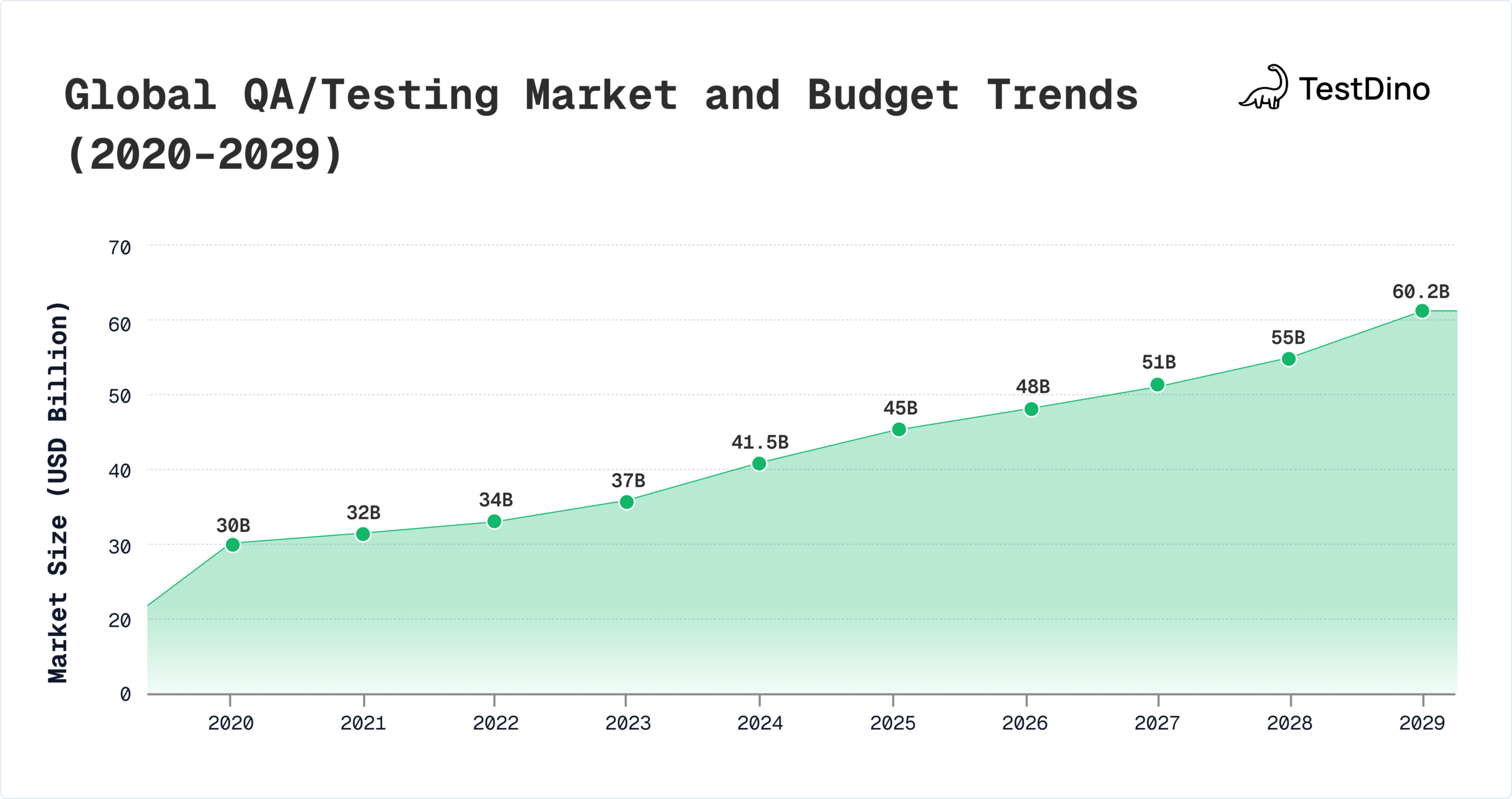
Companies typically put around 15–25% of their development spend into QA. That covers automation platform licenses, cloud infrastructure, training, and consulting. It shows that quality is a strategic priority.
In firms moving to cloud testing infrastructure, many report 30–40% savings on test environment costs compared with traditional on-prem setups.
This frees the budget for training and tool investments.
As companies move to modern automation, QA training budgets have grown by roughly 20% year-over-year. That is a clear sign that team skills now matter as much as tooling.
ROI Factors
Organizations evaluate investments based on
- Reduced manual testing effort and labor costs (automation reduces manual effort by ~30–50% on average)
- Faster release cycles enabling earlier revenue (teams report 10–25% faster delivery with reliable automation)
- Improved quality reducing production defects (post-release bug fixes can cost 15–30× more than early fixes)
- Better coverage across platforms (cloud and cross-browser setups expand reach without extra staffing)
But you need realistic expectations to reach a positive ROI. Most teams see ROI within 12-18 months.
Venture Investment
Venture investment in QA is increasingly concentrated in areas set for rapid growth.
Recent funding data shows that AI-driven testing and automation tools have drawn a lot of capital. In the last 24 months, several rounds topped $40–100M. The money went to platforms focused on observability, analytics, and smart test generation.
Key focus areas include AI-driven testing platforms and codeless automation tools. Investors also back testing observability and analytics, plus testing models built for cloud-native and distributed systems.
Investment tracking reports show that funding for AI-based QA and test analytics grew above 30% year over year . That reflects strong market confidence and hopes for long-term efficiency gains.
These bets show that the market expects new platforms to cut manual work and improve quality metrics. Investors also expect them to handle the challenges of complex, fast-changing software systems.
8. Future Predictions
Near-Term (2026-2027)
AI-driven testing will keep expanding. Based on current adoption, platforms that use AI for defect detection and test analysis should grow around 20–25% a year. That will push more teams toward self-healing automation to cut maintenance work.
Container-based test environments will keep growing, because development has already moved this way.
Today, over 70% of cloud-native teams use Docker-based workflows, and this trend is expected to flow further into QA environments for consistency.
Observability will tie testing and production closer together. Observability tooling is growing at 11–13% CAGR. More teams will pull production metrics into QA dashboards to check real-world performance early.
Long-Term Trajectory
Test automation trends suggest a gradual shift toward
- Autonomous testing systems with minimal intervention
- Predictive quality models identifying risks early
- Natural language interfaces for non-technical users
- Integrated quality platforms unifying tools
Automation Maturity Timeline
| Timeframe | Capability Level | Key Characteristics |
|---|---|---|
| Current | Structured automation | Framework-based scripted tests |
| 2026-2027 | Intelligent automation | AI-assisted test generation |
| 2028+ | Autonomous testing | Self-managing systems |
Strategic Recommendations
Organizations should
- Set clear objectives before buying tools, since surveys show 73% of automation efforts miss ROI when goals are vague.
- Invest in team skills alongside tooling, with QA training budgets growing about 20 percent year over year.
- Roll out automation gradually, because most teams realize ROI in 12 to 18 months, not instantly.
- Keep AI expectations realistic, as AI testing still needs human oversight.
- Build flexible architectures, since the automation market is growing at about 8 to 9 percent CAGR and tools will keep evolving.
The future of test automation lies in augmenting human expertise through intelligent tools, not replacing it.
Conclusion
The state of test automation in 2026 is shaped by strong market growth and measurable value, not just hype.
Global spending is already above $41.5 billion. It is projected to reach $60.2 billion by 2029. Some segments, like AI-driven tooling, are growing 20 to 25 percent a year .
Adoption is wide, but the biggest gains come when teams combine tools with strategy.
The data on frameworks, AI, cloud testing, security automation, and DevOps integration all points the same way.
Teams that plan realistically, build skills, and invest in reporting and analytics see real results. They cut manual work by 30 to 50 percent. They speed up releases by 10 to 25 percent. And they avoid the 15 to 30 times higher cost of fixing issues in production.
The outlook for 2027 and beyond is bright. Smart automation, predictive test ranking, and unified quality platforms will grow. But they will support human expertise, not replace it.
The teams that treat automation as an ongoing journey, guided by data rather than guesses, will lead in quality, speed, and efficiency.
FAQs

Pratik Patel
Co-founder