BuildPulse does one job: finding flaky tests. It connects to your CI, automatically detects and ranks unstable tests, and can quarantine them to keep flaky tests from blocking merges.
But flaky detection is only one part of test reporting. When a test fails for a real reason, you still need the full picture: the trace, the screenshots, the error grouping, the run history, and a place to manage your test cases. BuildPulse is built around flakiness and CI optimization, not full Playwright reporting and debugging.
Teams that run Playwright in CI and want failure intelligence, test management, and reporting depth in one place often look for BuildPulse alternatives that treat test reporting as the primary workflow rather than a CI add-on.
Here are the 7 best BuildPulse alternatives to consider in 2026.
Best BuildPulse Alternatives: How to Choose the Right Tool
We evaluated each tool on test reporting depth, failure analysis, flaky test detection, Playwright support, CI/CD integration, pricing transparency, and ease of onboarding. We checked G2 reviews and official documentation to verify each claim, and we limited each competitor to its test reporting and analytics capabilities.
How to Compare BuildPulse Alternatives
Here is a quick comparison of the top alternatives to BuildPulse to help you identify your preferred test reporting tool:
 TestDino |  BuildPulse |  Datadog |  ReportPortal |  BrowserStack | |
|---|---|---|---|---|---|
| PricingLowest paid plan, per the listed billing terms. | $39/month (billed annually) | $119/month | $20/committer/month + usage | Free self-host / $599/month (SaaS) | Free / $299/month (Pro) |
| Best for | Playwright test intelligence & management | Flaky test detection & CI noise reduction | CI pipeline monitoring | Reporting with history and clustering | Cross-browser testing teams |
| Playwright integration | Native (trace viewer, error grouping, MCP) | Via JUnit XML | Via library | Via agents | Via SDK |
| One-step CI setup | One reporter line, streams live | Reporter upload | |||
Dashboards & Reporting | |||||
| Unified Playwright dashboard | Flaky-focused views | Custom dashboards | Custom widgets | Custom widgets (Pro) | |
| Multi-tab test run detail | Summary, History, AI Insights & more | Flaky test detail | Span-level view | Launch-level view | Build-level view |
| Pull request insightsSee test results and history for each pull request. | Per-PR coverage | Branch-level only | |||
| Test ExplorerBrowse tests as a hierarchy, a flat list, or by tag. | Launch tree | ||||
| Real-time streaming | Per-shard/worker | ||||
| Scheduled PDF reportsGet report PDFs emailed on a set schedule. | Daily/Weekly/Monthly | Slack digests | Custom monitors | Email/Slack alerts | |
Test Analytics | |||||
| Analytics: trends & patterns | Flaky trends | Explorer-based | Widget-based | Build trends and stability | |
| Code coverage, per-file | Istanbul, run-level | Coverage trends | Separate product | ||
| Environment analytics | Pass-rate/flaky by env | Via attributes | |||
Debugging & Evidence | |||||
| Built-in Playwright trace viewer | |||||
| Screenshots & video replay | Embedded | ||||
| Console logs | Node + browser | If attached | Session logs | ||
| Visual diff comparison | |||||
| Smart error grouping | Message/stack/location | Failure patterns | Pattern matching | Unique error analysis | |
| Flaky detectionSpot tests that pass and fail inconsistently, with a stability score. | Requires config | ||||
| Playwright tags & annotations | Priority/owner/links/metrics | Custom tags | Custom attributes | Smart tags | |
CI/CD Optimization | |||||
| GitHub CI Checks quality gates | Per-env + mandatory tags | Merge gating | Build verification rules | ||
| Branch → environment mappingMatch each Git branch to the environment it runs against. | Exact/regex | Tag-based | |||
| Sharded / parallel run support | Per-shard live view | Via JUnit | Parallel launches | ||
| Native CI breadth | GitHub, GitLab, Azure DevOps, TeamCity, Bitbucket, CircleCI, Jenkins | GitHub, CircleCI, Buildkite, Jenkins, Bitbucket | Major CI providers | Agents/plugins | CI plugins |
| Self-managed GitLab | |||||
Test Management | |||||
| Test case management | |||||
| Bulk test creationGenerate many test cases at once from PRDs, Jira, or user stories. | via MCP | ||||
| Release trackingGroup test results by release, cycle, or sprint. | |||||
| Exploratory / manual sessions | |||||
| Import / export test cases | JSON/CSV/ZIP | Via API | |||
AI & Automation | |||||
| Local MCPLet AI coding assistants in your editor act on test data directly. | Cursor/Claude Code/Copilot | MCP server | Limited scope | ||
| Remote MCPLet web-based AI tools query your test data. | |||||
| AI test run summary on GitHub PRs | |||||
| AI test suite auditAI scores your test suite and gives a downloadable report. | |||||
| AI failure classification | Flaky ranking | ML-based auto-analysis | Failure reason tagging | ||
Integrations & Collaboration | |||||
| Bug tracking breadth | Jira, Linear, Asana, monday | Jira | Jira, PagerDuty | Jira, Rally | Jira |
| Slack notifications | App + webhooks | ||||
Platform & Security | |||||
| Public API & CLIs | REST + @testdino/playwright | REST API + CLI | REST API | REST API | REST API |
| Project-level AI controls | Per-feature toggles | ||||
| Compliance & certifications | ISO 27001, SOC 2 Type II, GDPR | Not published | ISO 27001, SOC 2 | Self-managed (your infra) | ISO 27001, SOC 2 Type II |
Plans & Pricing | |||||
| Plan tiers | Free · Pro $39 · Team $79 · Enterprise | Startup $99 · Team $249 · Growth $499 · Enterprise | $20/committer/mo + usage · Enterprise | OSS free (self-hosted) · SaaS $599 · Enterprise | Free · Pro $299 · Enterprise |
| Free executions | 5,000/mo | Free trial | Usage-based | Unlimited (self-host) | Varies |
| Support | Chat + Slack Connect + Priority email | Email + Slack | Email + docs | Community / Paid | 24/7 email |
| Try for free | Learn more | Learn more | Learn more | Learn more | |
Best BuildPulse Competitors for Test Reporting
Here are the top 7 alternatives to BuildPulse for teams that want deeper test reporting:
1. TestDino
Best for:
Playwright-first teams that need test reporting, test management, and CI/CD optimization in one platform, without stitching multiple tools together.
Platform Type:
Test reporting, dashboards, test management, and CI observability platform for Playwright.
Integrations with:
GitHub Actions, GitLab CI, Azure DevOps, TeamCity, Jira, Linear, Asana, monday, Slack.
Key Features:
 Test management and automated reporting in one place
- AI failure classification into 4 categories
- Built-in trace viewer with DOM snapshots and network logs
- Error grouping by message and stack trace
- GitHub CI Checks as merge quality gates
- MCP Server for AI agent queries from your IDE
- Flaky test detection across run history
- AI summaries posted to GitHub commits
- Real-time results streaming via WebSocket
- Code coverage per file breakdown

Pros
- Playwright-native with under 10-minute setup
- Test management and automated reporting on the same platform
- Broad CI/CD support: GitHub Actions, GitLab CI, Azure DevOps, TeamCity
- AI summaries posted to GitHub commits, GitLab MRs, and Slack
- 1-click bug filing into Jira, Linear, Asana, or monday
- Affordable at $39/month billed annually

Cons
- Purpose-built for Playwright (multi-framework support on the roadmap)
First-Hand Experience with TestDino
Here is a limit teams hit with flaky-test tools: they tell you which tests are unstable, but not much more. When a test fails for a real reason, you still have to go through CI artifacts, screenshots, and logs to understand why. BuildPulse is built around flaky-test detection and CI noise reduction, not a full reporting and debugging workspace.
TestDino takes a broader approach. It is built around Playwright test intelligence. Test management and automated test reporting live on the same platform, with suites, ownership, custom fields, and version history. Playwright results flow in from CI and link to manual tests in the UI.
The Test Explorer lets you sort by flaky rate, filter by tags, and see exactly which manual tests have automated coverage. Every feature helps Playwright teams debug faster and ship with confidence.
Debugging That Saves You from Re-running Locally
Each failed test in TestDino comes with screenshots, video, browser console logs, and a trace you can step through action by action, available right after the CI run finishes.
AI Insights classifies each failure as an Actual Bug, a UI Change, an Unstable Test, or Miscellaneous. Bug filing is 1-click into Jira, Linear, Asana, or monday, pre-filled with error details, stack trace, failure history, and links to the run and CI job.
CI/CD Speed and Merge Safety
Each shard reports as its tests finish. History persists across different CI runners.
GitHub CI Checks adds quality gates to your PRs. Set a minimum pass rate, mark critical tags as mandatory, and configure different rules per environment. AI-generated summaries are posted to GitHub commits and GitLab merge requests with pass/fail/flaky counts.
Flaky Test Detection That Tells You Why
Flaky test detection classifies unstable tests by root cause: timing-related, environment-dependent, network-dependent, or assertion-intermittent. Each test gets a stability percentage, and you can compare flaky rates across environments to spot infrastructure problems.
Real-Time Streaming and Scheduled Reports
Results appear on the dashboard as each test completes via real-time streaming, not after the full suite finishes. Automated PDF reports deliver test health summaries on daily, weekly, or monthly schedules. Slack notifications send run summaries filtered by environment and branch.
MCP Server for AI-Assisted Workflows
The MCP Server connects your AI assistant to your test data. List test runs, pull debugging context, perform root cause analysis, and manage manual test cases through natural language. It covers both automated debugging and test management without switching tools.
Pricing & Value
Pricing may vary. Check the pricing page for the latest details.
Final Verdict
TestDino is the strongest BuildPulse alternative for Playwright teams. Where BuildPulse focuses on detecting and quarantining flaky tests, TestDino covers the full picture: AI failure classification, a built-in trace viewer, error grouping, and flaky detection with root-cause categories and stability percentages.
It also adds test management, automated PDF reports, and GitHub CI Checks as quality gates.
At $39/month billed annually with flat pricing, it gives Playwright teams a complete reporting and debugging workspace, not just a flaky-test filter.
2. Datadog Test Optimization
Best for:
Teams already in Datadog that want test-run visibility alongside their other monitoring data.
Platform Type:
Test reporting and analytics module inside the Datadog monitoring platform.
Integrations with:
Major CI providers, Jira, Slack.
Key Features:
- Test run visibility at session, suite, and test level
- Flaky test detection with historical flakiness tracking
- Test traces and spans for every CI test execution run
- Branch-level test history with Git author and CI metadata
- Dashboards, notebooks, and CI test monitors with alerts
Pros
- Strong end-to-end tracing of test runs inside CI pipelines
- Flaky tests and performance regressions surfaced automatically
- Fits teams already standardized on the Datadog platform
Cons
- Test data sits inside a broad monitoring platform, not a test tool
- Per-committer plus usage pricing is hard to forecast as CI scales
- No built-in Playwright trace viewer or test case management
First-Hand Experience
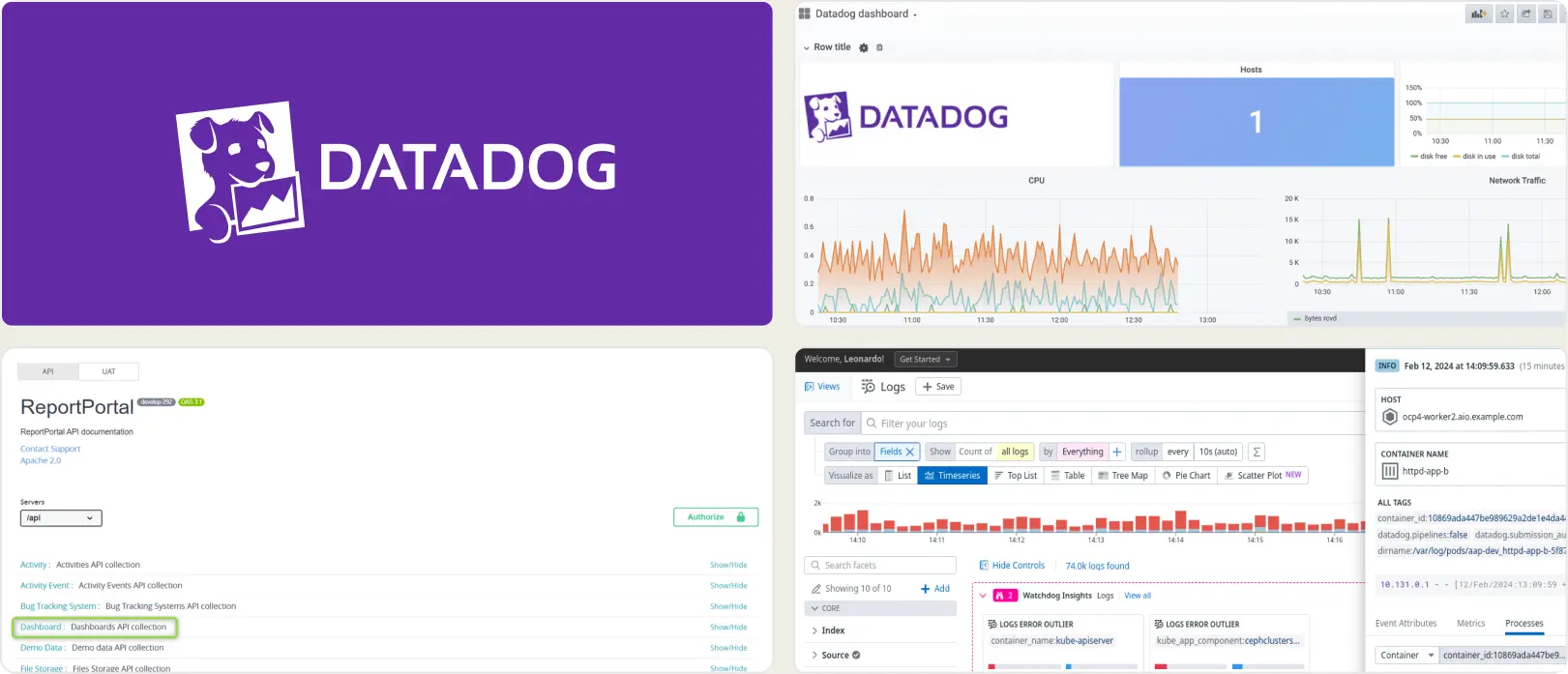
Datadog Test Optimization brings test runs into the same platform teams already use for monitoring. Each test is captured as a trace, with flaky-test detection and branch-level history available in dashboards. The trade-off is that test results sit alongside infrastructure and application data, so getting a test-focused view means working inside a platform built for broad monitoring. For Playwright teams that mainly want test reporting and debugging, that is more surface area than the job needs.
Pricing & Value
Test Optimization is billed per active Git committer, starting at $20/committer/month billed annually, plus usage-based charges for test spans. Costs grow with team size and test volume.
Final Verdict
Datadog Test Optimization is for teams already invested in Datadog who want test visibility alongside their other telemetry. For Playwright-first teams that want focused reporting, a built-in trace viewer, and flat pricing, a dedicated tool gets to value faster.
3. ReportPortal
Best for:
Teams that want self-hosted, open-source test reporting with ML-based failure clustering.
Platform Type:
Open-source test reporting and analytics platform (self-hosted or SaaS).
Integrations with:
Jenkins, GitHub, GitLab, Jira, Rally.
Key Features:
- ML-based pattern matching for recurring failure clusters
- Custom dashboard widgets for pass and fail run trends
- Defect-type classification for triaging logged failures
- Multi-framework result aggregation in one dashboard
- Launch-level run history for cross-run trend comparison
Pros
- Open source and self-hostable with full control of your data
- ML pattern matching clusters recurring failures automatically
- Custom dashboard widgets and multi-framework aggregation
Cons
- Self-hosting needs Docker, multiple services, and ongoing upkeep
- Managed SaaS starts at $599/month, steep for small teams
- No Playwright trace viewer; ML needs accumulated run history
First-Hand Experience
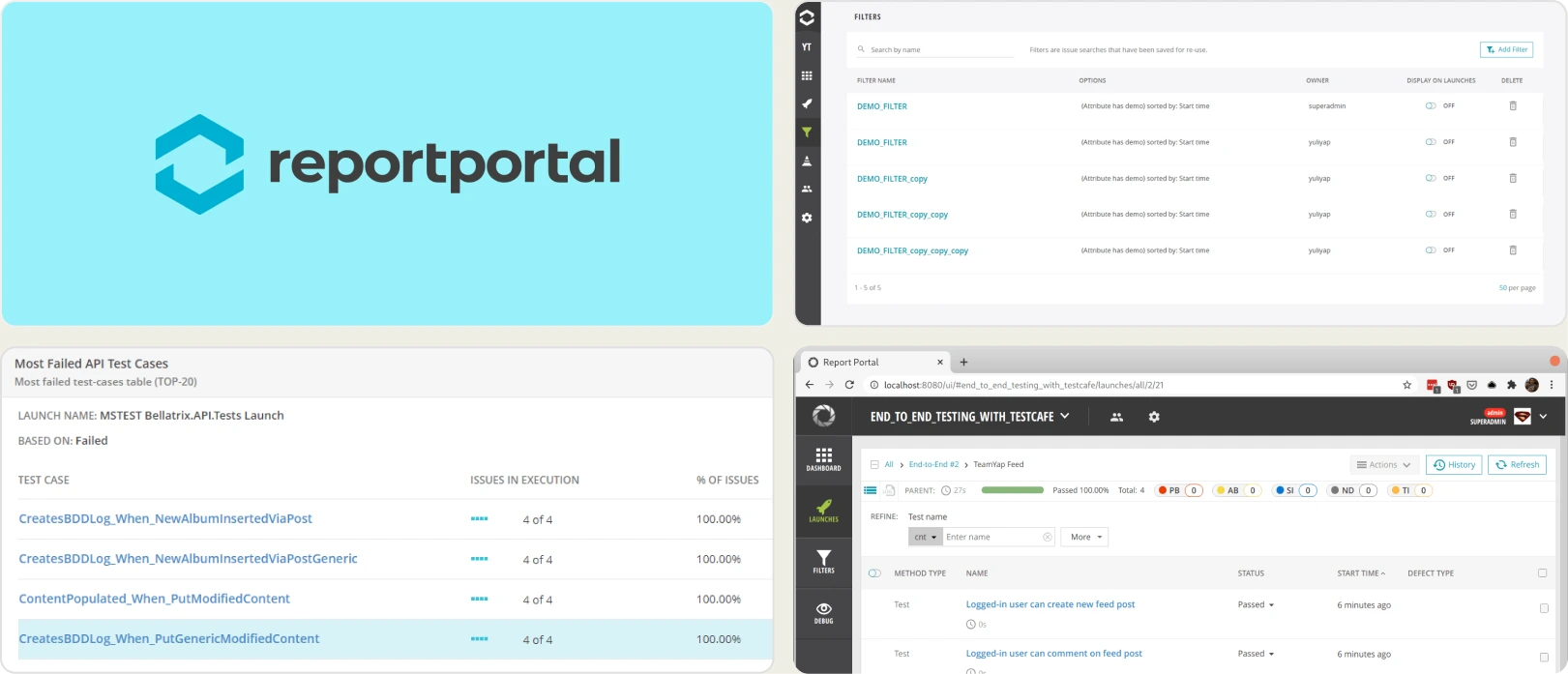
ReportPortal aggregates results from multiple frameworks into a single dashboard and uses ML-based pattern matching to cluster recurring failures. The self-hosted, open-source option gives full control of your data.
In practice, running it means standing up several services and maintaining them over time, and the ML analysis works best once it has accumulated an investigated history. Teams that want a managed, Playwright-specific reporting workspace may find the operational overhead high relative to the reporting they get.
Pricing & Value
Free and open source when self-hosted. The managed SaaS starts at $569/month billed quarterly for the Startup tier with 100 GB of storage, with higher tiers and custom Enterprise pricing available.
Final Verdict
ReportPortal suits teams that want self-hosted, open-source reporting with ML-based failure clustering. For teams that prefer a managed platform with Playwright-native debugging and faster setup, there are lighter options without the infrastructure burden.
4. BrowserStack Test Reporting & Analytics
Best for:
Teams already on BrowserStack that want reporting in the same place where they run tests.
Platform Type:
Test reporting and analytics module inside the BrowserStack platform (formerly Test Observability).
Integrations with:
Jenkins, Azure Pipelines, GitLab, Jira, Slack.
Key Features:
- Automatic flaky and new-failure detection per build
- AI failure categorization by bug, automation, or environment
- Test health and stability trend dashboards over time
- Timeline debugging with logs, traces, and screenshots
- Quality gates enforced through GitHub pull-request checks
Pros
- Automatic flaky detection and AI failure categorization
- Build health and stability trend dashboards across projects
- Ingests Playwright results from your own CI via an SDK
Cons
- Reporting is one module inside a large execution-cloud platform
- Pricing scales with the broader platform and is steep for small teams
- No Playwright-native trace viewer for step-level debugging
First-Hand Experience
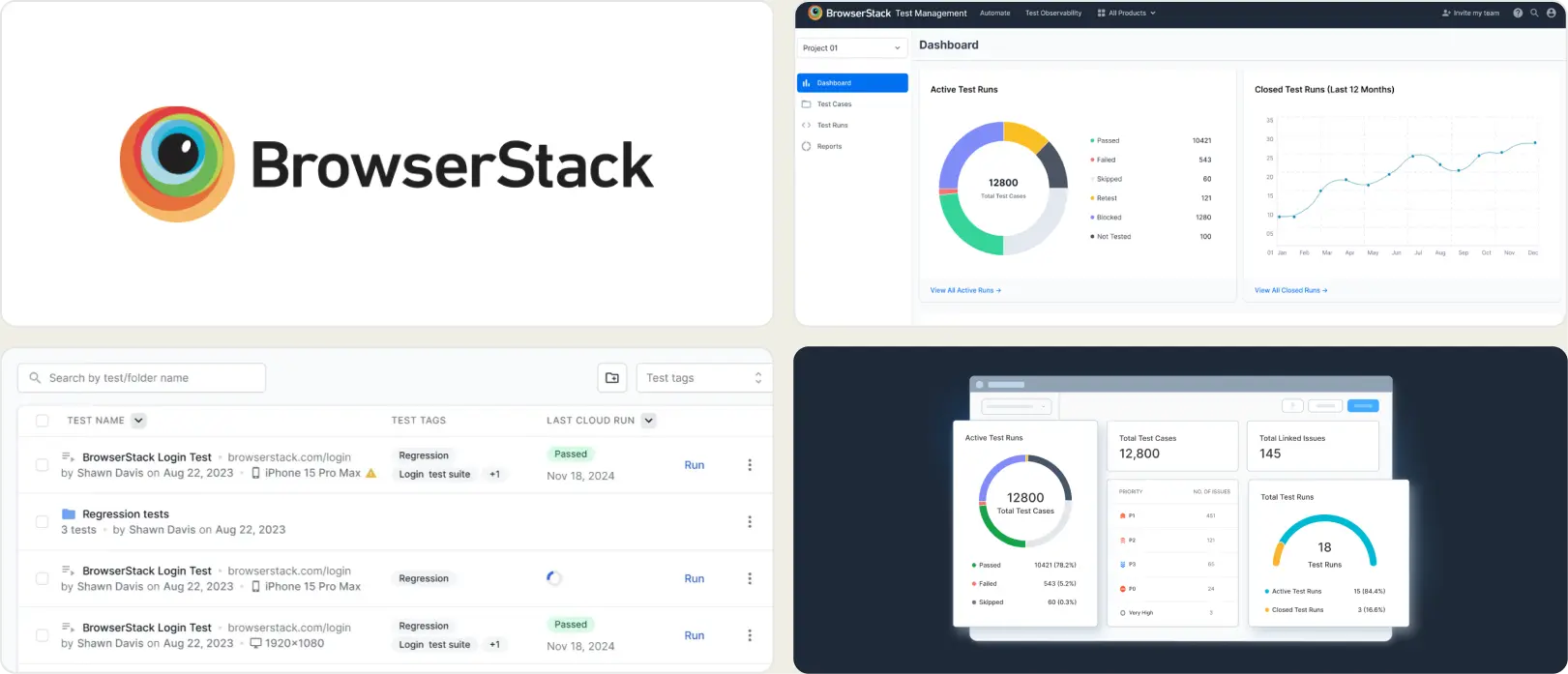
BrowserStack Test Reporting & Analytics adds smart reporting to test runs, with automatic flaky-test detection, AI failure categorization, and build-health trends. It can ingest Playwright results from your own CI through an SDK.
The reporting itself is solid, but it is a single module within a large cross-browser execution platform, so it is most natural for teams already standardized on BrowserStack. Debugging happens through BrowserStack's own timeline and logs rather than a Playwright-native trace viewer.
Pricing & Value
BrowserStack offers a free tier, with the Pro plan at $299/month and custom Enterprise pricing. Test Reporting & Analytics is included within the BrowserStack platform plans rather than priced separately.
Final Verdict
BrowserStack Test Reporting & Analytics is a reasonable fit for teams already on BrowserStack that want reporting in the same place they run tests. For Playwright-first teams that want a dedicated reporting workspace with a built-in trace viewer, a focused tool is a closer match.
5. TestMu AI (formerly LambdaTest)
Best for:
Teams running cloud test execution that want built-in execution analytics.
Platform Type:
Cloud test execution platform with a test analytics module.
Integrations with:
Jira, Slack, GitHub, GitLab, CI/CD pipelines.
Key Features:
- Unified test execution overview across environments
- Custom dashboards built from 30+ reporting widgets
- Flaky test flags with flakiness trend analysis charts
- Video recordings, screenshots, and per-test console logs
- Real-time dashboard sharing with CSV and PDF export
Pros
- Unified dashboards with rich pass/fail and trend metrics
- Video, screenshots, and console logs captured per test
- Free tier available to start with execution analytics
Cons
- Reporting is secondary to the cloud execution platform
- Playwright-specific analytics stay relatively surface-level
- Costs scale with parallel tests and concurrency, not reporting
First-Hand Experience
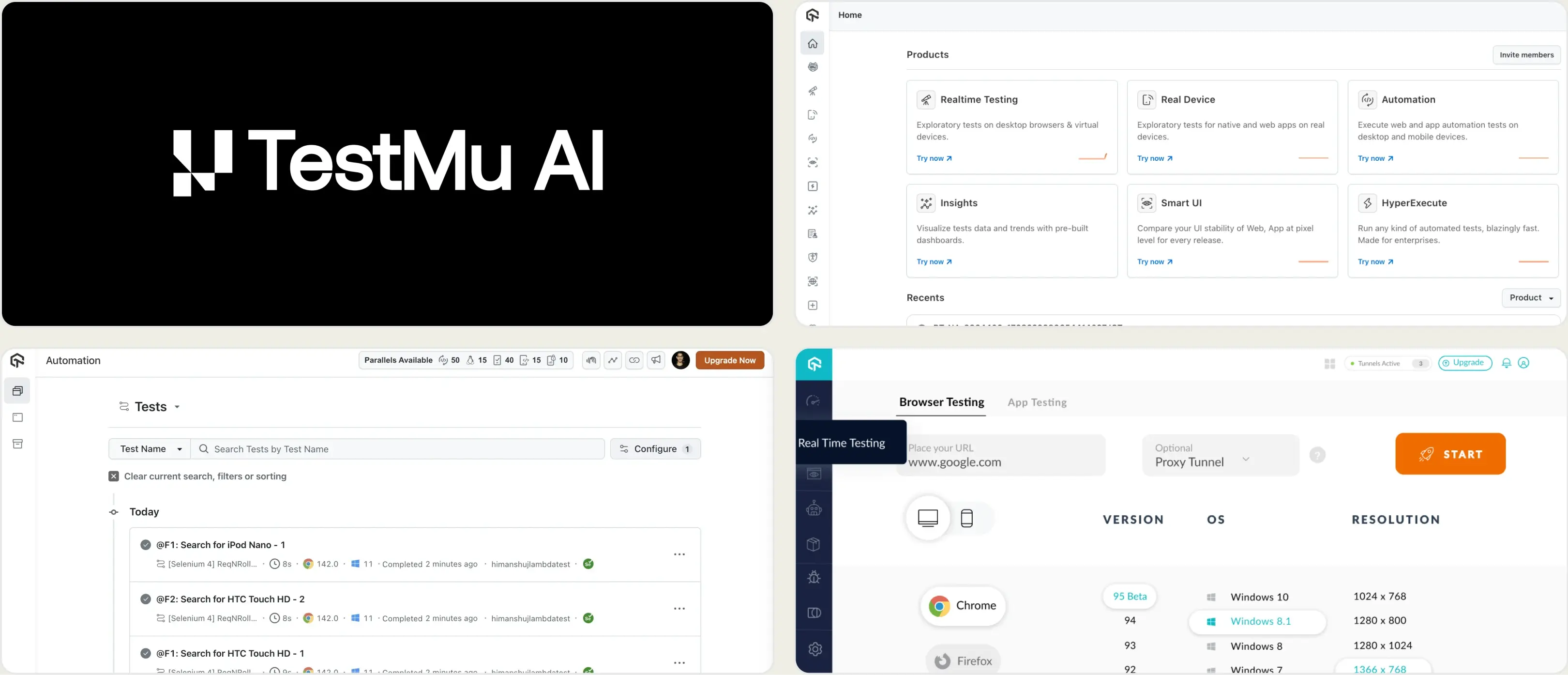
TestMu AI centralizes test execution data in real-time dashboards, with custom widgets, pass/fail and flakiness trends, and video, screenshots, and console logs captured for each test. For teams running tests on its cloud, the analytics cover the essentials and are easy to share.
Reporting is one module inside a larger cloud execution platform, though, so the depth is tuned to execution-level data. Playwright-specific analysis stays relatively surface-level compared with a purpose-built Playwright reporting tool.
Pricing & Value
A free tier is available, with paid plans from $199/month. Test analytics is included in the plans rather than sold separately, and the overall cost scales with the number of parallel tests and concurrency.
Final Verdict
TestMu AI is for teams that want cloud-based execution with built-in analytics. For teams focused on Playwright test intelligence and depth of reporting, evaluate whether an execution-first platform meets your analytics needs.
6. Trunk
Best for:
Engineering teams focused on CI reliability and flaky test quarantine at scale.
Platform Type:
CI reliability platform with flaky test detection.
Integrations with:
GitHub, Jira, Linear, Slack.
Key Features:
- Flaky test detection with auto-quarantine
- AI failure clustering for similar errors
- Environment-variant detection for flakes
- CI pipeline analytics and health trends
- Jira and Linear ticket auto-creation
Pros
- Strong flaky quarantine keeps CI pipelines moving
- Works across all languages and frameworks
- Jira/Linear auto-ticketing for flaky tests
Cons
- No test reporting dashboards or run views
- No Playwright-specific debugging features
- Pricing requires contacting sales
First-Hand Experience
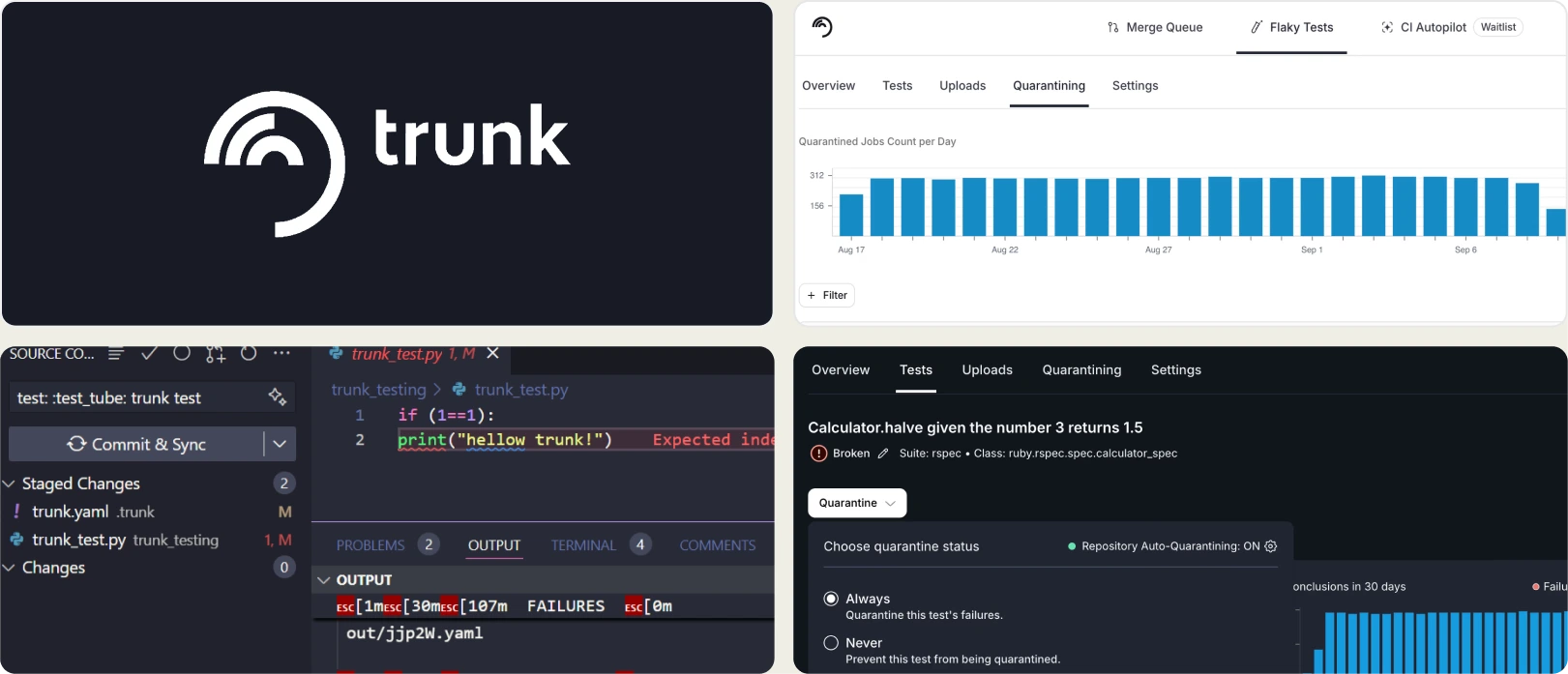
Trunk focuses on keeping CI pipelines moving by automatically detecting and quarantining flaky tests. AI-powered failure clustering groups similar failures and tracks stability trends. It integrates with Jira and Linear to create tickets. Teams that need Playwright-specific reporting, trace viewing, or test management will need to pair Trunk with a separate reporting tool.
Pricing & Value
Contact sales for pricing. Free tier available for getting started.
Final Verdict
Trunk is a strong option for teams focused on CI reliability and quarantining flaky tests. For teams that also need test reporting, failure classification, and test management, it works best as a complementary tool alongside a dedicated reporting platform.
7. Allure TestOps
Best for:
QA teams with formal test management processes that need structured reporting workflows.
Platform Type:
Test management and reporting platform.
Integrations with:
Jira, GitHub, GitLab, Jenkins.
Key Features:
- Test case organization with launch history
- CI/CD adapter integrations
- Configurable dashboards via AQL queries
- Access control and permissions
- Report exports and sharing
Pros
- Established feature set for structured QA
- Works across multiple test frameworks
- Configurable dashboards and reports
Cons
- Setup and adapter configuration require effort
- Smaller teams may find the overhead heavy
- Reporting requires manual dashboard building
First-Hand Experience
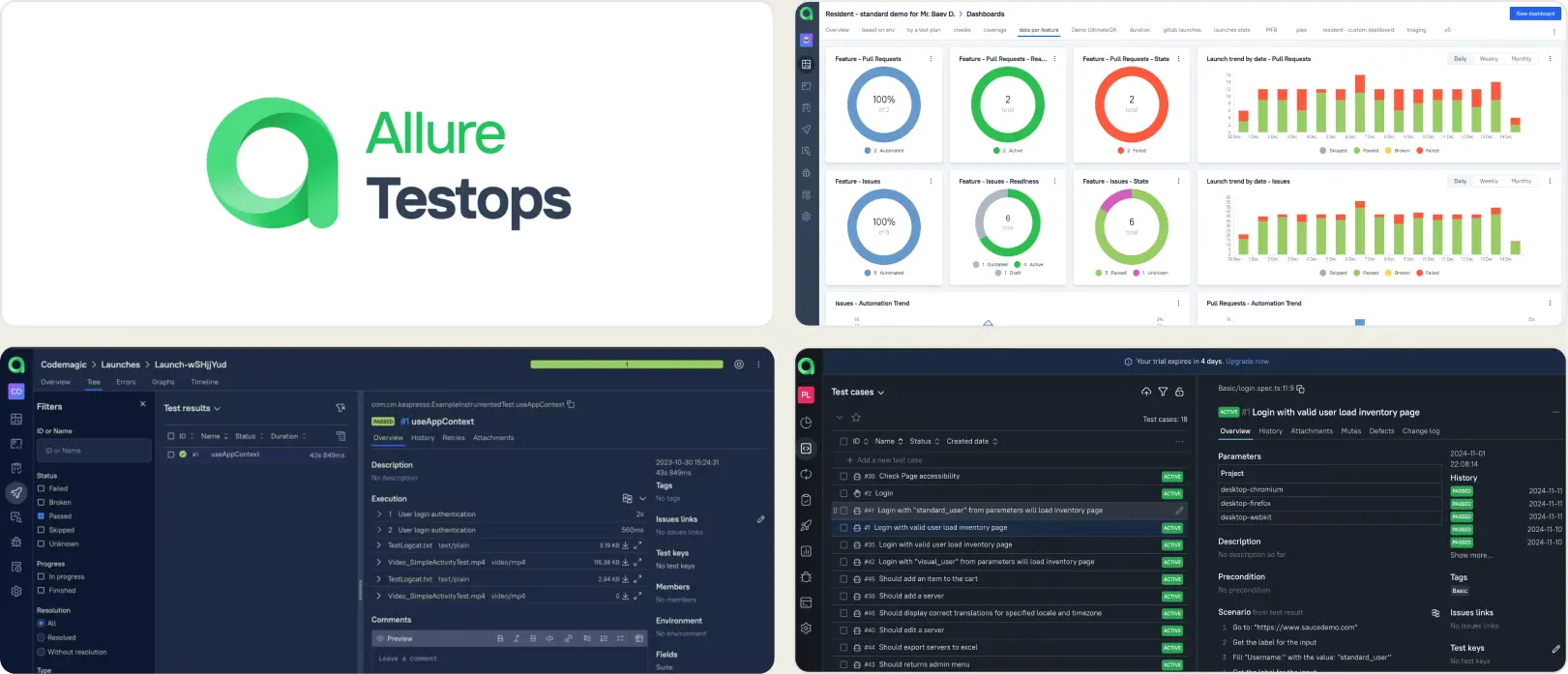
Allure TestOps provides a structured workspace for organizing test cases and viewing launch results. The platform works best when teams have defined QA processes and the bandwidth to set up adapters and configure dashboards. Teams looking for faster onboarding and built-in failure intelligence may find the configuration effort slows time-to-value.
Pricing & Value
Custom pricing. Targets teams that need formalized test management with governance.
Final Verdict
Allure TestOps is suited to teams that follow structured QA processes. For teams prioritizing fast setup and focused test analytics, lighter platforms get to value faster.
What to Look for When Moving Beyond BuildPulse for Test Reporting
Switching from BuildPulse is not just about finding another flaky-test detector. Flakiness is one signal; the tool you pick should treat test reporting as the primary workflow, with the depth to understand a failure end-to-end.
Failure intelligence, not just flaky flags
When a test fails, you need to know whether it is a real defect, a flaky issue, or a UI change. Flaky detection tells you a test is unstable, but it does not classify the failure or group related errors for you. Look for tools that automatically classify failures, group related errors, and separate persistent issues from new regressions. That is the difference between "something is flaky" and "here is what to fix."
Debugging evidence in the report
A flaky ranking sends you back to your CI artifacts to find the trace, the screenshots, and the logs. A reporting tool should keep that evidence in one place. A built-in trace viewer, screenshots, video, and console and network logs attached to each failed test save time when re-running tests locally.
Test management without separate tooling
If your test cases live in one tool, execution results in another, and failure analysis in a third, you spend more time switching contexts than fixing problems. BuildPulse does not include test case management, so teams using it still need a separate tool to organize suites, track manual coverage, and link cases to automated results. Platforms that combine reporting, debugging, and test management in one workspace remove that overhead.
Predictable pricing as you scale
Volume-based and usage-based pricing models make cost forecasting harder as your team and test suites grow. Flat monthly pricing lets you plan your budget without worrying about billing spikes from increased CI activity. Compare the per-volume and per-committer models with flat-rate plans to see which gives your team predictable costs.
Fast onboarding from the first CI run
A reporting tool should deliver a usable dashboard from the first CI run, not after a week of configuration. Managed platforms with one-step CI integration deliver actionable insights to your team faster than tools that require extra services to stand up and maintain.
Wrapping Up
BuildPulse works well as a focused flaky-test detector for teams that mainly want to cut CI noise and stop unstable tests from blocking merges. But when test reporting is a primary need rather than a single signal, purpose-built tools provide more depth.
Datadog Test Optimization adds test visibility inside a monitoring platform. ReportPortal offers self-hosted, open-source reporting with ML clustering. BrowserStack Test Reporting & Analytics covers reporting inside a cross-browser cloud. TestMu AI provides execution analytics alongside cloud test runs. Trunk focuses on CI reliability and flaky quarantine. Allure TestOps targets structured QA processes.
For Playwright-first teams that want AI failure classification, a built-in trace viewer, test management, flaky detection, and CI/CD optimization in one platform, TestDino combines test intelligence, management, and reporting for $39/month billed annually.
Turn flaky flags into fixes
Classify every failure by root causeDebug from the trace, not the CI logFAQs
TestDino is built specifically for Playwright. It provides a built-in trace viewer, AI-driven failure classification, flaky detection with stability percentages, and test management for manual and automated tests on one platform. It also supports GitHub Actions, GitLab CI, Azure DevOps, and TeamCity.