Katalon helped a lot of QA teams move beyond spreadsheets and scattered test runs. Katalon Studio gives you low-code authoring for web, API, mobile, and desktop, and True Platform adds dashboards, execution history, and traceability on top.
The pricing model is where teams start looking around. Katalon Studio is genuinely free to author in, but running those tests headlessly in CI requires a Runtime Engine licence at $1,749 per year per concurrent run. True Platform is $700 per seat per year, the True Automation bundle is $1,699 per seat per year for the first three seats and $2,000 from the fourth, and each cloud execution pack adds $1,899 per year. The free IDE gets expensive the moment you scale it.
The technical friction compounds it. Scripting drops you into Groovy, which narrows your hiring pool and complicates migration. The IDE slows down as suites grow. Platform updates have historically changed internal selectors and broken existing tests. Mobile runs on Appium underneath, so you inherit Appium's fragility with an extra abstraction layer on top.
Most teams that leave move to Playwright, Cypress, or Selenium for authoring and execution, then discover they have traded a licence bill for a reporting gap: no dashboards, no run history, no flaky detection, no test case management.
Here are the 8 best Katalon alternatives to consider in 2026, and how to cover both halves of the switch.
Best Katalon Alternatives: How to Choose the Right Tool
We evaluated each tool based on authoring model and scripting language, execution and CI/CD fit, reporting and analytics depth, AI failure analysis, flaky test detection, test management, and total cost at scale rather than headline price.
How to Compare Katalon Alternatives
Here is a feature comparison of the top alternatives to Katalon:
TestDino | Katalon | Playwright | Selenium | Testsigma | |
|---|---|---|---|---|---|
| PricingLowest paid plan, per the listed billing terms. | $39/month (billed annually) | Studio free · True Platform $700/seat/year · Runtime Engine $1,749/year | Free (Apache 2.0) | Free (Apache 2.0) | Free tier · Pro quoted (est. $499+/month) |
| Best for | Playwright cloud companion & test management | All-in-one low-code authoring, execution & analytics | Modern open-source browser automation | Maximum language and browser flexibility | Low-code authoring for non-engineering QA |
| Playwright integration | Native (trace viewer, error grouping, MCP) | Via reporter plugin | Native framework | Different framework | Own authoring model |
| One-step CI setup | One reporter line, streams live | Via Runtime Engine licence + CLI | npx playwright test in any runner | Grid or driver setup required | Cloud-triggered via CLI/API |
Dashboards & Reporting | |||||
| Unified Playwright dashboard | Local HTML report only | Built-in cloud dashboard | |||
| Multi-tab test run detail | Summary, History, AI Insights & more | Execution detail view | Single-run HTML | Run summary | |
| Pull request insightsSee test results and history for each pull request. | |||||
| Test ExplorerBrowse tests as a hierarchy, a flat list, or by tag. | Folder structure | UI mode, local only | Suites and modules | ||
| Real-time streaming | Per-shard/worker | Live run view | |||
| Scheduled PDF reportsGet report PDFs emailed on a set schedule. | Daily/Weekly/Monthly | Email reports | |||
Test Analytics | |||||
| Analytics: trends & patterns | Dashboard widgets | Per-run only | Basic trends | ||
| Code coverage, per-file | Istanbul, run-level | Via external tooling | |||
| Environment analytics | Pass-rate/flaky by env | Env configuration mgmt | Via test data profiles | ||
Debugging & Evidence | |||||
| Built-in Playwright trace viewer | Hosted, per test | Local CLI only | |||
| Screenshots & video replay | Embedded | Via reporter attachments | Local artifacts | Manual capture | Cloud session recording |
| Console logs | Node + browser | Via attachments | Local | Via driver logs | Session logs |
| Visual diff comparison | toHaveScreenshot, local | Visual testing add-on | |||
| Smart error grouping | Message/stack/location | AI root cause analysis | |||
| Flaky detectionSpot tests that pass and fail inconsistently, with a stability score. | Root cause classification | Flaky tests view (no %) | Retry count only | Flaky flag | |
| Playwright tags & annotations | Priority/owner/links/metrics | Tags in code only | |||
CI/CD Optimization | |||||
| GitHub CI Checks quality gates | Per-env + mandatory tags | Release readiness gates | |||
| Branch → environment mappingMatch each Git branch to the environment it runs against. | Exact/regex | Env configs | Via environments | ||
| Sharded / parallel run support | Per-shard live view | Via execution packs | Native sharding | Via Selenium Grid | Parallel sessions (metered) |
| Native CI breadth | GitHub, GitLab, Azure DevOps, Bitbucket, CircleCI, Jenkins, TeamCity, AWS CodeBuild, Buildkite, Harness | Jenkins, GitHub Actions, CircleCI, GitLab, Azure DevOps, Bamboo, Bitbucket | Any CI (CLI based) | Any CI (CLI based) | Major CI providers |
| Self-managed GitLab | Runs anywhere | Runs anywhere | |||
Test Management | |||||
| Test case management | |||||
| Bulk test creationGenerate many test cases at once from PRDs, Jira, or user stories. | via MCP | AI test generation | NLP authoring | ||
| Release trackingGroup test results by release, cycle, or sprint. | |||||
| Exploratory / manual sessions | |||||
| Import / export test cases | JSON/CSV/ZIP | CSV | |||
AI & Automation | |||||
| Local MCPLet AI coding assistants in your editor act on test data directly. | Cursor/Claude Code/Copilot | Playwright MCP (browser control) | |||
| Remote MCPLet web-based AI tools query your test data. | |||||
| AI test run summary on GitHub PRs | GitHub/GitLab/Slack | ||||
| AI test suite auditAI scores your test suite and gives a downloadable report. | Release readiness reports | ||||
| AI failure classification | 4 categories with confidence | AI root cause analysis | Self-healing locators | ||
Integrations & Collaboration | |||||
| Bug tracking breadth | Jira, Linear, Asana, monday | Jira, Azure DevOps, GitHub | Jira, Slack | ||
| Slack notifications | App + webhooks | Via integrations | |||
Platform & Security | |||||
| Public API & CLIs | REST + @testdino/playwright | REST API + Runtime Engine CLI | Playwright CLI | WebDriver protocol | REST API + CLI |
| Project-level AI controls | Per-feature toggles | Tenant-level governance | n/a | n/a | |
| Compliance & certifications | ISO 27001, SOC 2 Type II, GDPR | SOC 2, SSO, SCIM (Ent) | n/a (self-hosted) | n/a (self-hosted) | SOC 2, GDPR |
Plans & Pricing | |||||
| Plan tiers | Free · Pro $39 · Team $79 · Enterprise | Studio free · True Platform $700/seat/yr · True Automation $1,699/seat/yr · Runtime Engine $1,749/yr | Free, open source | Free, open source | Free tier · Pro (quoted) · Enterprise |
| Free executions | 5,000/mo | 30-day trial | Unlimited (self-run) | Unlimited (self-run) | Limited free tier |
| Support | Email (Pro) · Priority (Team) · Slack Connect (Enterprise) | Digital 24/5 (Team) · Live + CSM (Ent) | Community + GitHub | Community | Email + chat (paid) |
| Try for free | Learn more | Learn more | Learn more | Learn more | |
Best 8 Katalon Competitors for Modern Test Automation
Here are the top 8 alternatives to Katalon that you can choose from, covering both the authoring side and the reporting layer you lose when you leave:
1. TestDino
Best for:
Teams moving off Katalon to Playwright that need the dashboards, run history, and test management True Platform gave them, without the Katalon ecosystem dependency.
Platform Type:
Test reporting, dashboards, test management, and CI observability platform for Playwright
Integrations with:
GitHub Actions, GitLab CI, Azure DevOps, Bitbucket, CircleCI, Jenkins, TeamCity, AWS CodeBuild, Buildkite, Harness, Jira, Linear, Asana, monday, Slack
Key Features:
 Test management and automated reporting in one place
- AI failure classification into 4 categories with confidence scores
- Built-in trace viewer with DOM snapshots and network logs
- Error grouping by message, stack trace, and location
- GitHub CI Checks as merge quality gates
- MCP Server for AI agent queries from your IDE
- Flaky test detection with root cause classification
- AI summaries posted to GitHub commits and GitLab MRs
- Real-time results streaming via WebSocket
- Code coverage per file breakdown

Pros
- Pro from $39/month (billed annually), no execution packs
- Playwright-native with under 10-minute setup
- Test management and automated reporting on the same platform
- Broad CI/CD support: GitHub Actions, GitLab CI, Azure DevOps, Bitbucket, CircleCI, Jenkins, TeamCity, AWS CodeBuild, Buildkite and Harness
- AI summaries posted to GitHub commits, GitLab MRs, and Slack
- 1-click bug filing into Jira, Linear, Asana, or monday

Cons
- Purpose-built for Playwright (multi-framework support on the roadmap)
First Hand Experience
Katalon ties reporting to the Katalon ecosystem. If your authoring happens in Katalon Studio, the dashboards, execution history, and orchestration work together. The moment your team moves to Playwright, that dependency stops being a feature and becomes the reason you cannot see anything.
This is the gap most teams hit second, not first. You migrate the tests, the CI job goes green or red, and suddenly nobody can answer which branch broke what, which tests are flaky, or how coverage is trending.
TestDino fills that gap without asking you to adopt another IDE. Test management and automated reporting live on one platform. Manual test cases sit in suites up to 6 levels deep with ownership, custom fields, and version history. Playwright results flow in from CI, and you link them in the UI, with no API calls, no case IDs in your code, and no maintenance.
The Test Explorer shows manual and automated tests side by side. Sort by flaky rate, filter by tags, and see which manual tests have automated coverage.
Debugging That Saves You from Re-running Locally
Each failed test comes with screenshots, video, browser console logs, and a trace you can step through action by action, available right after the CI run finishes.
AI Insights classifies each failure as Actual Bug, UI Change, Unstable Test, or Miscellaneous. Bug filing is 1-click into Jira, Linear, Asana, or monday, pre-filled with error details, stack trace, failure history, and links to the run and CI job. Katalon's AI root cause analysis groups related failures; it does not tell you whether a failure is a genuine defect or an environment problem.
CI/CD Speed and Merge Safety
Each shard reports as its tests finish. History persists across different CI runners.
GitHub CI Checks adds quality gates to your PRs. Set a minimum pass rate, mark critical tags as mandatory, and configure different rules per environment. AI-generated summaries are posted to GitHub commits and GitLab merge requests with pass/fail/flaky counts.
Flaky Test Detection That Tells You Why
Flaky test detection classifies unstable tests by root cause: timing-related, environment-dependent, network-dependent, or assertion-intermittent. Each test gets a stability percentage, and you can compare flaky rates across environments to spot infrastructure problems. Katalon shows a flaky tests view without a stability percentage or a cause.
Real-Time Streaming and Scheduled Reports
Results appear on the dashboard as each test completes via real-time streaming, not after the full suite finishes. Automated PDF reports deliver test health summaries on daily, weekly, or monthly schedules. Slack notifications send run summaries filtered by environment and branch.
MCP Server for AI-Assisted Workflows
The MCP Server connects your AI assistant (Cursor, Claude Code, Copilot) to your test data. List test runs, pull debugging context, perform root cause analysis, and manage manual test cases through natural language.
Final Verdict
TestDino is the best Katalon alternative for the half of the switch most teams underestimate. Katalon works well when your entire workflow lives inside the Katalon ecosystem, so the moment your team moves to Playwright, you lose visibility.
Pair Playwright for authoring with TestDino for reporting and you get AI failure classification, hosted trace viewing, error grouping, flaky root cause detection, and test management from the first CI run, with no Runtime Engine licence and no execution packs.
Pricing & Value
Four plans are available on TestDino, each built to meet a different team size and automation maturity.
2. Playwright
Best for:
Engineering-led teams that want to replace Katalon Studio authoring and execution with a modern, free, code-first framework.
Platform Type:
Open-source browser automation framework
Integrations with:
Any CI system, Docker, Kubernetes, GitHub Actions, GitLab CI, Jenkins, Azure DevOps
Key Features:
- TypeScript, JavaScript, Python, Java, and .NET bindings
- Auto-waiting and web-first assertions that remove most sleep calls
- Bundled Chromium, Firefox, and WebKit browsers
- Built-in trace viewer, video, and screenshot capture
- Native sharding and parallel workers
- API testing and network interception in the same framework
Pros
- Completely free with no licence, seat, or execution costs
- Escapes Groovy for languages your team already hires for
- Auto-wait removes the flakiness class Katalon users fight most
- Runs anywhere, including self-hosted GitLab and air-gapped CI
Cons
- Code-first, so manual QA testers need upskilling or pairing
- No test case management, dashboards, or run history out of the box
- Trace viewer is local-only unless you host reports yourself
- No native desktop application testing
First Hand Experience
Playwright is the destination for most teams leaving Katalon Studio, and the migration story is better than people expect. Auto-waiting alone removes a large share of the timing flakiness that makes Katalon suites feel brittle, and the bundled browsers mean no driver version matrix to maintain.
The language change is the real win. Moving from Groovy to TypeScript or Python opens your hiring pool and lets application developers contribute tests without learning a bespoke scripting dialect.
What you give up is everything on the True Platform side. Playwright generates a single-run HTML report and nothing else. There is no history across runs, no flaky rate per test, no environment comparison, no test case management, and no way for a QA lead to see suite health without opening CI artifacts. That gap is what teams solve with a reporting layer on top.
Pricing & Value
Free and open source under Apache 2.0. Your only cost is CI compute, which you are already paying for.
Final Verdict
Playwright is the strongest authoring and execution replacement for Katalon Studio, and it eliminates the licence bill entirely. Budget for a reporting platform to replace what True Platform was giving you.
3. Selenium
Best for:
Teams that need maximum language and browser flexibility, or that have existing Selenium expertise and legacy suites to preserve.
Platform Type:
Open-source browser automation framework and grid
Integrations with:
Any CI system, Selenium Grid, Docker, Kubernetes, cloud device clouds
Key Features:
- W3C WebDriver standard supported by every major browser vendor
- Bindings for Java, Python, C#, Ruby, JavaScript, and more
- Selenium Grid for distributed and parallel execution
- Selenium IDE for record-and-playback authoring
- Largest ecosystem of third-party tooling and tutorials
Pros
- Free, mature, and supported by every browser vendor
- Widest language support of any framework on this list
- Enormous hiring pool and documentation base
- Selenium Grid scales parallel execution on your own infrastructure
Cons
- No auto-waiting, so explicit waits and flakiness management fall to you
- Driver and browser version management is ongoing overhead
- Grid requires DevOps time to run and scale
- No reporting, analytics, or test management layer
First Hand Experience
Selenium is the conservative choice, and for teams with a decade of existing suites that is exactly the point. Katalon itself is built on Selenium and Appium underneath, so migrating from Katalon Studio to raw Selenium is often the shortest technical path, especially where the test logic already maps to WebDriver concepts.
The trade-off compared with Playwright is developer experience. No auto-waiting means you write and maintain explicit waits, which is the single largest source of flakiness in most Selenium suites. Driver management adds a recurring maintenance tax that Playwright's bundled browsers avoid.
For reporting, Selenium gives you nothing. Teams pair it with Allure, ReportPortal, or a managed platform depending on how much infrastructure they want to run.
Pricing & Value
Free and open source under Apache 2.0. Real cost is DevOps time for Grid and driver maintenance, plus whatever reporting layer you add.
Final Verdict
Selenium suits teams with existing WebDriver expertise or unusual language requirements. Teams starting fresh will get less flakiness and less maintenance from Playwright.
4. Cypress
Best for:
JavaScript and TypeScript front-end teams that want the best in-browser debugging experience for component and end-to-end tests.
Platform Type:
Open-source JavaScript testing framework with an optional paid cloud
Integrations with:
GitHub Actions, GitLab CI, CircleCI, Jenkins, Cypress Cloud
Key Features:
- Time-travel debugging in an interactive test runner
- Automatic waiting and retry-ability on assertions
- Component testing for React, Vue, Angular, and Svelte
- Network stubbing and request interception
- Cypress Cloud for parallelization, run history, and flake detection
Pros
- Best-in-class interactive debugging experience
- Very fast onboarding for front-end developers
- Component testing alongside end-to-end in one tool
- Large plugin ecosystem
Cons
- JavaScript and TypeScript only, unlike Katalon's multi-language reach
- Runs inside the browser, which limits multi-tab and multi-origin scenarios
- Parallelization and run history require paid Cypress Cloud
- Weaker cross-browser reach than Playwright, especially WebKit
First Hand Experience
Cypress makes sense when your team is already a JavaScript shop and the tests belong next to the application code. The interactive runner is genuinely better than anything Katalon offers for iterating on a failing test.
The architectural constraint matters for teams coming from Katalon. Cypress runs inside the browser, so scenarios involving multiple tabs, multiple origins, or native browser dialogs need workarounds that Playwright handles directly.
The commercial detail to plan for is Cypress Cloud. Parallelization, run history, and flake detection are cloud features, so the reporting layer that Katalon bundled becomes a separate subscription starting around $75/month.
Pricing & Value
Core framework free and open source. Cypress Cloud from around $75/month, scaling with recorded test results and parallelization.
Final Verdict
Cypress is an excellent Katalon replacement for JavaScript front-end teams. Teams needing broader browser coverage, multi-origin flows, or non-JS languages will fit better with Playwright.
5. Testsigma
Best for:
QA teams with manual testers who want to keep low-code authoring rather than move to a code-first framework.
Platform Type:
Low-code, AI-assisted test automation platform
Integrations with:
Jira, Slack, GitHub, GitLab, Jenkins, Azure DevOps, CI/CD pipelines
Key Features:
- Natural-language test authoring for web, mobile, and API
- Self-healing locators that adapt to UI changes
- Built-in cloud execution grid with parallel sessions
- Test data profiles and environment management
- Built-in reporting dashboard and run history
- Test case management inside the platform
Pros
- Closest like-for-like replacement for Katalon's low-code model
- Natural-language authoring keeps manual testers productive
- Cloud execution included rather than a separate licence
- Self-healing locators reduce the maintenance Katalon users complain about
Cons
- Pricing is not published; third-party estimates put Pro around $499+/month
- Execution is metered by test minutes and parallel sessions
- Proprietary authoring model creates a new vendor lock-in
- No Playwright trace viewer or root cause flaky classification
First Hand Experience
Testsigma is where teams land when the real constraint is people rather than technology. If half your QA org cannot write TypeScript, moving to Playwright means either retraining or shrinking test coverage during the transition. Testsigma keeps low-code authoring while removing the Groovy dependency and the Runtime Engine licence model.
Self-healing locators address the specific Katalon complaint about updates breaking existing tests, and cloud execution being included avoids the per-concurrent-run licence maths.
The catch is transparency and lock-in. Testsigma does not publish rates, so evaluation requires a sales conversation, and consumption-based execution makes forecasting harder. You are also swapping one proprietary authoring format for another, which means the next migration will be just as costly.
Pricing & Value
Free tier available. Pro pricing is quoted rather than published, with third-party aggregators estimating $499 to $799 per month, plus consumption for cloud test minutes and parallel sessions.
Final Verdict
Testsigma is the best fit if keeping low-code authoring is non-negotiable. Teams willing to move to code-first will get more control and lower cost from Playwright.
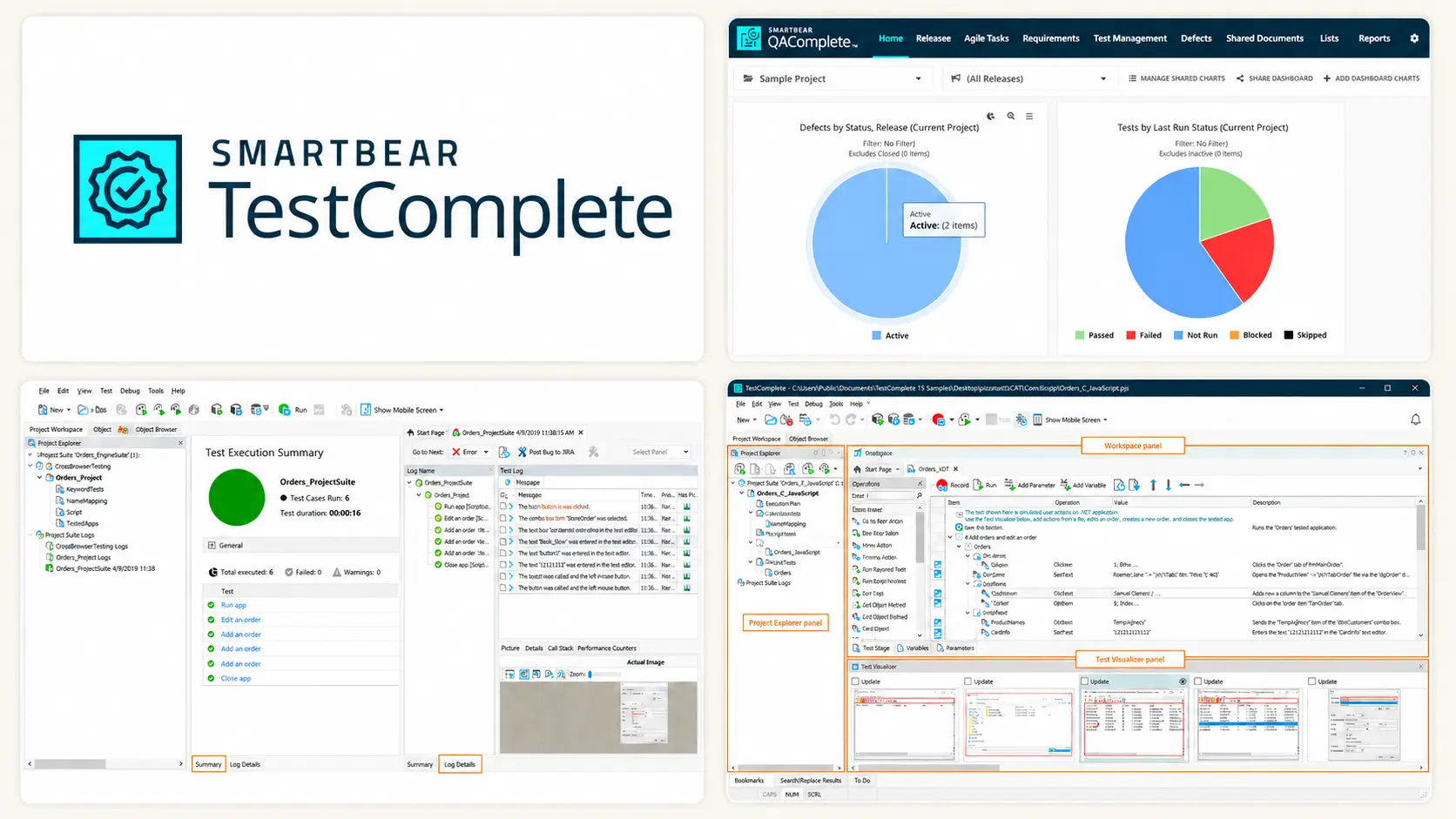
6. TestComplete
Best for:
Enterprise teams that need desktop, web, and mobile application testing from one commercial tool with vendor support.
Platform Type:
Commercial GUI test automation platform
Integrations with:
Jenkins, Azure DevOps, Jira, Git, SmartBear ecosystem (Zephyr, BitBar)
Key Features:
- Desktop, web, and mobile automation in one product
- Record-and-playback plus scripting in JavaScript, Python, VBScript, and more
- Object recognition with AI-assisted property matching
- TestExecute for parallel and headless execution
- Integration with Zephyr and BitBar across the SmartBear stack
Pros
- Genuine desktop application testing, which Playwright and Cypress lack
- Multiple scripting languages rather than Groovy only
- Mature object recognition for legacy and thick-client applications
- Commercial support with enterprise SLAs
Cons
- Around $3,800 per year per licence, more expensive than Katalon per seat
- Windows-centric tooling and authoring environment
- Heavier and slower than modern code-first frameworks
- Reporting stays at execution level with no AI failure classification
First Hand Experience
TestComplete is the alternative for the one thing open-source frameworks genuinely cannot do: automate desktop applications. If part of your Katalon usage is thick-client or legacy Windows testing, Playwright and Cypress are not replacements at all.
Object recognition on legacy applications is where TestComplete earns its price. It handles the awkward controls and non-standard widgets that break most modern tools.
For web testing alone it is hard to justify. At roughly $3,800 per year per licence you are paying more than Katalon for a heavier authoring experience and reporting that is no deeper.
Pricing & Value
Around $3,800 per year per node-locked licence, with floating licences priced higher. Modules for desktop, web, and mobile are bundled in the Pro tier.
Final Verdict
TestComplete is the right Katalon alternative when desktop application coverage is a hard requirement. For web-only suites, it is an expensive way to stay in the same paradigm.
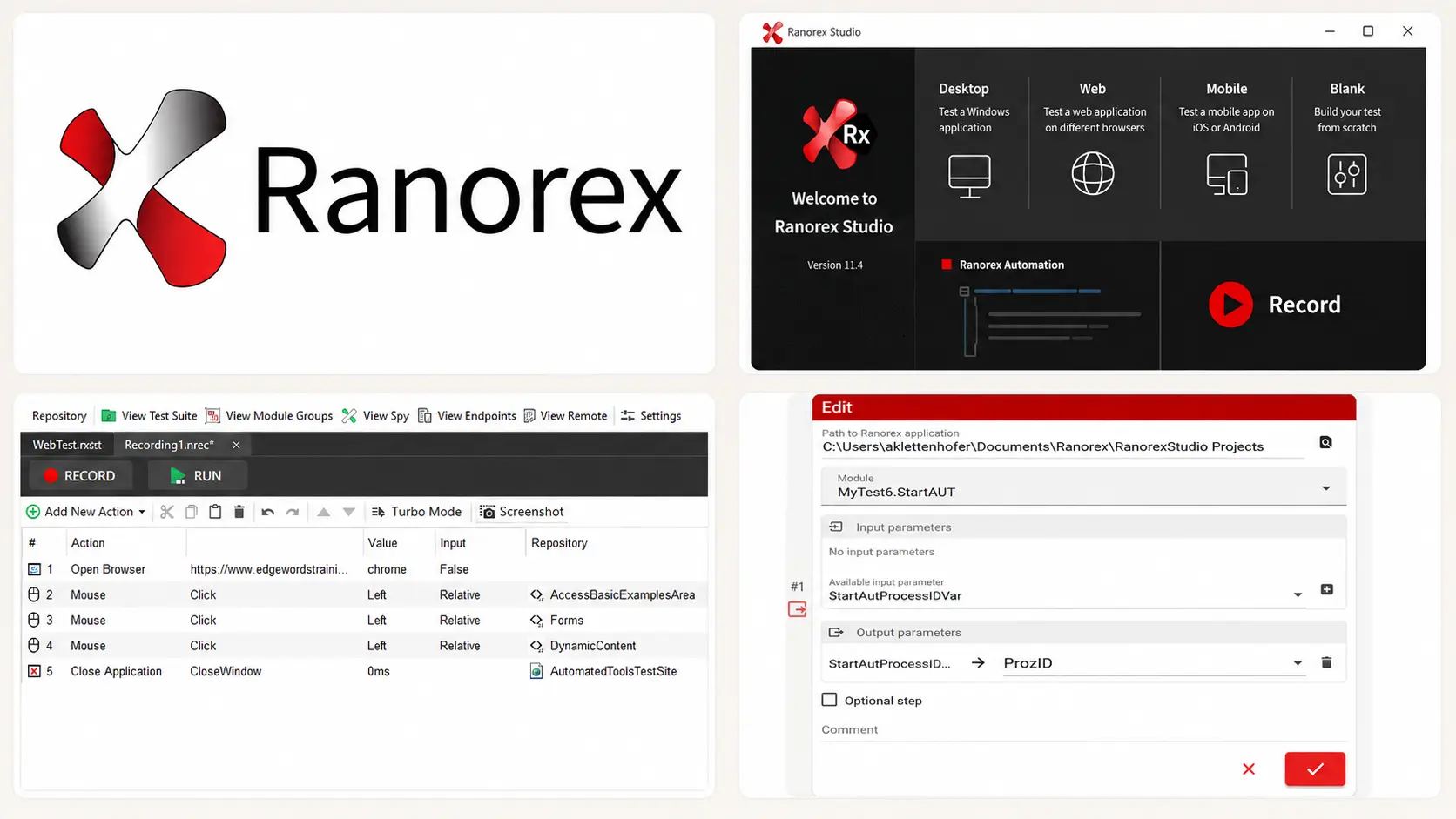
7. Ranorex Studio
Best for:
Teams testing legacy desktop, ERP, and thick-client applications that need codeless authoring with reliable object identification.
Platform Type:
Commercial codeless and code-based GUI automation tool
Integrations with:
Jenkins, Azure DevOps, Jira, TestRail, Git, Selenium Grid
Key Features:
- Codeless recorder with an editable action table
- RanoreX object repository with reusable identifiers
- Desktop, web, and mobile coverage from one IDE
- C# and VB.NET scripting for advanced scenarios
- Floating and runtime licences for shared team use
Pros
- Strong object identification on legacy and ERP interfaces
- Codeless authoring accessible to manual testers
- Flexible licensing including floating and runtime-only options
- Integrates with Selenium Grid for distributed web execution
Cons
- Windows-only authoring environment
- Licence costs are quoted rather than published
- Reporting is basic with no analytics, trends, or AI failure analysis
- Smaller community than Katalon or the open-source frameworks
First Hand Experience
Ranorex occupies similar territory to TestComplete: legacy and desktop applications where modern web frameworks do not apply. Its object repository model is closer to Katalon's than anything else here, which makes the mental migration straightforward for teams that built large object libraries in Katalon Studio.
The licensing flexibility is a practical advantage. Runtime-only licences let you run tests on build agents without paying for full authoring seats, which is a cheaper structure than Katalon's Runtime Engine at $1,749 per concurrent run.
Reporting is the weak point. Ranorex produces run reports, not analytics. There is no trend history, no flaky rate, and no failure classification, so teams generally pair it with TestRail or a separate reporting tool.
Pricing & Value
Quoted pricing with separate authoring, floating, and runtime licence types. Runtime licences for build agents are meaningfully cheaper than full seats.
Final Verdict
Ranorex fits teams with heavy legacy desktop coverage that want to keep codeless authoring. Web-first teams will find open-source frameworks faster and cheaper.
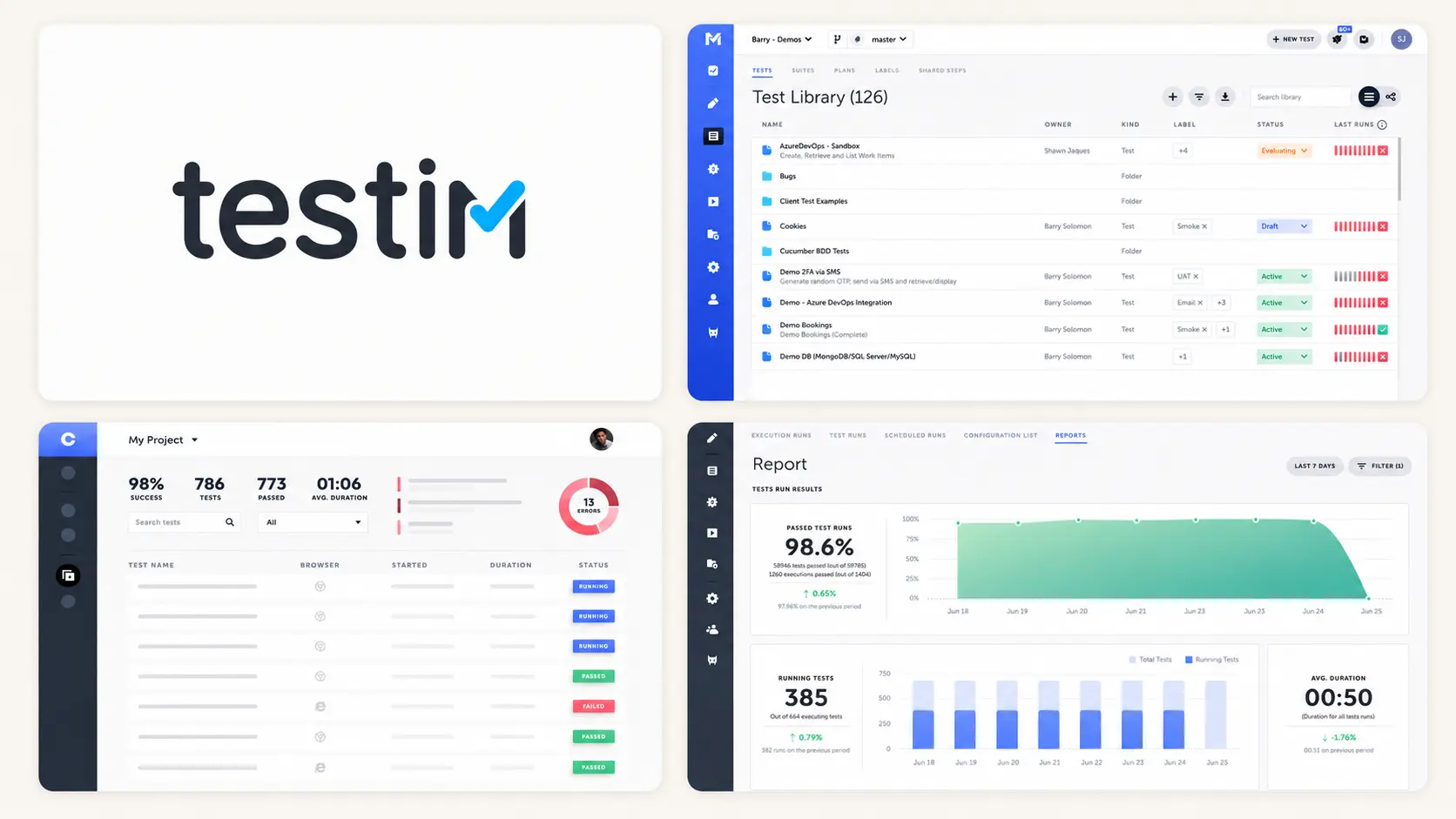
8. Testim
Best for:
Teams with large UI suites that want AI-assisted locator stability without moving fully to code-first authoring.
Platform Type:
AI-powered low-code web test automation platform
Integrations with:
GitHub, GitLab, Jenkins, CircleCI, Jira, Slack, Selenium Grid
Key Features:
- AI-based Smart Locators that adapt to DOM changes
- Recorder-based authoring with JavaScript escape hatches
- Reusable grouped steps shared across tests
- Root cause analysis on failed steps
- Parallel cloud execution with run history
- Branching and merging of test suites alongside code
Pros
- Smart Locators materially reduce selector maintenance on volatile UIs
- Recorder plus custom JavaScript suits mixed-skill teams
- Test branching maps onto Git workflows
- Faster onboarding than a code-first framework
Cons
- Web-focused, with no desktop coverage
- Pricing is custom with a sales cycle
- Proprietary test format, so migration out is costly
- Reporting is run-centric with no per-file coverage or trace viewing
First Hand Experience
Testim targets the exact maintenance complaint Katalon users raise most: tests breaking when the UI changes. Its Smart Locators score multiple attributes per element and pick the most stable match, which holds up better than a single brittle XPath.
The hybrid authoring model works well for mixed teams. Manual testers record flows, engineers drop into JavaScript where logic gets complicated, and both live in the same test.
The commercial model is the friction. Pricing is custom, the free tier is limited, and the proprietary format means the cost of leaving is high. Reporting covers run history and step-level root cause, but there is no hosted trace viewer, no per-file coverage, and no environment-level flaky comparison.
Pricing & Value
Free tier for evaluation. Paid plans are custom-quoted based on test volume and parallel execution, with enterprise contracts negotiated annually.
Final Verdict
Testim is a reasonable Katalon alternative when locator maintenance is the main pain and low-code authoring must stay. Teams comfortable with code will get more capability and no lock-in from Playwright.
Why Teams Are Switching from Katalon and What to Prioritize
Switching from Katalon is not just about finding another dashboard. The tool you pick should solve the problems that made you look for alternatives in the first place.
Total cost of execution, not the headline price
Katalon Studio being free is the most misleading number in this comparison. Authoring is free; running headlessly in CI is not. Runtime Engine is $1,749 per year per concurrent run, True Platform is $700 per seat per year, and cloud execution packs add $1,899 per year each.
Model your real shape before comparing: how many concurrent runs your pipeline needs, how many seats read dashboards, and how much parallel execution you buy. Open-source frameworks remove the licence line entirely, and platforms priced by plan rather than by seat avoid the per-seat scaling that Katalon applies to viewers as well as authors.
An authoring language your team can actually hire for
Groovy narrows your hiring pool and makes every migration more expensive, in both directions. Playwright and Cypress use TypeScript and JavaScript, Selenium supports most mainstream languages, and TestComplete offers several scripting options.
If your QA team is primarily manual, a code-first move has a real transition cost. That is the case where Testsigma or Testim earn their price, by keeping low-code authoring while removing the Runtime Engine model. Just be clear that you are exchanging one proprietary format for another.
Test intelligence and failure analysis
When hundreds of tests fail across branches and environments, knowing that a test failed is not enough. Your replacement should classify failures by type, group related errors by root cause, and separate flaky tests from real defects.
Katalon's flaky tests view shows which tests are unstable without a stability percentage or a cause. AI-driven test failure analysis and error grouping reduce the time between "something broke" and "here is what to fix," which is the gap most teams feel when they outgrow Katalon's reporting.
Reporting you do not lose when you leave
This is the step most migrations underestimate. Playwright, Cypress, and Selenium give you a per-run artifact and nothing more. No history across runs, no flaky rate per test, no environment comparison, no test case management.
Plan the reporting layer at the same time as the framework, not six months later. If what you actually want to replace is True Platform's management side rather than Studio's authoring, Xray, Zephyr Scale, and testomat.io cover test case management, while ReportPortal handles self-hosted reporting with ML-based failure clustering.
CI/CD integration that reduces pipeline time
Every minute your CI pipeline spends re-running passing tests is wasted money. Quality gates on pull requests and environment-specific merge rules protect coverage without a separate reporting tool.
Support for your specific CI provider (GitHub Actions, GitLab CI, Azure DevOps, TeamCity) matters more than a generic "works with CI" claim. Small teams especially benefit from CI/CD test integration that works without dedicated DevOps configuration, and from platforms that do not meter concurrent runs.
Wrapping Up
Katalon provides low-code authoring, execution, and analytics in one suite, but it is tightly coupled to its own ecosystem, priced per concurrent run and per seat, and built on Groovy. For teams running or moving to open-source frameworks, that combination stops making sense.
Playwright is the strongest authoring replacement and removes the licence bill entirely. Selenium suits teams with existing WebDriver expertise. Cypress fits JavaScript front-end teams. Testsigma and Testim keep low-code authoring for manual QA. TestComplete and Ranorex cover the desktop and legacy applications open-source frameworks cannot reach.
Whichever you pick for authoring, the reporting layer is a separate decision. For Playwright-first teams that want AI failure classification, hosted trace viewing, flaky test detection with root causes, test management, and CI/CD optimization in one platform, TestDino's Pro plan starts at $39/month billed annually ($49 monthly) for 3 users, less per year than a single Runtime Engine licence, with a Free plan for 5,000 test results a month.
Scale QA with Clear Failure Insights
Classify failures automaticallyReduce CI re-run timeFAQs
Katalon Studio is free for test authoring with no feature limits. Running those tests headlessly in CI requires a Runtime Engine licence at $1,749 per year per concurrent run. True Platform is $700 per seat per year, the True Automation bundle is $1,699 per seat per year for the first three seats, and cloud execution packs are $1,899 per year each. The free tier covers authoring, not automation at scale.