Agentic Testing Tools Compared: QA.tech, Momentic, Spur vs. Deterministic Playwright
Wondering if agentic testing tools can replace Playwright? Compare QA.tech, Momentic, and Spur to make an informed decision.
Software testing is going through a massive shift where AI is moving from just writing code to actually interacting with applications. Teams are no longer just writing step by step instructions but instead giving goals to smart bots.
The biggest struggle with this change is dealing with broken tests every time a developer changes a button ID or moves a form. Spending half the day fixing old tests instead of finding new bugs is burning out QA teams.
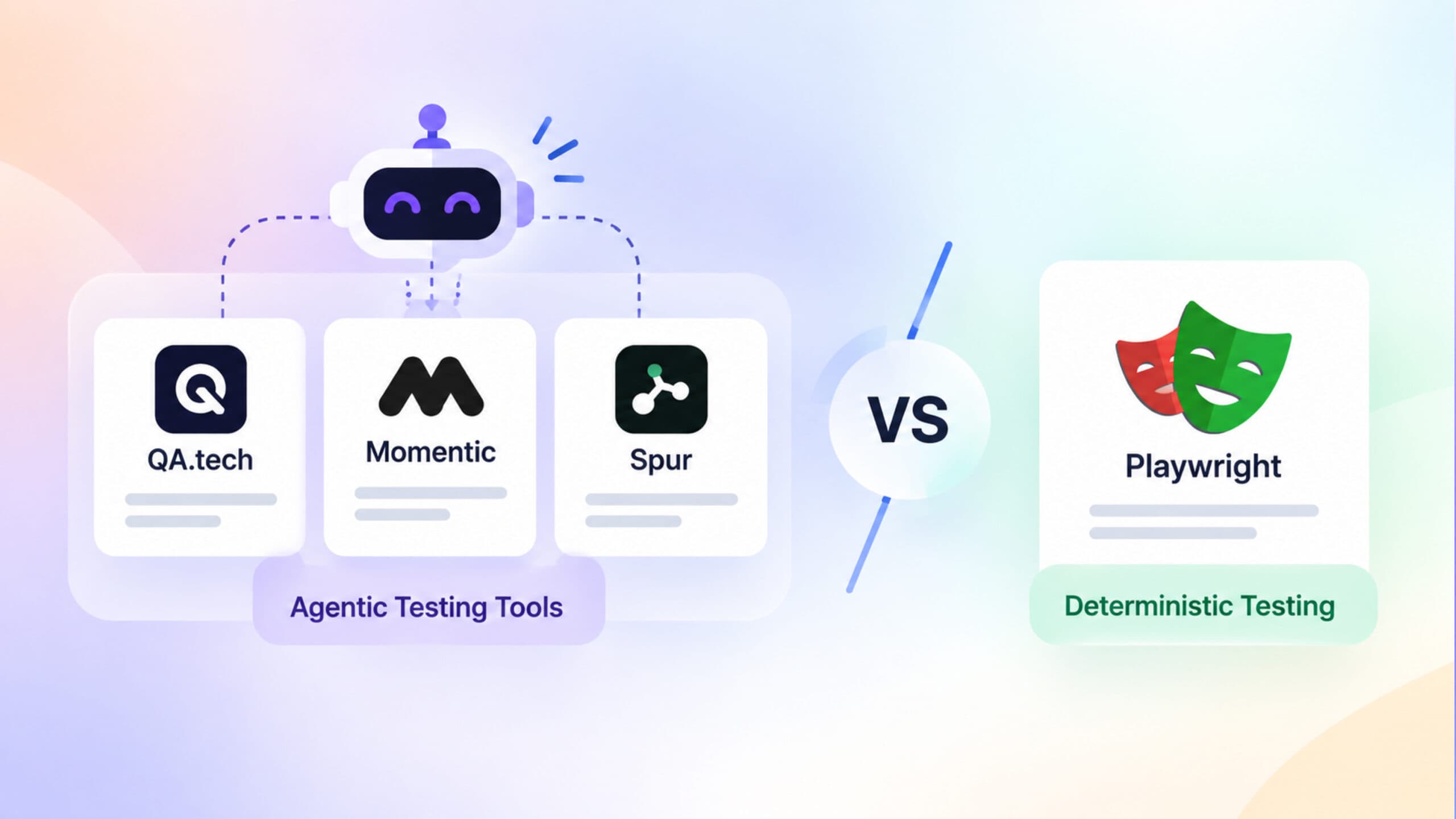
This guide will break down how the newest AI agents compare to standard tools. You will learn exactly when to use tools like QA.tech, Momentic, or Spur, and when you should just stick to normal Playwright.
What is agentic testing in 2026?
Definition: Agentic testing uses AI models to independently explore, plan, and execute test cases based on high level goals instead of fixed locators.
Testing tools have evolved far beyond just recording your screen. Today, we have test automation tools that can actually "see" the screen. Instead of telling the code exactly where to click, you just tell it what you want to achieve.
These tools are categorized by how they handle instructions. Some explore your app entirely on their own to map out user journeys. Others let you write steps in plain English and figure out the code behind the scenes.

All of them aim to reduce the time spent fixing brittle test scripts. When your web app updates a component, agentic tools adapt automatically. This adaptation is a huge upgrade for continuous testing environments.
However, they are not a magic bullet for every problem. They often trade raw speed for this high level of adaptability. Understanding this trade off is vital before ripping out your existing frameworks.
Why deterministic Playwright is still the speed king
Playwright remains the absolute standard for deterministic testing. When you write a Playwright test, it executes exactly what you coded. There is no AI "thinking" delay, meaning it interacts with the browser instantly.

Tip: Keep your critical payment and login flows in standard Playwright for the fastest execution times in your CI/CD pipeline.
Because it connects directly to the browser engine, Playwright can run thousands of tests in minutes. This makes it the perfect Playwright framework for stable, unchanging interfaces. When speed is your top priority, nothing beats a direct, scripted command.
However, this speed comes with a steep maintenance cost. If a developer changes a class name, your deterministic test will instantly fail. You then have to manually locate the new selector and update the code.
test('should login successfully', async ({ page }) => {
  await page.locator('#username-input').fill('testuser');
  await page.locator('.btn-primary.submit').click();
});
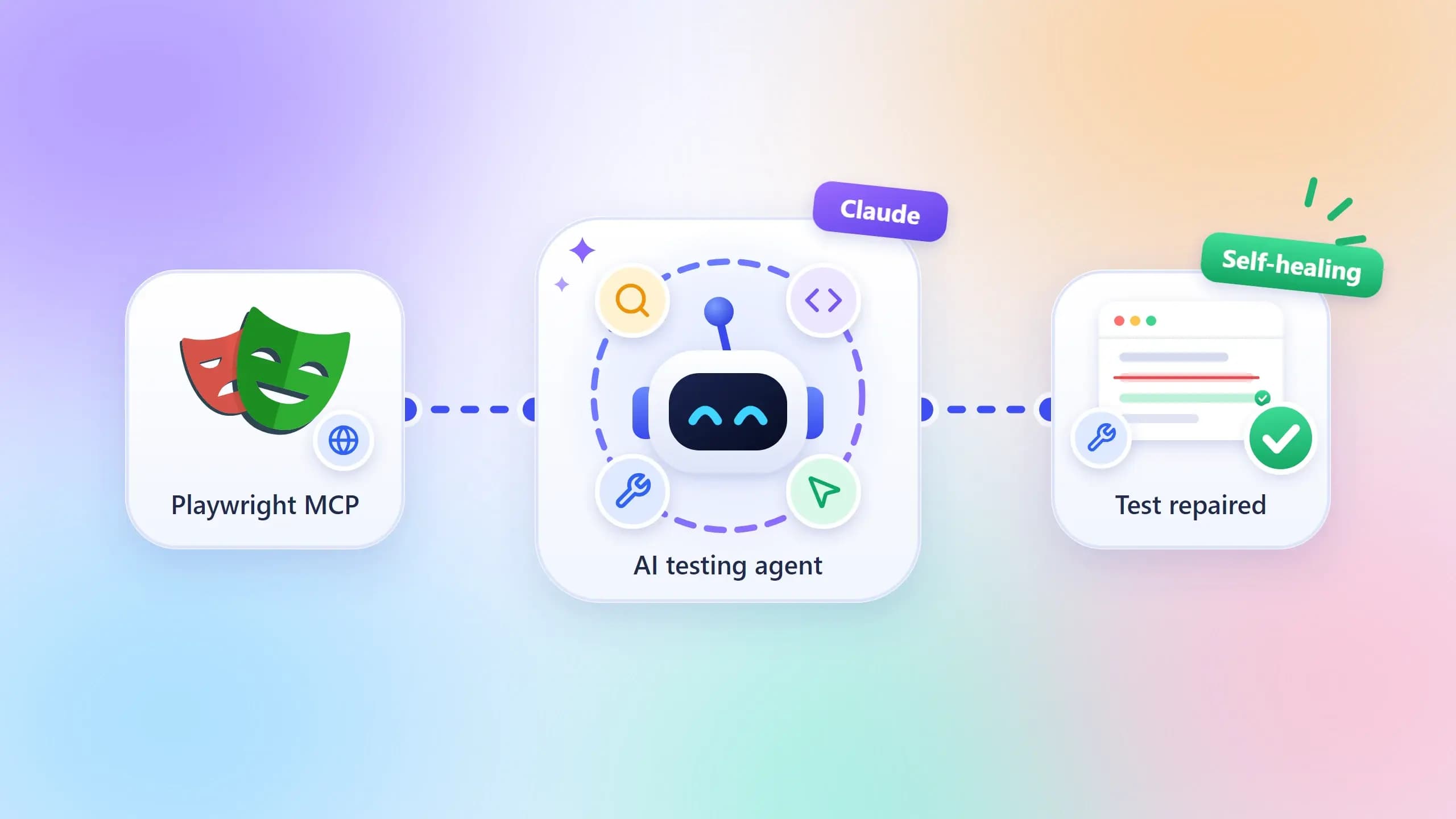
To combat this, Microsoft recently introduced Playwright Test Agents. These allow you to use an AI codegen tool alongside the framework. You get the speed of deterministic tests with the authoring power of AI.
QA.tech: The runtime exploration agent
QA.tech takes a completely different approach called runtime exploration. You do not give it a step by step script to follow. Instead, you provide a high level goal like "check out as a guest".
The agent then clicks around your application to figure out how to do that. It behaves exactly like a human QA engineer exploring a new feature. This makes it incredible at finding edge cases you never thought to script.
Note: Exploratory agents are great for finding unknown bugs but can be hard to track for strict compliance reporting.
Because it explores at runtime, it does not rely on static DOM selectors. If the checkout button moves to a new page, QA.tech will search and find it. This drastically lowers the maintenance burden of your software testing suite.
However, this exploration takes time and processing power. It will never run as fast as a strict, hardcoded Playwright test. You use QA.tech to replace manual exploratory testing, not your fast CI pipeline.

It also integrates well with issue trackers and reporting systems. When it finds a bug, it generates a comprehensive report of the path it took. This feature alone saves hours of manual bug ticket creation.
Momentic: Natural language spec execution
Momentic bridges the gap between human readable requirements and automation. You write your test scenarios entirely in plain English text. The AI engine translates those English steps into executable actions on the fly.
This approach is known as natural language spec execution. It allows product managers and designers to write tests without knowing code. It is a massive win for agile testing teams that want to shift left.
When a test runs, Momentic interprets the intent behind your words. If you say "click the submit button", it will find it regardless of the HTML tag. It handles random pop ups and cookie banners automatically during execution.
This makes your tests highly resilient to minor UI changes. You spend your time writing business logic rather than updating XPaths. It brings the ease of codeless testing to complex web applications.
The downside is that interpreting natural language requires LLM processing. This introduces a slight latency into every step of your test suite. For a suite of 500 tests, this extra time can add up significantly.
Spur: Vision based testing without selectors
Spur represents the cutting edge of vision based agentic testing. It completely abandons the concept of DOM selectors, XPaths, and element IDs. Instead, it looks at the rendered pixels on the screen just like a human does.
Definition: Vision based testing uses computer vision algorithms to interact with UI elements based on their visual appearance rather than backend code.
If your frontend team refactors a React component into Vue, Spur does not care. As long as the button looks the same on the screen, the test will pass. This provides the highest level of resilience against code level changes.
It is particularly powerful for testing complex canvas elements or third party iframes. Standard tools struggle to penetrate iframes or read canvas data. Spur handles these easily because it relies entirely on visual processing.

It is an excellent tool for visual regression testing. It verifies both functionality and visual correctness in a single pass. You get high confidence that your app looks and works perfectly for the end user.
However, vision based models require significant computing resources. They can sometimes struggle with highly dynamic pages where elements constantly shift. You must weigh the benefit of zero selectors against the cost of heavy processing.
Head to head comparison: Speed, maintenance, and reliability
Choosing the right tool requires analyzing real world performance metrics. We have compared Playwright, QA.tech, Momentic, and Spur across key categories. The data reveals clear trade offs between execution speed and maintenance effort.
Playwright dominates in pure execution speed and deterministic reliability. If the UI is stable, Playwright will run flawlessly every single time. It is the backbone of efficient CI/CD testing pipelines.
Agentic tools shine when we look at maintenance hours saved per month. While their execution is slower, they require almost zero manual upkeep. This shift fundamentally changes how QA teams allocate their daily hours.
Execution speed vs maintenance time
Below is a data representation of execution speed versus monthly maintenance hours based on industry averages.

When evaluating these tools, you must consider the total lifecycle cost. Fast execution is useless if your team spends 40 hours a week fixing broken selectors. Conversely, zero maintenance is not helpful if a test suite takes 4 hours to run.

Many enterprise teams are adopting a hybrid test strategy. They use Playwright for core APIs and stable backend flows. They then deploy tools like Spur for front end, highly dynamic user interfaces.
Another option worth considering is Qodex, which combines AI-assisted test creation with reusable HTTP and Playwright scenarios. Teams can start from plain English, API specifications or Postman collections, then run saved tests against their web application or API. Its scope spans functional testing, browser workflows and security checks, with execution evidence to investigate failures.
Conclusion
The debate between agentic testing tools and deterministic Playwright is not about finding an absolute winner, but understanding the trade-off between execution speed and maintenance effort. Playwright provides unmatched speed for stable CI/CD pipelines, while tools like QA.tech, Momentic, and Spur drastically reduce the human effort required to maintain tests for highly dynamic interfaces.
The most successful engineering teams will adopt a phased, hybrid approach. Keep your critical, backend-heavy tests in deterministic frameworks like Playwright, and deploy AI-driven tools where brittle DOM selectors cost you the most time. By choosing the right tool for the specific job, you can achieve both speed and stability in your software releases.
FAQs

Savan Vaghani
Product Developer