API Testing Statistics: Market Size, Tool Adoption & Industry Trends
API testing statistics and trends for 2026 covering tool adoption, REST vs GraphQL usage, common API failures, and security practices.
Every modern app runs on APIs.
Your login screen, your checkout page, your dashboard loading data in real time. All of it.
But here's the disconnect: The average application now uses 26 to 50 APIs to function. That's a lot of moving parts. And when one of those parts breaks, the whole thing falls apart!
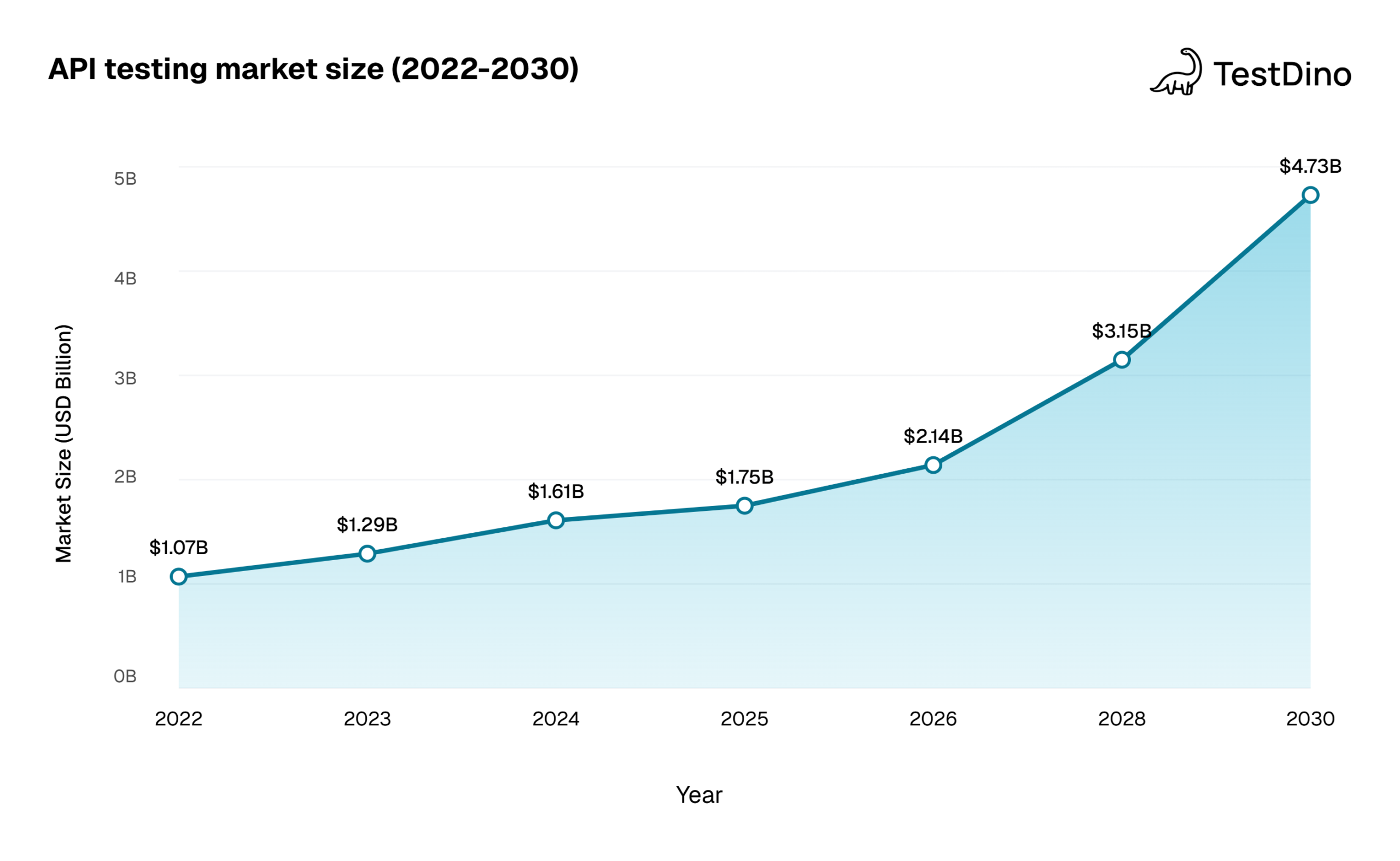
The API testing market was valued at $1.75 billion in 2025 and is growing at a 22.2% CAGR. Yet 39% of developers still say inconsistent documentation is their biggest roadblock.
That gap between API growth and testing maturity is exactly what this report covers. Below you'll find verified data on test automation tools, protocol adoption rates, failure categories, and where the industry is headed.
What is API testing?
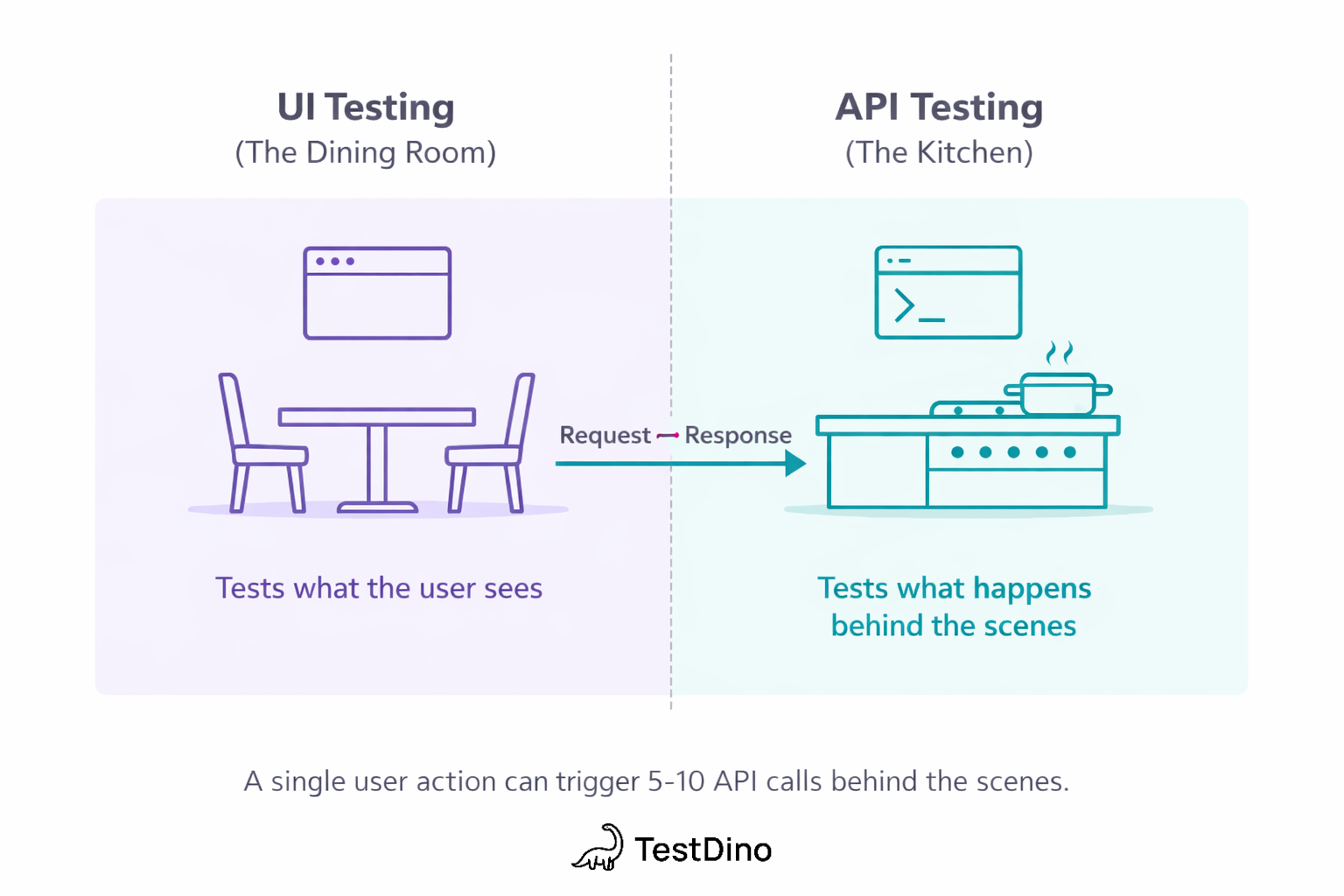
API testing is the process of verifying that application programming interfaces work correctly, return the right data, handle errors properly, and perform within acceptable limits. Unlike UI testing, API testing works at the request-response level, skipping the browser entirely.
API testing is the process of verifying that application programming interfaces work correctly, return the right data, handle errors properly, and perform within acceptable limits. Unlike UI testing, API testing works at the request-response level, skipping the browser entirely.
Think of it this way:
If your application is a restaurant, the UI is the dining room, and the API is the kitchen.
API testing checks whether the kitchen can -
-
Take orders
-
Prepare them correctly, and
-
Send back the correct dish every time.
You don't need to sit at the table to verify that the kitchen works.
API testing covers: functional checks, performance validation, security scanning, and contract verification between services. With microservices architectures now standard, a single user action might trigger 5 to 10 API calls behind the scenes.
The API testing market is growing fast
The numbers tell a clear story. API testing isn't a niche anymore. It's a major segment of the broader test automation industry.
MetricValueSource
| API testing market size (2025) | $1.75 billion | The Business Research Company, 2026 |
| Projected size (2026) | $2.14 billion | The Business Research Company, 2026 |
| CAGR (2025-2030) | 21.9% | The Business Research Company, 2026 |
| Broader test automation market (2025) | $37.66 billion | GII Research, 2026 |
| Test automation projected (2030) | $96.75 billion | GII Research, 2026 |
| API security testing tools market (2025) | $1.39 billion | SNS Insider, 2026 |
| API security testing projected (2033) | $14.68 billion | SNS Insider, 2026 |
Different research firms use different market definitions, which explains the varying estimates. Data Bridge Market Research, for instance, sizes the API testing market at $4.73 billion by 2030. The key takeaway is consistent: double-digit growth across all estimates.

Tip: If you're investing in test infrastructure, API testing should be a priority budget line item. The market's 20%+ CAGR reflects real demand from teams who've learned that UI-only testing misses too many backend issues.
North America holds the largest market share in 2025, but Asia-Pacific is the fastest-growing region, driven by cloud adoption and increasing use of microservices in fintech, e-commerce, and telecom.
API-first development is now the majority approach
| Year | API-first adoption | Source |
|---|---|---|
| 2023 | 66% | Postman State of the API, 2024 |
| 2024 | 74% | Postman State of the API, 2024 |
This matters for testing because API-first teams produce APIs faster. According to Postman's 2024 data, 63% of developers in API-first organizations can produce an API within a week, up from 47% in the previous year.
Faster production means more APIs in circulation. More APIs mean more things to test. Teams using shared workspaces see even faster output: 67% can ship an API within a week, compared with 58% without workspaces.
62% of respondents reported working with APIs that generate income. When APIs are revenue-generating products, the stakes for testing go up dramatically. A broken API isn't just a bug. It's lost revenue.
Tip: If your APIs generate revenue, treat API testing like you'd treat payment processing validation. Non-negotiable, automated, and monitored continuously.
Tool adoption: Who's winning the API testing market
Postman still dominates
Postman is the clear market leader with 35 million+ users and 500,000+ organizations, including 98% of the Fortune 500.
But the market is shifting. Open-source alternatives are growing fast, driven by developers who want:
-
Local-first data storage (no cloud sync required)
-
Git-native collaboration (collections as code)
-
Lighter resource usage (no Electron bloat)
-
Free or low-cost team features
Open-source alternatives gaining traction
| Tool | GitHub Stars | Key differentiator | Best for |
|---|---|---|---|
| Hoppscotch | 67,000+ | Browser-based, lightweight | Quick API testing, privacy-focused teams |
| Bruno | 30,000+ | Git-native, file-based storage | DevOps teams wanting version-controlled collections |
| Insomnia | 35,000+ | Design-first, gRPC support | Teams needing multi-protocol support |
| HTTPie | 34,000+ | Human-friendly CLI + desktop app | CLI-first developers |
| Thunder Client | VS Code extension | Lives inside the editor | Developers who never leave VS Code |
GitHub star counts as of early 2026. Star counts reflect popularity, not necessarily production usage.
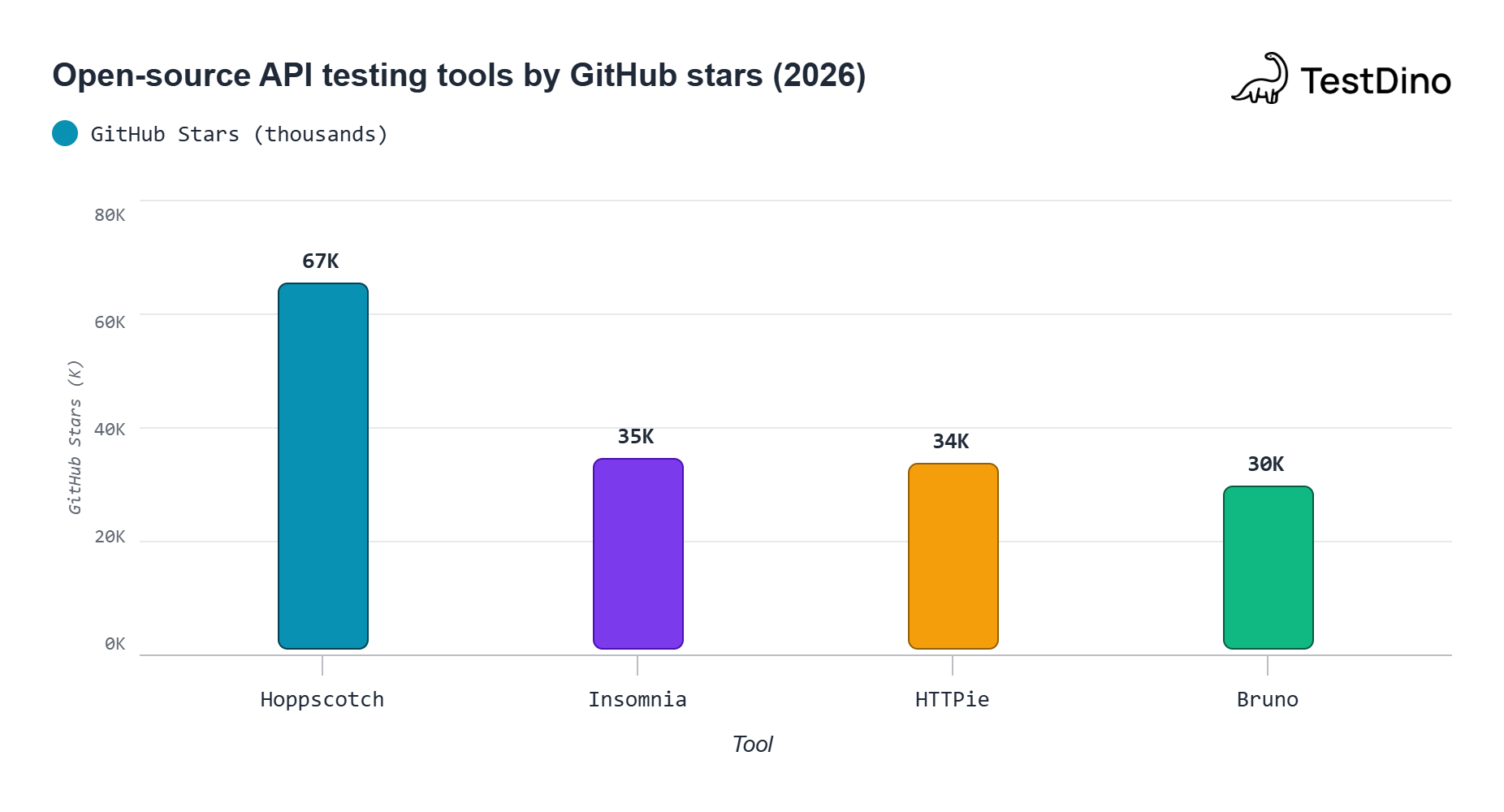
The trend is clear. Developers are moving toward tools that fit into their existing workflows (Git, VS Code, CLI) rather than requiring a separate platform. Hoppscotch's rapid growth to 67,000+ GitHub stars shows a strong appetite for lightweight, privacy-respecting alternatives.
For teams already using Playwright for end-to-end testing, it's worth noting that Playwright has built-in API testing capabilities through its request context. This means teams can run API tests alongside browser tests in the same framework, with results tracked through the same reporting pipeline.
Tip: Don't pick an API testing tool based on GitHub stars alone. Evaluate based on your CI/CD integration needs, team collaboration model (cloud vs. local), and protocol support requirements (REST, GraphQL, gRPC).
REST vs GraphQL vs gRPC: Protocol adoption breakdown
Not all APIs are built the same. The protocol your team chooses affects how you test, which tools you need, and the kinds of failures you'll encounter.
| Protocol | Market share | Best for | Testing complexity |
|---|---|---|---|
| REST | ~83% of web services | Public APIs, CRUD operations, & broad compatibility | Low to moderate |
| GraphQL | Growing fast (340% increase among Fortune 500) | Dynamic frontends, mobile apps, complex data fetching | Moderate to high |
| gRPC | Rising in infrastructure | Microservices communication, real-time streaming, & low-latency systems | High |
| SOAP | Declining | Legacy enterprise, banking, telecom | High |
| WebSocket | Niche but stable | Real-time bidirectional communication | Moderate |
REST market share from RapidAPI Developer Survey. GraphQL growth from Postman State of the API, 2024.
What the data tells us
- REST will remain dominant for public-facing APIs because it's simple, well-documented, and works with every programming language.
- But GraphQL is eating into REST's share for frontend-heavy applications.
- gRPC benchmarks show up to 10x lower latency than REST in production AI workloads (25ms vs 250ms). That's why companies like Netflix, Google, and Uber use it for internal microservices. But it comes with a steeper learning curve and requires protocol-aware tooling for debugging.
The practical takeaway for testing teams: you probably need to test multiple protocols. The SmartBear State of Software Quality report found that developers are increasingly working in polyglot API environments. Standardization (52%) ranked as the top challenge organizations want to solve.
Tip: If your team tests both REST and GraphQL endpoints, look for tools that handle both in 1 workflow. Running separate test suites for each protocol creates maintenance overhead and gaps in coverage.
Common API failure categories
APIs fail in predictable patterns. Understanding these patterns helps you write better tests and catch issues before they reach production.
The 5 most common API failure types
| Failure type | HTTP codes | Root cause | How to test for it |
|---|---|---|---|
| Authentication & authorization | 401, 403 | Expired tokens, missing credentials, wrong permissions | Send requests with expired, missing, and invalid tokens |
| Bad requests & validation | 400, 422 | Malformed payloads, missing required fields, wrong data types | Fuzz inputs, send edge cases, omit required fields |
| Rate limiting | 429 | Too many requests in a given time window | Load test at and above rate limits |
| Server errors | 500, 502, 503 | Unhandled exceptions, database issues, dependency failures | Test under load, simulate dependency failures |
| Timeouts | 504 | Slow upstream services, unoptimized queries, network issues | Test with slow responses, large payloads |
Note: Authentication failures are the most common category across most API monitoring platforms. They cascade particularly badly in microservices architectures, where one expired token can bring down multiple downstream services.
API security incidents are nearly universal
Salt Security's research found that 95% of organizations experienced an API security incident in recent years. That's not a typo. Nearly every company with APIs has been hit.
The OWASP API Security Top 10 (2023 edition) ranks these as the most critical API security risks:
-
Broken Object Level Authorization (BOLA) - roughly 40% of all API attacks
-
Broken Authentication
-
Broken Object Property Level Authorization
-
Unrestricted Resource Consumption
-
Broken Function Level Authorization
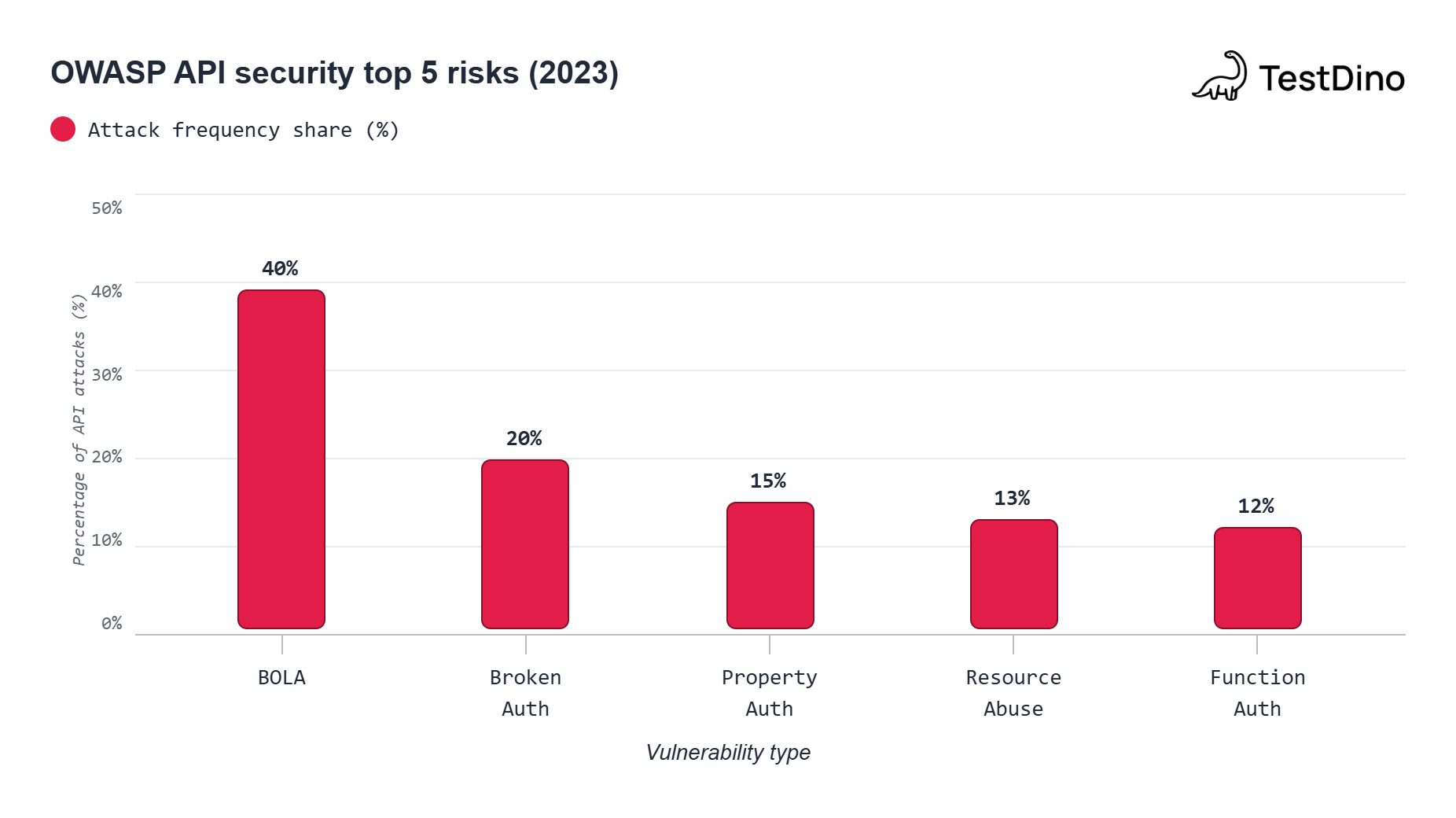
Salt Security also reported a 400% increase in API attacks in a single quarter at the end of 2022, with 78% of those attacks originating from legitimate users. That means traditional perimeter security isn't enough. You need to test your authorization logic at the API level.
For teams using Playwright for test failure analysis, applying the same systematic approach to API failure patterns helps. Categorizing failures into buckets (auth, validation, infrastructure, timeouts) makes triage faster and helps identify recurring issues.
Tip: Start your API test suite with authentication and authorization tests. They're the most common failure point and the easiest to automate. Test with valid tokens, expired tokens, tokens for wrong users, and no tokens at all.
The automation gap: Who's testing APIs and how
The SmartBear State of Software Quality API report (surveying 1,100+ API practitioners across 17 industries) provides the clearest picture of current testing practices.
| Metric | Value |
|---|---|
| Teams using automated API testing | 77% |
| Teams using API monitoring in production | 66% |
| Teams using API design/documentation tools | 62% |
| Developers involved in testing | 57% |
| Testers spending 70%+ of the week on testing | 50% |
Source: SmartBear Report (2023); SmartBear Report (2022)
There's a gap between knowing you should automate and actually doing it well. 77% of teams have automated API testing, but that doesn't mean their coverage is complete. Many teams automate happy-path scenarios and skip edge cases, error handling, and security validation.
The Postman data adds another dimension: 44% of developers still dig through source code to understand APIs, and 39% say inconsistent documentation is their top collaboration obstacle. That means even when tests exist, developers often don't know what they're supposed to be testing against.
For test reporting and analytics, the same principle applies. Having tests is step 1. Knowing what your tests actually tell you is step 2. Teams that track pass rates, flakiness, and failure categories across their API and E2E test suites catch patterns that single-run results miss.
AI is reshaping API traffic and testing
AI-driven API traffic surged 73% on the Postman platform in a single year. OpenAI alone accounts for 79% of AI API traffic on Postman's network.
This matters for testing teams in 2 ways:
1. More AI APIs to test. If your product integrates with OpenAI, Anthropic, Google Gemini, or similar services, you now need to test for:
-
Token limits and rate limiting behavior
-
Response format variations
-
Latency under load
-
Fallback behavior when the AI service is slow or down
2. AI-powered testing tools. SmartBear notes that AI-driven test generation reduces manual effort by about 25%. Tools like Postman are adding AI features to auto-generate test scripts. For teams using Playwright, AI-powered failure classification automatically categorize test failures , which is particularly useful when API responses change unexpectedly.
43% of survey respondents planned to use ChatGPT for API development in 2025, with GitHub Copilot and Google Gemini as the next most popular choices (Postman, 2024).
Tip: When testing AI-powered APIs, don't just test for correctness. Test for response time variability. AI endpoints often have latency ranges 5-10x wider than traditional APIs, which can break client-side timeout handling.
Postman network data: What developers actually build
Postman's internal data provides a rare look at how developers are actually using APIs at scale.
| Metric | Value |
|---|---|
| Total Postman users | 35 million+ |
| Organizations on Postman | 500,000+ |
| Fortune 500 coverage | 98% |
| Countries with Postman collections | 266 |
| Most active country | India |
| Top forked API collections | Salesforce, WhatsApp, PayPal |
Source: Postman, 2024
India leads in both collection count and API requests, followed by the United States, China, Brazil, and the U.K. This global distribution means API testing needs to account for latency, regional compliance requirements, and time zone-based load patterns.
71% of API users remain developers and engineers, but the user base is diversifying to include executives, architects, directors, and product managers. This broadening audience makes good documentation and clear test reporting more important than ever.
API documentation: The hidden testing bottleneck
Poor documentation creates testing blind spots. You can't write good tests for an API you don't understand.
| Documentation challenge | Percentage |
|---|---|
| Developers using internal docs to understand APIs | 58% |
| Developers citing inconsistent docs as top obstacle | 39% |
| Developers digging through source code to understand APIs | 44% |
| Teams choosing APIs based on documentation quality over performance or security | Majority |
Source: Postman, 2024
That last point is striking. Postman's data shows developers choose public APIs based on documentation quality more than performance or security. Good docs attract adoption. Bad docs repel it.
For testing, the implication is direct. If your internal API documentation is inconsistent or outdated, your test coverage probably has gaps. Contract testing (verifying that APIs match their documented specifications) is one way to catch documentation drift before it becomes a production issue.
Tip: Treat your API specification (OpenAPI/Swagger) as a living document that generates both documentation AND tests. When spec and reality diverge, contract tests catch it.
The job market wants API testing skills
API testing skills are increasingly in demand. The SmartBear report notes that web apps and APIs are the most commonly tested application types, and the demand for engineers who can test both is rising.
The broader test automation job market reflects this shift. Engineers with experience in API testing frameworks, CI/CD integration, and multi-protocol testing command higher salaries than those focused only on UI testing.
For QA engineers and SDETs looking to stay competitive, API testing proficiency is no longer optional. It's expected. Frameworks like Playwright, which support both browser testing and API testing in a single framework, are particularly valuable because they reduce the tooling surface area a tester needs to maintain.
Security testing: The critical gap
API security testing deserves its own focus. The numbers are alarming.
| Security metric | Value |
|---|---|
| Organizations with API security incidents | 95% |
| API attack increase (Q4 2022) | 400% in 1 quarter |
| Attacks from "legitimate" users | 78% |
| Companies NOT using API key vault tools | 27% |
| Companies using multiple API gateways | ~33% |
| API security testing tools market CAGR | 34.38% |
Source: Salt Security; Postman; SNS Insider
Note: The 34.38% CAGR for API security testing tools is nearly double the growth rate of the broader API testing market. Security is where the investment is flowing fastest.
More than a quarter of companies still don't use API key vault security tools. That's a basic hygiene gap. When you combine that with the fact that about a third of API providers use multiple gateways (making unified security harder), you get an environment where testing is the last line of defense.
The OWASP API Security Top 10 (2023 edition) should be your baseline checklist for API security testing. Every API endpoint should be tested against at least the top 5 risks: BOLA, broken authentication, broken object property authorization, unrestricted resource consumption, and broken function-level authorization.
What this means for your team
The data paints a clear picture. Here's what testing teams should take away:
If you're not testing APIs, you're flying blind. With 26-50 APIs powering the average application, untested APIs are your biggest risk area. 77% of teams are already automating API tests. If you're in the other 23%, you're behind.
REST isn't going anywhere, but plan for multi-protocol. 83% REST dominance doesn't mean you can ignore GraphQL or gRPC. As your architecture evolves, your testing toolkit needs to evolve with it.
Security testing is under-invested. 95% of organizations have experienced an API security incident, but investment in security testing tools is still lagging. Start with the OWASP API Top 10 as your testing baseline.
AI is changing both what you test and how you test. AI API traffic grew 73% in 1 year. If you're integrating AI services, test for their unique failure modes (latency variability, token limits, format changes).
Documentation quality determines testing quality. If your docs are inconsistent, your tests probably are too. Invest in specification-driven development where your OpenAPI spec generates both docs and test cases.
For Playwright users specifically, the framework's built-in API testing capabilities let you combine browser and API tests in a single suite. Tracking results across both layers through a test reporting platform gives you visibility into issues regardless of where they originate.
FAQs

Jashn Jain
Product & Growth Engineer