Test automation Jobs Report 2026: Postings by Tool, Region, and Salary
Test Automation Jobs Report 2026 compares Selenium, Playwright, and Cypress hiring demand by region, job title, and salary, and highlights the skills that show up most often in real job posts.

You want to know which testing tool gets you hired. Fair question.
Here's the short answer. Selenium still dominates job boards. Indeed lists 8,800+ "Automation Testing Selenium" roles in the US alone. LinkedIn shows 10,000+ Selenium positions. That's more than Playwright and Cypress combined.
But the trend line tells a different story. Playwright postings tripled between 2024 and 2026. Cypress plateaued. And the automation testing market is projected to grow, meaning every one of these frameworks will see more jobs, not fewer.
This report breaks down the numbers. Tool by tool. Region by region. Title by title.
If you're deciding which framework to learn, planning a career in Playwright, or benchmarking your team's hiring strategy against market data, the data here will help you make that call.
Job postings by tool: the raw numbers
Let's start with what matters most. Which tool appears in the most job postings?
We pulled data from Indeed, LinkedIn, ZipRecruiter, Glassdoor, and Wellfound in February 2026. Here's what the US market looks like:
| Job board | Selenium | Playwright | Cypress |
|---|---|---|---|
| Indeed ("automation testing [tool]") | 8,800+ | 10,221* | 11,871* |
| 10,000+ | 1,000+ (QA-specific) | 2,000+ | |
| ZipRecruiter | 9,800+ | 538 | 600+ |
| Glassdoor | 1,933 | 1,056 (India) | 179 (Cypress, CA area) |
| TestDevJobs (QA-specific) | N/A | 279 | 306 |
Sources: Job board searches, February 2026. Numbers are snapshots and change daily.
A big caveat on these numbers. The Indeed count for Playwright (10,221) and Cypress (11,871) is inflated. These searches match any listing containing the tool name alongside common QA terms. Many enterprise postings list all three frameworks: "Experience with Selenium, Cypress, or Playwright preferred." A single listing can appear in all three counts.
When you search for tool-specific roles (e.g., "Selenium Automation Tester" as the exact title), the numbers drop sharply:
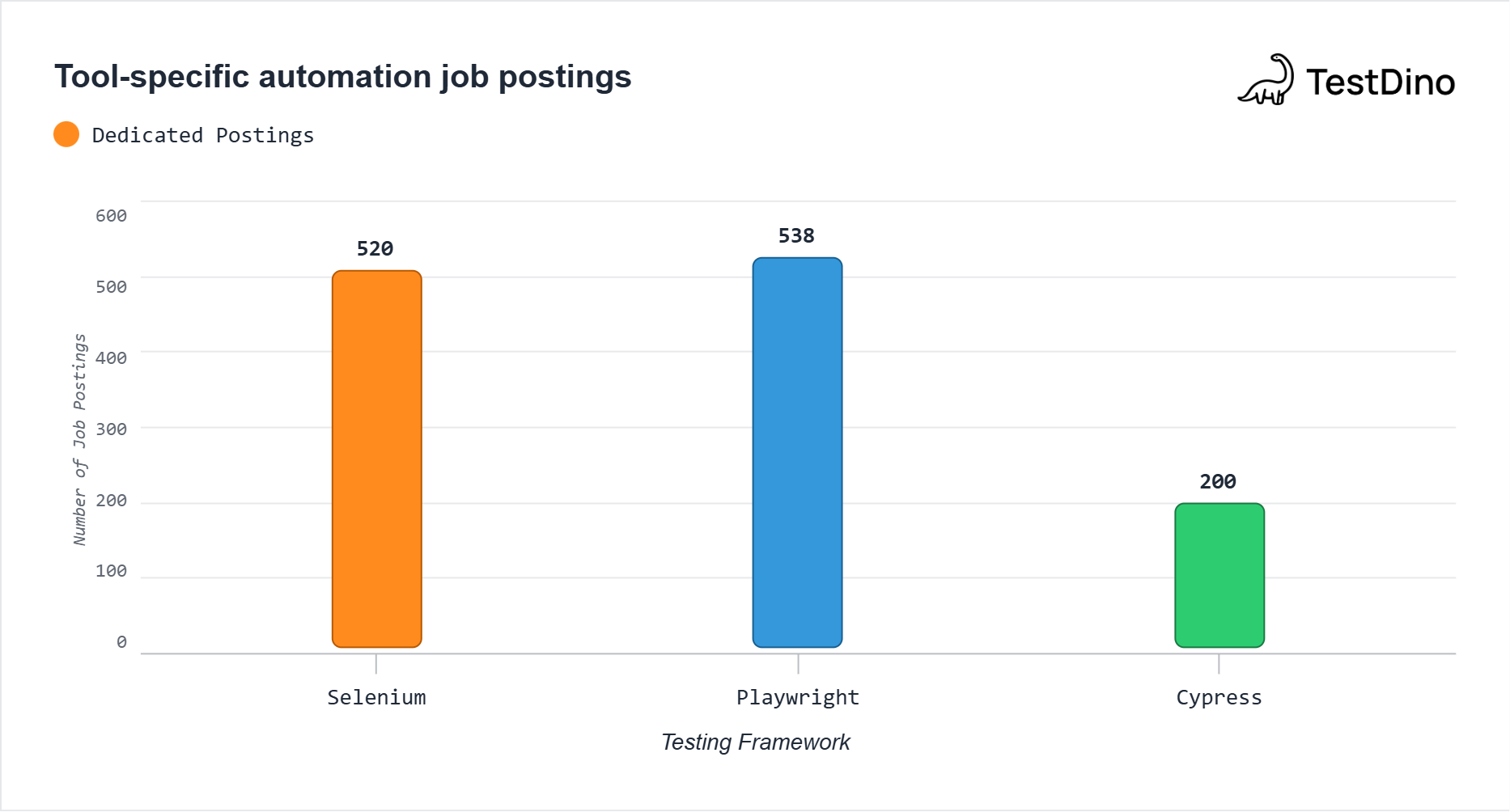
- Selenium Automation Tester: 520 on Indeed
- Playwright Automation: 538 on ZipRecruiter
- Cypress.io: ~200 on Indeed
The real takeaway? Selenium is still the most commonly required framework. But Playwright is closing the gap fast, especially in roles at product companies and startups. Cypress holds steady in the JavaScript ecosystem but isn't growing as quickly as Playwright.
For a deeper look at how framework adoption tracks with these job numbers, see the testing framework adoption trends analysis.
How Playwright jobs grew 3x in two years
Here's what changed. In 2024, a search for "Playwright" on Indeed returned roughly 1,200 results, and most of those were theater jobs. The testing framework was still niche.
By February 2026, that same search returns 1,242 results for the raw keyword. But the more targeted "QA Automation Engineer Playwright" search now pulls 10,221 results. In India, Naukri lists 2,496 Playwright job vacancies and Glassdoor India shows 1,056 openings.
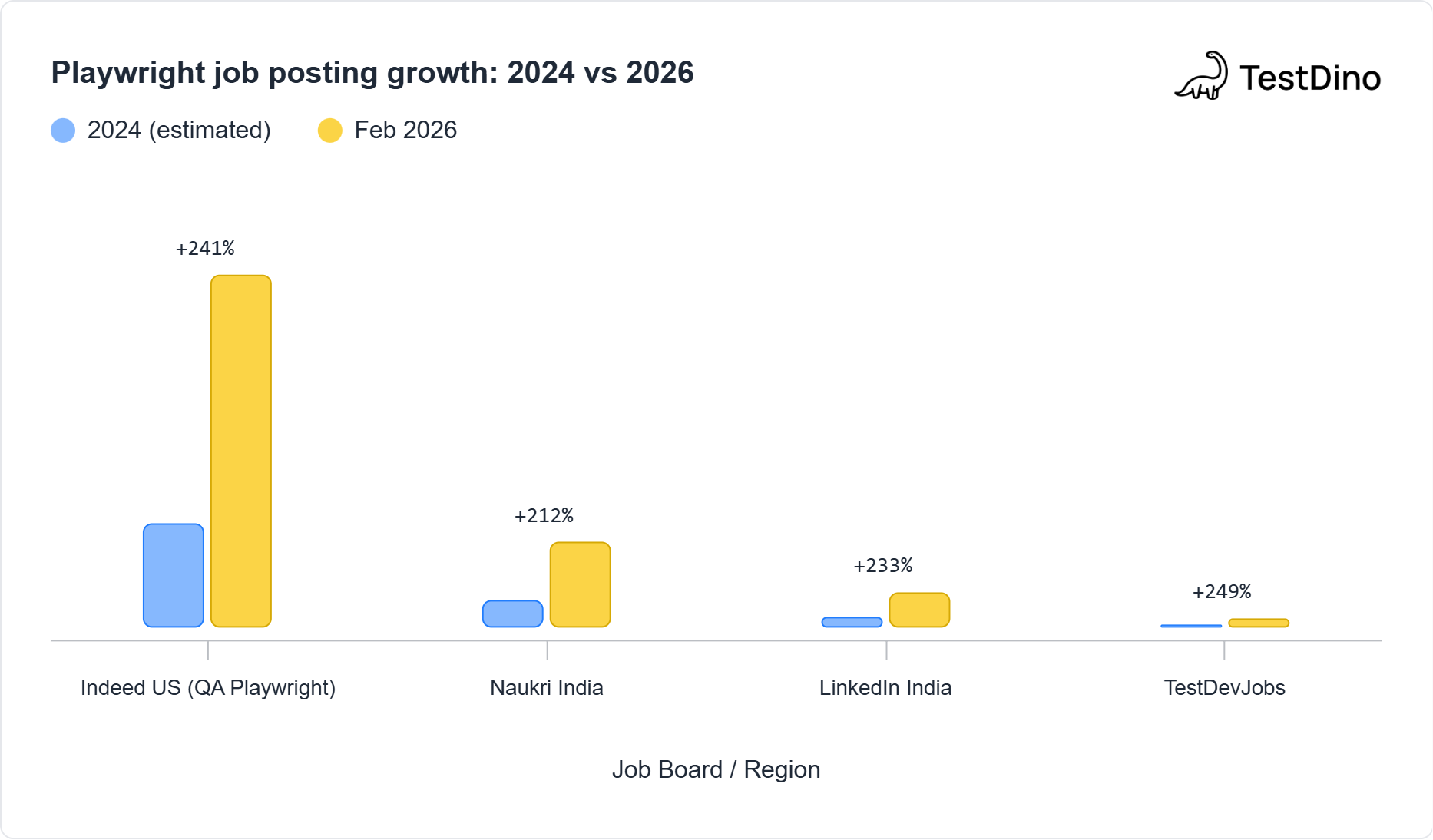
What's driving this growth?
- Framework adoption caught up with interest. Playwright hit 78,600+ GitHub stars and 424,000+ repositories by late 2025. When teams adopt, they hire. The Playwright market share data clearly tracks this pattern.
- Microsoft's backing provides enterprise confidence. Big companies trust tools backed by big companies. Microsoft's continued investment in Playwright made it safe for enterprise hiring managers.
- AI-native testing workflows accelerated demand. Playwright's MCP integration with AI coding tools like Claude and Cursor created a new class of jobs that didn't exist before 2024.
- Bootcamps and training platforms updated their curriculum. CodeMe5, a popular QA training channel with 38,000+ subscribers, noted in a 2025 analysis that Playwright was surpassing Cypress in job postings and that approximately 75% of new automation projects chose Playwright.
Note: The LinkedIn search for "Playwright" returns 85,000+ results, but this number is heavily contaminated with theater, writing, and entertainment roles. For accurate Playwright (testing) job counts on LinkedIn, filter by "Software Development" or "QA."
Selenium jobs: still the biggest slice
Selenium isn't going anywhere soon. Despite the hype around newer tools, the numbers tell a clear story.
Why Selenium still leads in job count:
- Enterprise inertia. Companies with 5 to 10 year old Java-based test suites don't rewrite overnight. That maintenance alone generates thousands of roles.
- Multi-language ecosystem. Selenium supports Java, Python, C#, Ruby, JavaScript, and more. The decline in npm downloads (from ~3M/week in 2022 to ~2.1M/week in 2026) captures only the JavaScript slice. Java (Maven) and Python (PyPI with 50M+ monthly downloads) are where the bulk of Selenium usage lives.
- IT services firms. Companies like TCS, Infosys, Wipro, and Capgemini employ tens of thousands of Selenium testers globally. These aren't startups experimenting with new tools. These are large contracts where Selenium is written into the SOW.
| Selenium job metric | Value | Source |
|---|---|---|
| Indeed US ("Automation Testing Selenium") | 8,800+ | Indeed, Feb 2026 |
| LinkedIn US | 10,000+ | LinkedIn, Feb 2026 |
| ZipRecruiter US | 9,800+ | ZipRecruiter, Feb 2026 |
| Salary range (ZipRecruiter) | $42-$76/hr | ZipRecruiter, 2026 |
| Verified companies using Selenium | 31,000+ | GitHub Marketplace, 2025 |
| GitHub repositories using Selenium | 357,000+ | GitHub, 2025 |
For a full breakdown of how Selenium's position is evolving relative to modern frameworks, the Selenium vs Cypress vs Playwright comparison covers both technical and market angles.
And if you're wondering whether the "Is Selenium dead?" narrative holds up to data, the answer is no, it isn't.
Top job titles in test automation
Not all automation jobs have the same title. The title signals seniority, scope, and the kind of work you'll actually do.
Here are the most common job titles across all three frameworks, based on postings from Indeed, LinkedIn, and ZipRecruiter in February 2026:
| Job title | What it means | Common tools | Salary range (US) |
|---|---|---|---|
| QA Automation Engineer | Core automation role, writes and maintains test scripts | Selenium, Playwright, Cypress | $80,000-$130,000 |
| SDET (Software Development Engineer in Test) | Hybrid dev+test, builds frameworks and tools | Playwright, Java+Selenium | $96,545-$145,801 |
| Test Automation Engineer | Similar to QA Automation, but often more senior | Selenium, Playwright | $90,000-$140,000 |
| Senior QA Engineer | Leads test strategy, reviews automation code | All three | $110,000-$160,000 |
| QA Lead / QA Manager | Manages testing teams, defines automation strategy | Framework-agnostic | $120,000-$170,000 |
| Automation Architect | Designs enterprise-wide test frameworks | Selenium Grid, Playwright | $140,000-$180,000 |
Sources: PayScale, Glassdoor, ZipRecruiter, Feb 2026.
The SDET title is growing fastest. The shift from manual QA to SDET reflects a broader industry trend. According to Lorien's 2025 UK Salary Survey, the AI, Machine Learning, and Automation sector grew by 50% since 2024, and SDETs are among the fastest-growing roles within it.

Tip: If you're job hunting, search for "SDET" alongside your framework name. Many Playwright-heavy roles are listed under SDET rather than "Playwright Tester." Companies like Amazon, Google, and Microsoft still use the SDET title extensively.
The World Quality Report 2025 found that 58% of enterprises are upskilling QA teams in AI tools. This means the SDET role in 2026 will increasingly expect fluency with AI tools alongside traditional automation skills.
Salary breakdown by tool and experience
Money talks. Here's what automation testing professionals actually earn, broken down by framework and experience level.
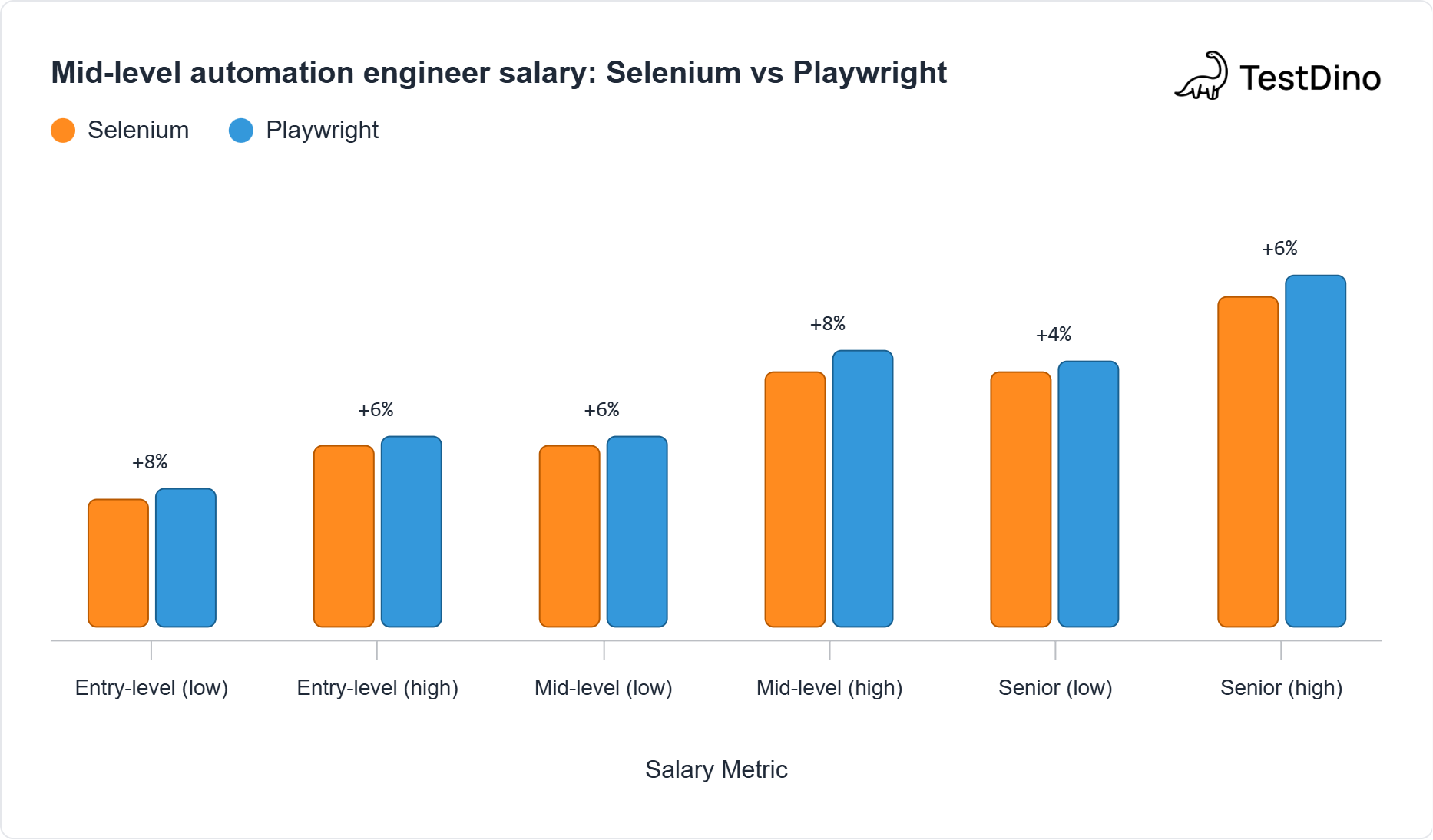
US salary data
| Experience level | Selenium | Playwright | SDET (any tool) |
|---|---|---|---|
| Entry-level (0-2 years) | $60,000-$85,000 | $65,000-$90,000 | $67,000-$97,000 |
| Mid-level (3-6 years) | $85,000-$120,000 | $90,000-$130,000 | $97,000-$131,000 |
| Senior (6+ years) | $120,000-$155,000 | $125,000-$165,000 | $131,000-$184,000 |
Sources: PayScale, Glassdoor, ZipRecruiter, Refonte Learning, 2025-2026.
India salary data
| Experience level | Selenium | Playwright | Both tools |
|---|---|---|---|
| Entry-level | ₹3.5-6.0 LPA | ₹4.0-7.0 LPA | ₹5.0-8.0 LPA |
| Mid-level (3-6 years) | ₹7.0-12.0 LPA | ₹8.0-14.0 LPA | ₹10.0-16.0 LPA |
| Senior (6+ years) | ₹12.0-20.0 LPA | ₹15.0-25.0 LPA | ₹18.0-30.0 LPA |
Sources: Naukri, Glassdoor India, Varnik Technologies analysis, 2025-2026.
A pattern emerges. Playwright roles pay 5-15% more than equivalent Selenium roles. This makes sense. Newer skills with fewer qualified candidates command a premium. The same happened as teams moved from jQuery to React, from bare metal operations to Kubernetes, and from JavaScript to TypeScript.
UK and Europe
Lorien's 2025 UK Salary Survey reports:
- SDETs in the UK command £60,000-£90,000+ annually
- DevOps Engineering leads: £80,000-£110,000
- AI-focused testing roles show the highest premium, with daily contractor rates reaching £600-£900
Jobs by region: where the demand is
Test automation hiring is global, but the concentration varies.
United States
The US remains the largest market for automation testing jobs. The Bureau of Labor Statistics reported 1,897,100 job vacancies for software developers, QA analysts, and testers in 2023. The US testing market has continued expanding since then.
Key stats:
- 450,000+ testing jobs total (Gitnux, 2026)
- 35% automation adoption rate across enterprises
- Top hiring cities: New York, Dallas, Austin, San Francisco, Chicago, Charlotte, Atlanta, Plano
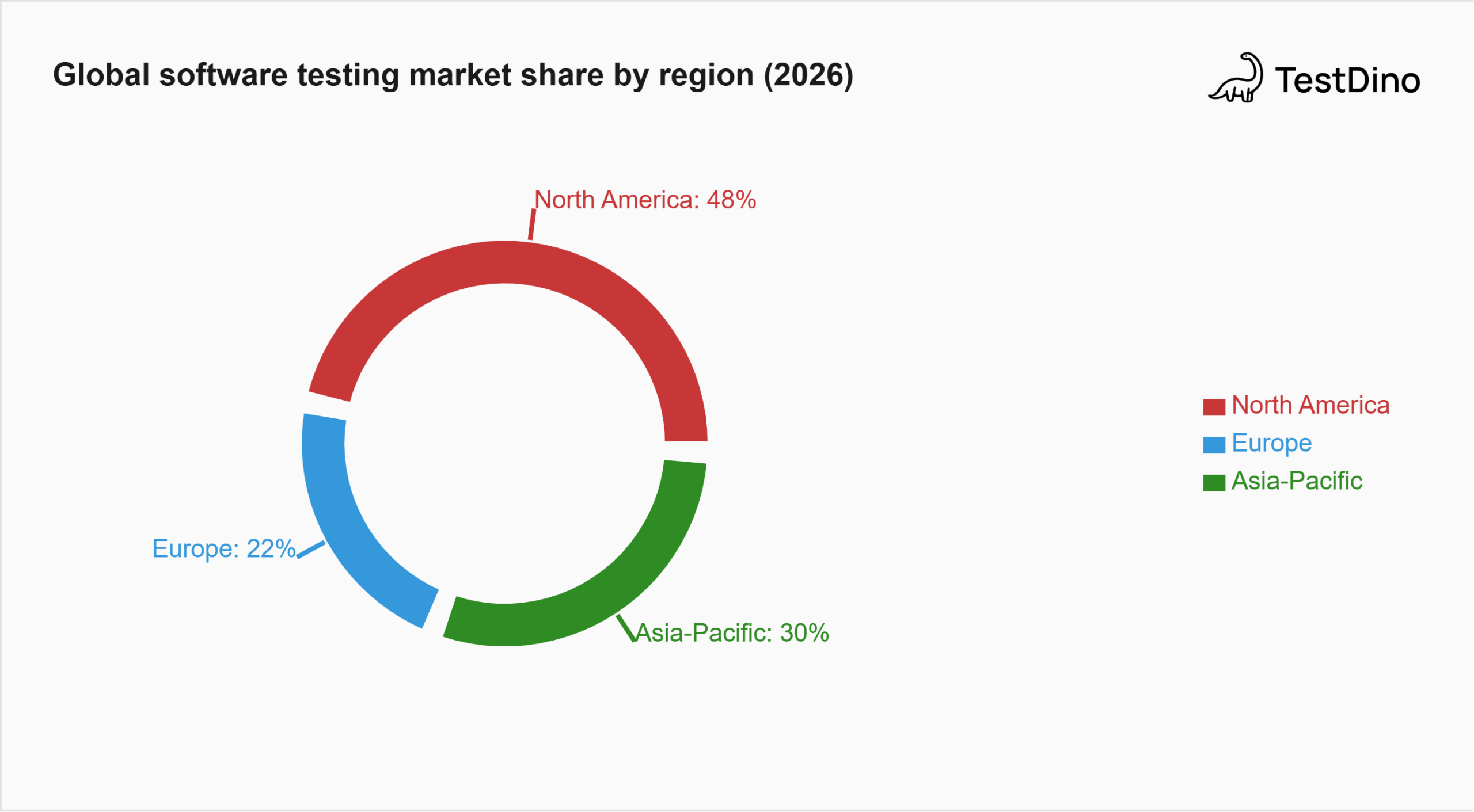
- North America holds 48.1% of the global software testing market share (Research Nester, 2026)
India
India is the world's largest QA talent pool. The IT services industry drives most of the volume.
- $5.2 billion testing market, 12% of global share (Gitnux, 2026)
- 2,496 Playwright job vacancies on Naukri (Feb 2026)
- 1,000+ Playwright roles on LinkedIn India
- Top cities: Bangalore, Hyderabad, Pune, Chennai, Noida
- Major employers: TCS, Infosys, Wipro, HCL, Cognizant, plus thousands of startups
Entry-level Selenium testers in India start around ₹3.5-6.0 LPA. Senior engineers with both Selenium and Playwright can reach ₹18-30 LPA, especially in product companies.
Europe
- UK: QA services market worth $2.3 billion in 2023 (Gitnux, 2026). AI-related job postings surged 70% year-over-year (Lorien, 2025)
- Germany: Automation testing leader in Europe with 28% share (Gitnux, 2026). Strong demand in automotive (BMW, Daimler) and enterprise tech (SAP, Siemens)
- France: 92% accessibility testing compliance requirement creates specialized demand
- Europe overall accounted for $3.26 billion (22%) of the automation testing market in 2026 (Global Growth Insights, 2026)
Asia-Pacific (excluding India)
Asia-Pacific is the fastest-growing region in automation testing, with 20% CAGR projected through the 2030s (Precedence Research).
- China: Testing market at 10.5% CAGR, projected to hit $8.1 billion by 2030
- Japan: Mobile testing dominant at $2.8 billion market
- Australia/Singapore: Growing Playwright adoption in fintech and gov-tech sectors
Top industries hiring automation testers
Which industries post the most automation testing jobs? Based on job board analysis and the testing industry statistics report, here are the top six:
| Industry | Why they hire | Typical tools |
|---|---|---|
| IT Services / Consulting | Client projects, outsourced QA | Selenium (dominant), Playwright (growing) |
| Banking / Financial Services (BFSI) | Regulatory compliance, transaction testing | Selenium, Java-based frameworks |
| Software / SaaS | Product quality, CI/CD pipelines | Playwright, Cypress |
| Healthcare / Insurance | HIPAA compliance, claims processing | Selenium, API testing tools |
| E-commerce / Retail | Checkout flows, payment testing | Playwright, Cypress |
| Automotive / Manufacturing | Embedded systems, connected vehicle apps | Selenium, specialized tools |
BFSI is expected to grow at the highest CAGR in automation testing through 2034 (Fortune Business Insights, 2026). Banks move slowly, but they move big. A single banking automation project can generate 20-50 testing roles.
For teams in regulated industries who need strong test reporting capabilities, the combination of framework choice and reporting tooling matters as much as the framework itself.
Co-occurring skills: what else employers want
Knowing Selenium or Playwright isn't enough. Job postings in 2026 consistently require a broader skill set.
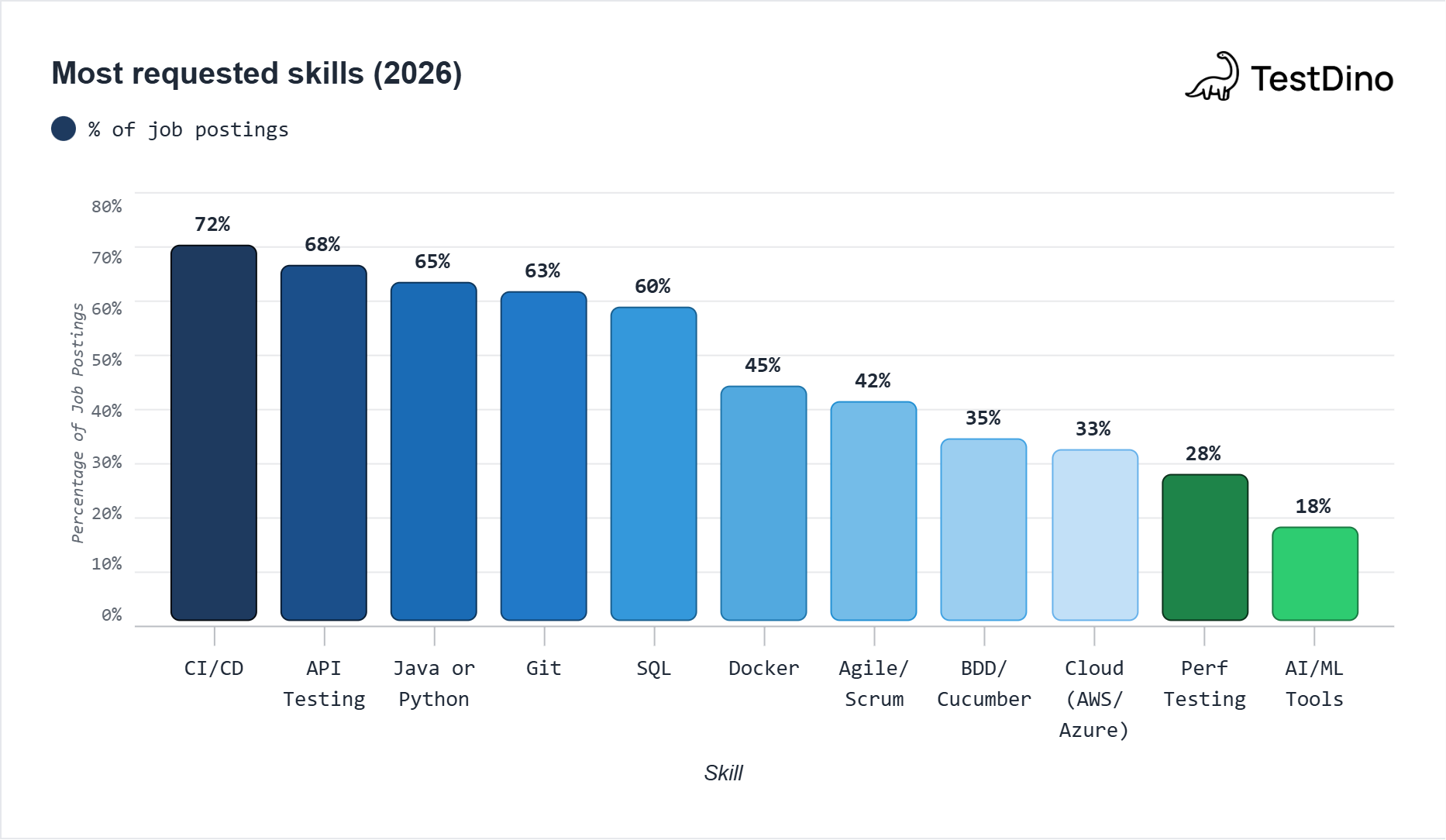
Here are the top co-occurring skills we found by analyzing job postings on Built In, Indeed, and ZipRecruiter:
Must-have skills (appear in 60%+ of postings):
- CI/CD pipelines (Jenkins, GitHub Actions, GitLab CI)
- API testing (Postman, REST Assured)
- Programming language (Java, Python, JavaScript/TypeScript)
- Git and version control
- SQL and database testing
Frequently requested (appear in 30-60% of postings):
- Docker and containerization
- Agile/Scrum methodology
- Cucumber / BDD frameworks
- Performance testing (JMeter, k6)
- Cloud platforms (AWS, Azure, GCP)
Emerging skills (growing fast in 2025-2026):
- AI/ML tool proficiency (prompting, AI test generation)
- Kubernetes
- Playwright MCP integration
- Security testing
- Observability and monitoring
Tip: The highest-paying automation roles (SDET, Automation Architect) almost always require Docker and CI/CD skills alongside the testing framework. If you're learning Playwright, pair it with GitHub Actions and Docker. The Playwright CI/CD integration guide covers this setup.
JetBrains' 2025 CI/CD Survey found that 62% of developers use GitHub Actions for personal projects and 41% in organizational settings. Frameworks with native GitHub Actions support (such as Playwright) are increasingly preferred in job requirements.
The 55% labor shortage problem
Here's the stat that should concern hiring managers.
Global Growth Insights (2026) reports that 55% of QA teams face skilled labor shortages in automation testing. Another 44% experience a high workload, and 70% struggle with the complexity of tool integration.
This shortage creates a few downstream effects:
- Salaries keep rising. When supply can't meet demand, pay goes up. SDET salaries have climbed steadily from a median of $90,000 in 2023 to $96,545-$145,801 in 2026, depending on the source and title definition.
- Multi-framework fluency commands a premium. Engineers who know both Selenium and Playwright (or Playwright and Cypress) earn 15-25% more than single-framework specialists. The Indian salary data shows this clearly: dual-tool engineers reach ₹18-30 LPA vs ₹12-20 LPA for Selenium-only.
- AI-assisted testing fills the gap partially. Playwright's AI codegen capabilities and AI test generation tools are being adopted specifically to address the shortage. The World Quality Report 2025 found 58% of enterprises are upskilling QA teams in AI.
- Offshoring increases. India's testing market ($5.2 billion, 12% global share) continues to grow precisely because US and European companies can't fill roles domestically.
For teams trying to get more out of their existing test suites without hiring additional engineers, test analytics platforms that surface failure patterns and flaky tests can significantly reduce the manual debugging load.
Framework selection matters for your career
The data in this report point to a few career decisions worth making now.
If you're starting: Learn Playwright first. The job count is growing fastest, the salary premium is real, and the skill transfers well to modern CI/CD workflows. Pair it with TypeScript and GitHub Actions.
If you know Selenium: Don't abandon it. Add Playwright to your toolkit. The dual-skill premium (15-25% higher salary) is the fastest way to increase your earning potential without changing jobs.
If you're hiring: Require Playwright for new projects. List Selenium as "preferred" for legacy maintenance. And invest in CI/CD and Docker skills, not just the framework itself. The Playwright automation checklist can help structure your team's onboarding.
If you're in India: Both tools matter. Selenium dominates IT services contracts. Playwright dominates product company roles. The highest salaries (₹18-30 LPA) go to people who know both plus CI/CD tooling.
Frequently asked questions

Jashn Jain
Developer Advocate