
Appium Market Share in 2026: Usage Stats, Adoption Data & Trends
Learn Appium market share in 2026, adoption signals, GitHub activity, job demand, and comparisons with Maestro and Detox.

Mobile apps run on thousands of different devices. Testing them manually is slow, expensive, and impossible to scale.
That's where Appium comes in.
Appium is the most widely used open-source framework for mobile test automation. It lets teams write one set of tests and run them on both Android and iOS without changing the app's code.
But how big is Appium's actual market share in 2026? Is it still the default choice, or are newer tools catching up?
The numbers tell a clear story. Appium holds a 4.61% share of the testing and QA market, with 9,865+ companies using it globally (6sense).
This article breaks down every data point that matters: enterprise adoption, GitHub and npm metrics, the mobile testing market size, job data, competitor comparisons, and where Appium is headed. All sourced, all verified.
What is Appium market share?
Appium market share refers to Appium's relative adoption among mobile testing and QA tools. It's measured by enterprise usage tracking, npm download volume, GitHub activity, job postings, and developer survey responses.
Appium supports Android, iOS, Windows, macOS, and TV platforms. That broad compatibility is what drives its market position.
Unlike platform-specific tools (Espresso for Android, XCUITest for iOS), Appium uses the W3C WebDriver protocol to interact with apps through a single interface, regardless of platform. This means one test codebase can cover multiple platforms.
That's why enterprise teams gravitate toward it. Building separate test suites for each platform costs more and takes longer. Appium eliminates that.
Where Appium sits in the testing & QA market
6sense tracks 46 tools in the testing and QA category. Appium ranks #7 overall. Here's the competitive landscape:
| Tool | Domains | Market Share (%) |
|---|---|---|
| Bugzilla | 55,362 | 25.86 |
| Selenium | 49,358 | 23.06 |
| Azure Test Plans | 35,839 | 16.74 |
| JUnit | 23,218 | 10.85 |
| Playwright | 12,764 | 5.96 |
| Zephyr | 10,688 | 4.99 |
| Appium | 9,865 | 4.61 |
Note: This table compares Appium against ALL testing and QA tools, not just mobile testing tools. Bugzilla is a bug tracker, JUnit is a unit testing framework, and Azure Test Plans is a test management platform.
In the mobile-specific testing category, Appium has no close open-source competitor with the same breadth of platform support.
Enterprise adoption data
How many companies use Appium?
Three independent trackers give us verified numbers:
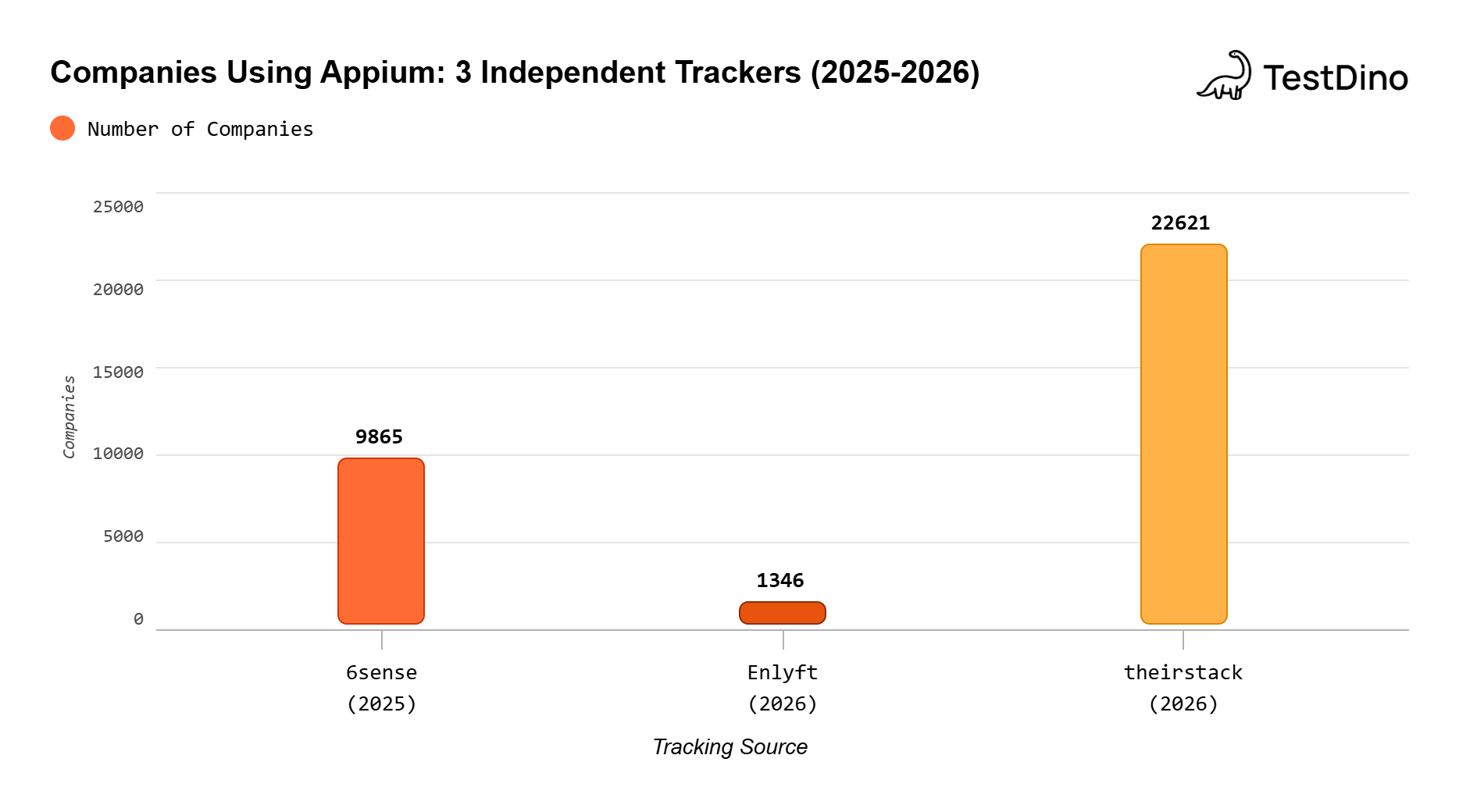
| Source | Companies Using Appium | Key Detail |
|---|---|---|
| 6sense, 2026 | 9,865 | 4.61% of the testing & QA market |
| Enlyft, 2026 | 1,346 | 0.42% of the software testing tools market |
| theirstack, 2026 | 22,621 | Enriched company data with firmographics |
The variance reflects different tracking methodologies and market definitions. 6sense and theirstack cast wider nets. Enlyft uses stricter verification criteria.
Note: The gap between 1,346 and 22,621 might seem confusing. Different trackers define "using" differently.
Enlyft counts companies with deep, verified adoption.
theirstack tracks job posting signals (if a company posts a job mentioning Appium, they count it).
6sense uses a mix of web scanning and technology detection. The real adoption number is somewhere in the middle.
Notable enterprise users include Amazon, Accenture, GE, Huawei Technologies, Capgemini, Cognizant, Infosys, EPAM Systems, EY, Renault SA, BlackBerry, Bath & Body Works, Mercado Livre, and Swisscom AG (6sense, theirstack, CheckThat.ai).
Geographic distribution
Appium adoption mirrors the global software development footprint:
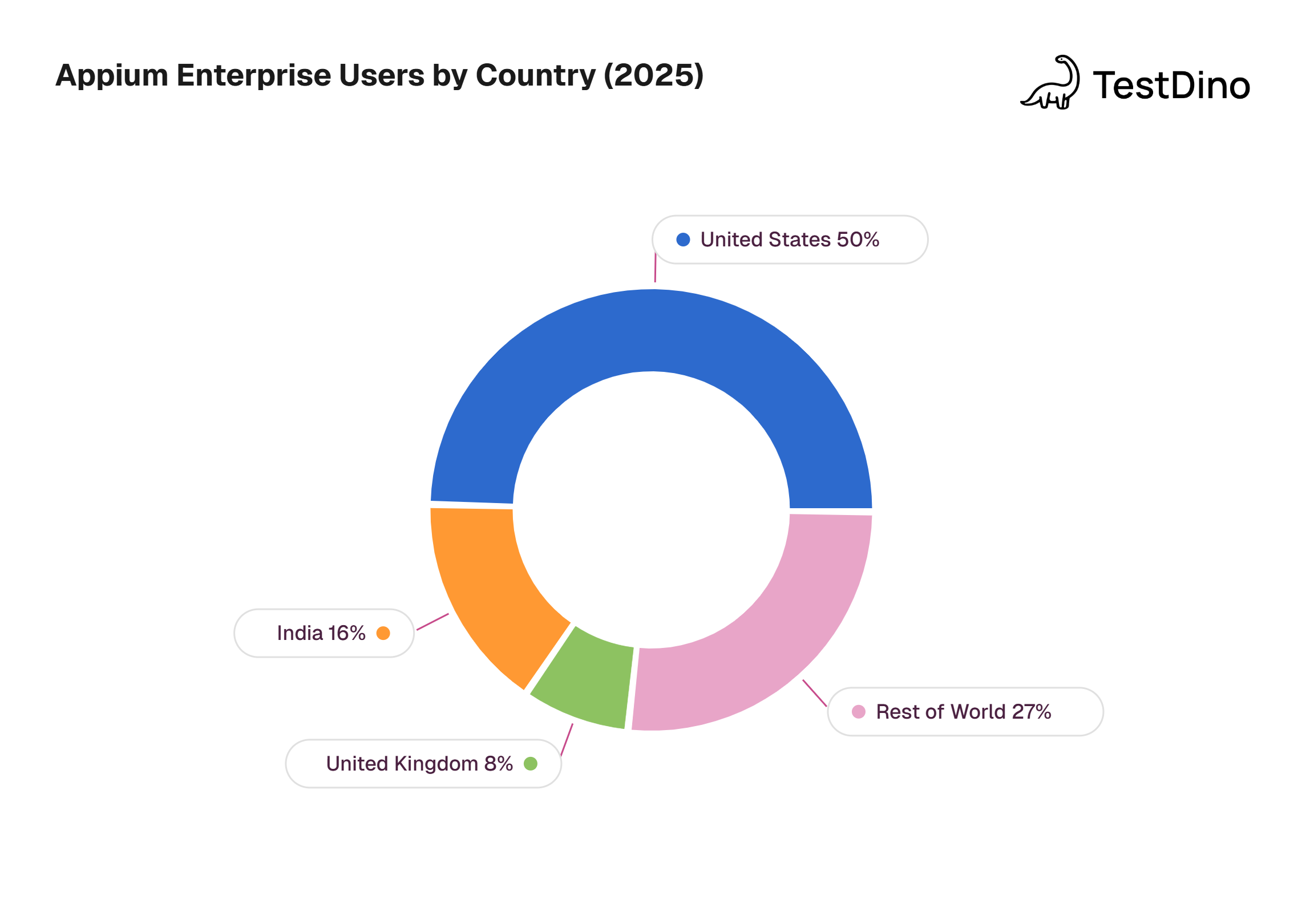
| Country | Share (%) | Companies |
|---|---|---|
| United States | 50.02 | 3,495 |
| India | 15.76 | 1,101 |
| United Kingdom | 7.66 | 535 |
| Brazil | 6.93 | 484 |
| Canada | 5.18 | 362 |
| Rest of World | 14.45 | ~1,888 |
Source: 6sense, 2026
Enlyft data tells a similar story: 49% US, 11% India (Enlyft, 2026). theirstack shows a broader global footprint: US 4,301, India 1,059, UK 694, Canada 388, France 329, Spain 288 (theirstack, 2026).
The US dominance makes sense. North America holds 37.10% of the global mobile app testing services market (Mordor Intelligence, 2026), and the largest tech companies are headquartered there.
Company size distribution
Who actually uses Appium? Mostly mid-size and large companies.
| Company Size (Employees) | Companies (6sense) |
|---|---|
| 20 - 49 | 1,271 |
| 100 - 249 | 2,360 |
| 250 - 499 | 1,215 |
| 1,000 - 4,999 | 1,534 |
| 10,000+ | 1,372 |
Source: 6sense, 2026
Enlyft breaks it down differently: 43% large enterprises (1,000+ employees), 38% medium-sized, and 17% small (Enlyft, 2026).
Key Insight: The 100-249 employee segment is the single largest adopter. These are fast-growing companies with enough mobile traffic to need automated testing but not enough headcount to build platform-specific test suites. Appium's "write once, run anywhere" approach fits perfectly.
Industry breakdown
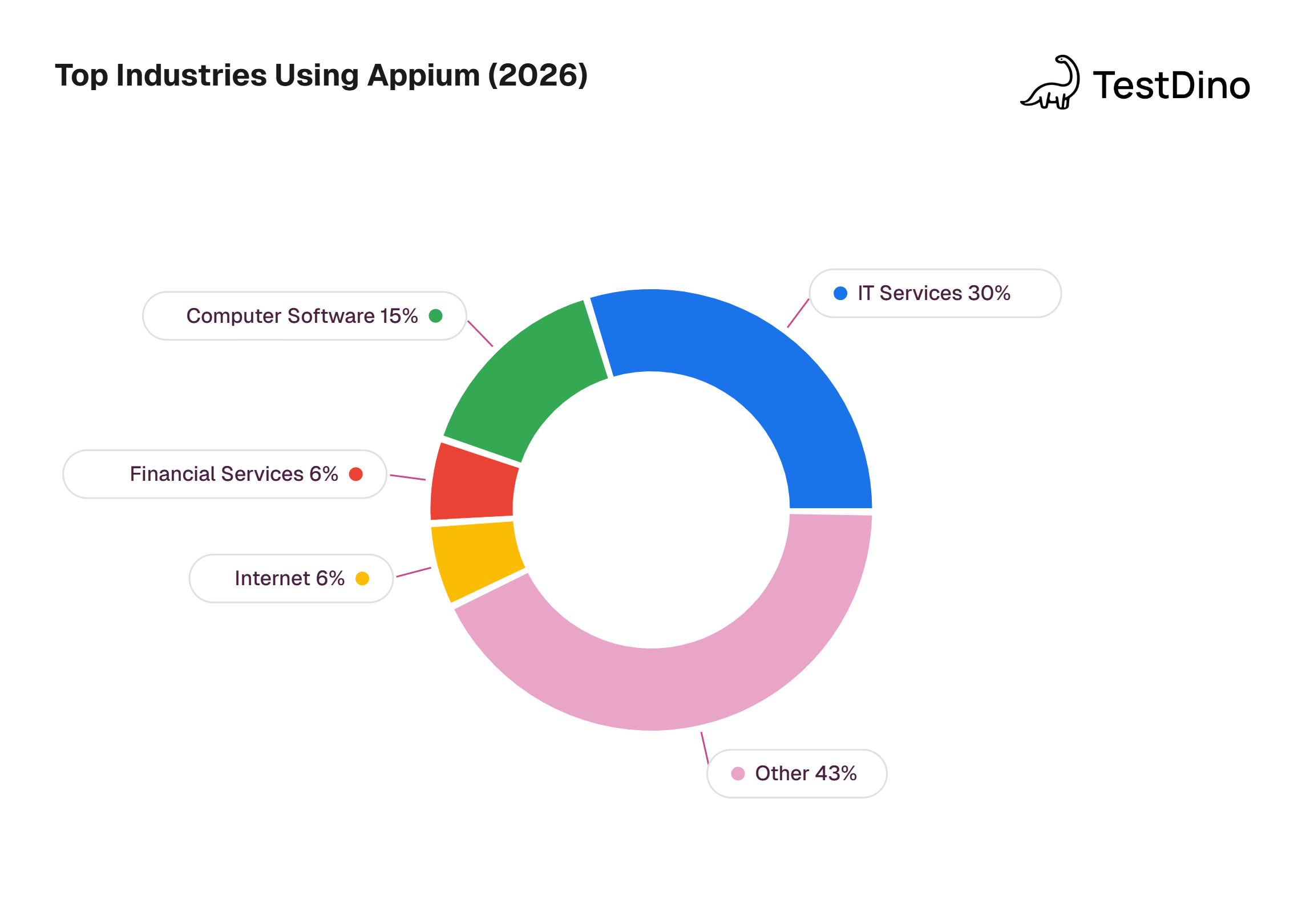
| Industry | Share (%) |
|---|---|
| IT Services | 30 |
| Computer Software | 15 |
| Financial Services | 6 |
| Internet | 6 |
| Other | 43 |
Source: Enlyft, 2026
6sense tracks by products/services offered, showing a different cut: Software Development (503 companies), Digital Transformation (291), Cloud Services (258), Data Analytics (253), and Web Development (239) (6sense).
IT Services leads because outsourced QA firms build Appium frameworks for multiple clients. Financial services are notable because banking apps require rigorous cross-platform testing to ensure regulatory compliance.
GitHub metrics and community data
Repository statistics
The official Appium GitHub repository shows strong community engagement as of March 2026:
-
GitHub Stars: 21,273+
-
Forks: 6,300+
-
Contributors: 356
-
Latest Version: v3.2.2 (March 2026)
-
Primary Language: TypeScript (78.1%), JavaScript (20.8%)
-
Used by: 7,500+ repositories
-
Watchers: 855
-
Total Releases: 1,544
The related ecosystem is also substantial:
-
Appium Inspector : 1,700+ stars, actively maintained
-
Appium Desktop (archived): 4,500+ stars
-
Appium Flutter Driver : 514 stars
Comparative GitHub analysis
How does Appium stack up against other mobile testing frameworks?
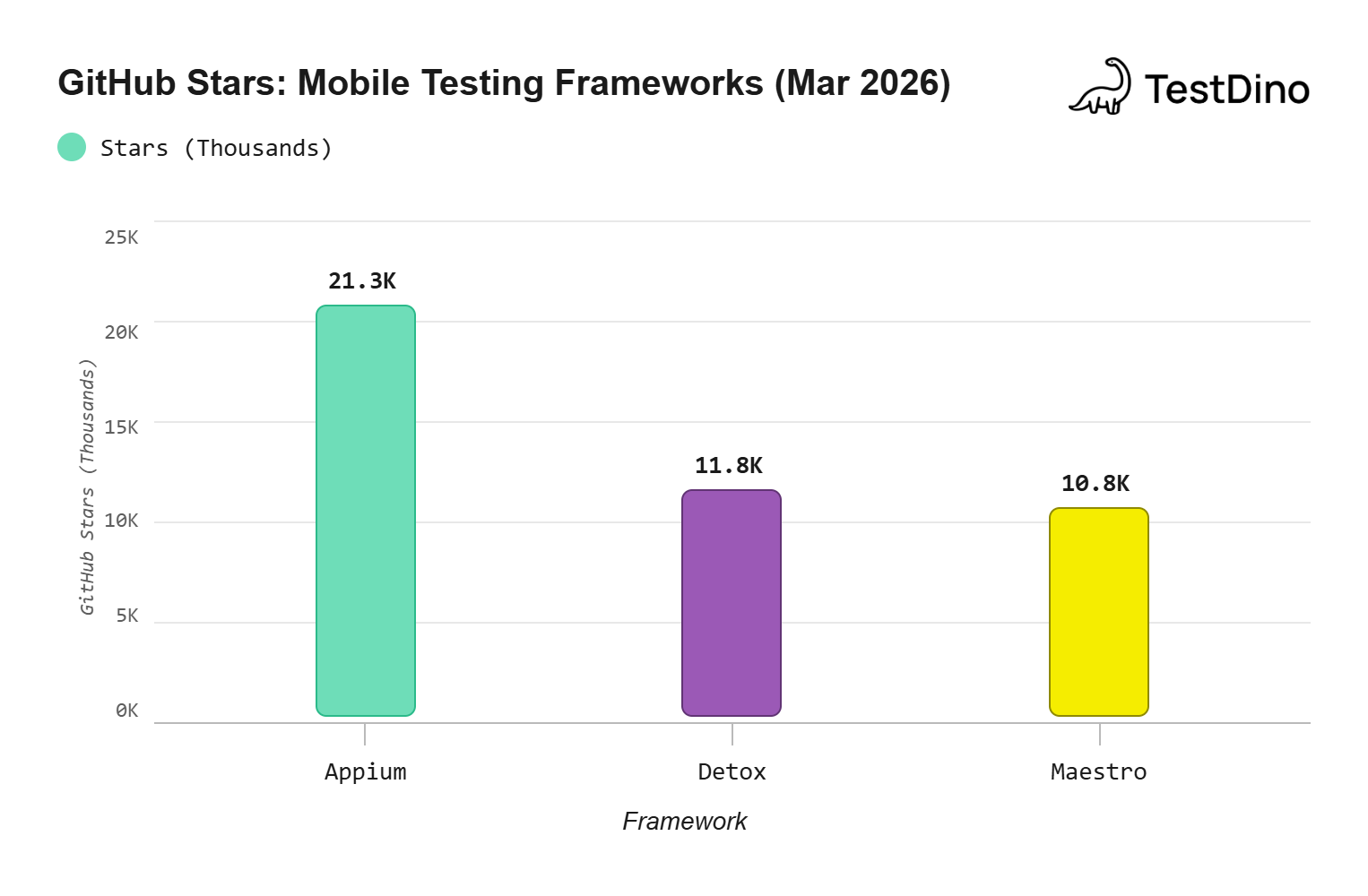
| Metric | Appium | Detox | Maestro |
|---|---|---|---|
| GitHub Stars | 21,273 | 11,845 | 10,800+ |
| Forks | 6,300+ | 1,100+ | 600+ |
| Platform Support | Android, iOS, Windows, macOS, TV | Android, iOS (React Native only) | Android, iOS |
| Language | Multi-language (Java, Python, JS, Ruby, C#) | JavaScript | YAML (codeless) |
| App Types | Native, Hybrid, Mobile Web | React Native only | Native, Hybrid |
| Testing Approach | Black-box | Gray-box | Black-box |
Sources: npm trends, Maestro
Appium leads in stars and forks by a wide margin. More importantly, it's the only framework on this list that supports all app types across all major platforms and provides multi-language bindings.
Download data
npm (JavaScript ecosystem)
The appium package on npm gets between 440,000 and 665,000 weekly downloads, depending on the measurement period. Here's how it compares:
| Package | Weekly Downloads | GitHub Stars |
|---|---|---|
| Playwright | 25,903,287 | 80,200+ |
| Cypress | 6,318,754 | 48,899 |
| selenium-webdriver | 2,024,173 | 34,100 |
| Appium | 832,908 | 21,273 |
| Detox | 438,938 | 11,845 |
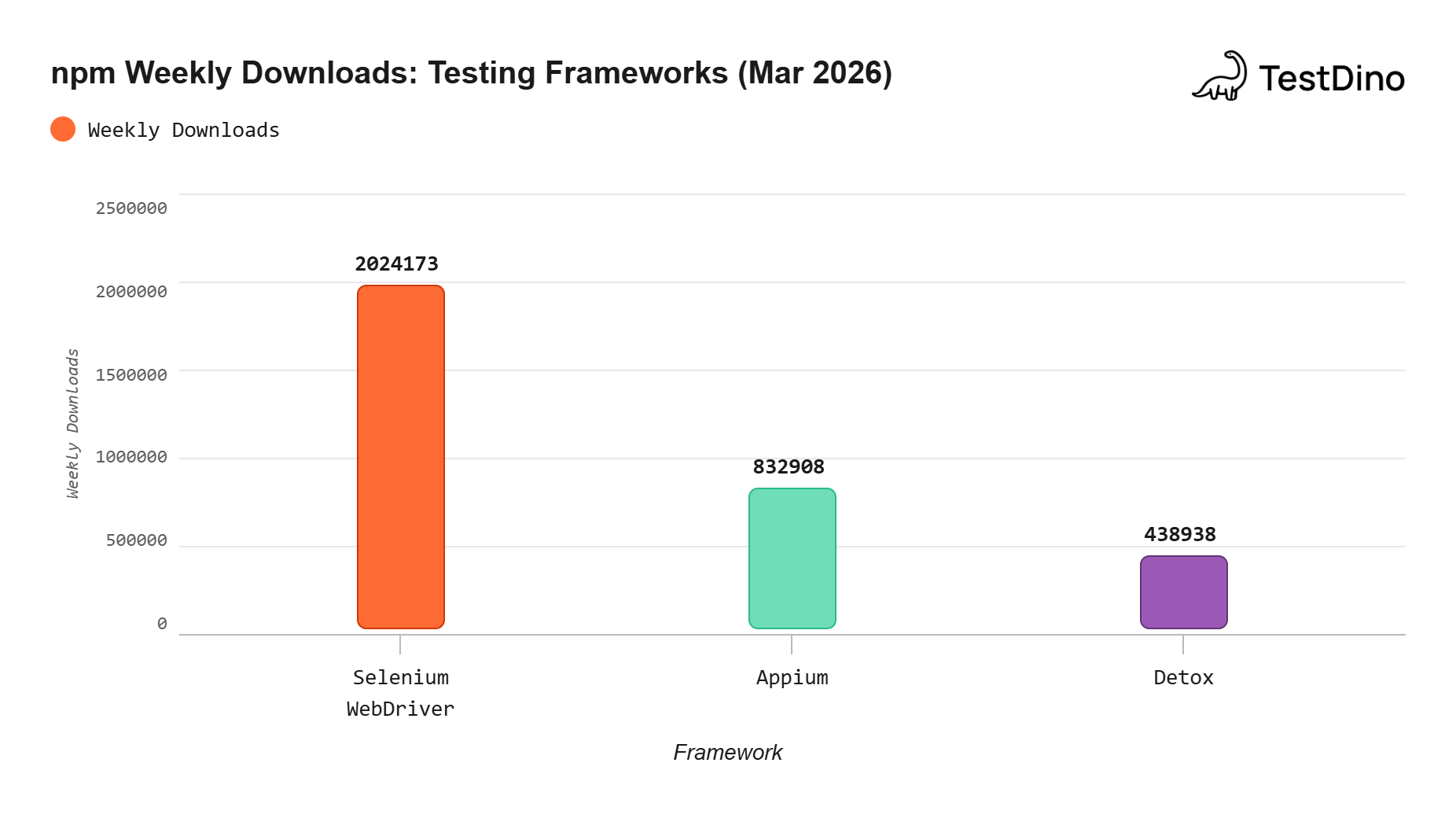
Appium's npm numbers look modest compared to Playwright or Cypress. But there's an important reason.
Appium's primary user base is Java and Python, not JavaScript. The npm package is the Appium server itself, not the client. Teams using Java (the most popular language for Appium tests) install Appium via npm but write tests with the Java client library. So npm captures infrastructure installs, not total end-user adoption.
Note: Comparing Appium npm downloads to Playwright npm downloads may be misleading.
Playwright is a JavaScript-first framework where npm is the primary distribution channel. Appium's npm is just the server.
The actual test clients are distributed via Maven (Java), PyPI (Python), and RubyGems (Ruby).
Job market data
US job market
Multiple job boards confirm steady demand for Appium skills:
| Source | Appium Job Postings (US) | Date |
|---|---|---|
| ~992 | Mar 2026 | |
| Indeed | 1,603 | Mar 2026 |
| ZipRecruiter | 500+ | Feb 2026 |
Pay ranges for Appium-related roles:
-
ZipRecruiter: $29 - $96/hr (ZipRecruiter, 2026)
-
QA Automation Engineer avg: $116,921/year (Glassdoor, 2025)
-
Software QA Engineer avg: $105,386/year (Glassdoor, 2026)
India job market
India shows strong Appium demand, driven by its massive IT services sector:
- Naukri: 1,857 Appium job vacancies (Naukri, Feb 2026)
This is expected. IT services firms (Infosys, Cognizant, EPAM, Globant) are the largest adopters of Appium, and India is their primary talent base.
How Appium jobs compare to web testing frameworks
| Framework | LinkedIn Jobs (US) | Type |
|---|---|---|
| Selenium | ~10,000 | Web |
| Playwright | ~4,500 | Web |
| Appium | ~992 | Mobile |
| Cypress | ~3,500 | Web |
Sources: LinkedIn Jobs, March 2026. Numbers approximate based on search results.
Appium's lower job count isn't a weakness. It reflects market size. Mobile-specific test automation is a smaller slice of the overall QA job market. But Appium completely dominates that slice.
Appium vs competitors: Mobile testing framework comparison
The mobile testing framework lineup
The mobile testing space in 2026 has more options than ever. Here's how they compare:
| Feature | Appium | Maestro | Detox | Espresso | XCUITest |
|---|---|---|---|---|---|
| Platform | Android, iOS, Windows, macOS, TV | Android, iOS | Android, iOS (React Native) | Android only | iOS only |
| App Types | Native, Hybrid, Web | Native, Hybrid | React Native | Native | Native |
| Languages | Java, Python, JS, Ruby, C# | YAML (codeless) | JavaScript | Java/Kotlin | Swift/ObjC |
| Testing Type | Black-box | Black-box | Gray-box | Gray-box | Gray-box |
| Setup Complexity | High | Low | Medium | Low | Low |
| Maintenance | High | Low | Medium | Low | Low |
| Speed | Slower | Fast | Fast | Very Fast | Very Fast |
| Learning Curve | Moderate | Very Low | Moderate | Moderate | Moderate |
| Open Source | |||||
| CI/CD Support | All major CI tools | All major CI tools | All major CI tools | Android Studio CI | Xcode Cloud |
Sources: Maestro, 2026, QA Wolf, 2025, Panto.ai, 2026
When to choose what
- Choose Appium if you need cross-platform coverage (Android + iOS), support multiple app types (native, hybrid, web), or your team works in Java/Python
- Choose Maestro if you want a fast setup with minimal code, and your team is smaller or less technical
- Choose Detox if you're building a React Native app and want fast, stable tests with tight integration
- Choose Espresso/XCUITest if you only target one platform and want the fastest possible execution
Tip: Most large teams don't pick just one.
The common pattern is Appium for cross-platform end-to-end regression tests and Espresso/XCUITest for fast unit-level UI tests during development.
Think of it like using both a highway (Appium, broad coverage) and local roads (native tools, fast shortcuts).
Speed benchmarks
Native frameworks are significantly faster than Appium because they run inside the app. Maestro is also faster since it uses a lightweight runner. Appium's overhead comes from the WebDriver protocol layer between the test and the app.
Typical execution times for a standard login-and-navigate flow:
| Framework | Execution Time (approx) |
|---|---|
| Espresso (Android native) | 3-5 sec |
| XCUITest (iOS native) | 4-6 sec |
| Maestro | 12-18 sec |
| Detox (React Native) | 8-12 sec |
| Appium | 25-40 sec |
Sources: Panto.ai, 2026, community benchmarks. Times vary by test complexity and device.
Appium is the slowest. That's the tradeoff for universal platform support. For teams that need coverage across both platforms from a single codebase, the speed difference is often acceptable because maintaining two entirely separate test frameworks is the alternative.
The mobile app testing market
Appium's market share exists within a fast-growing industry. Mobile apps aren't slowing down:
-
6.92 billion smartphone users globally (Global Growth Insights, 2025)
-
24,000+ distinct Android devices in the market (Global Growth Insights, 2025)
-
88% of users abandon an app after two instances of bugs or poor performance (42Gears, 2026)
-
320 billion+ app downloads projected annually by 2026 (ElectroIQ, 2026)
Market size projections
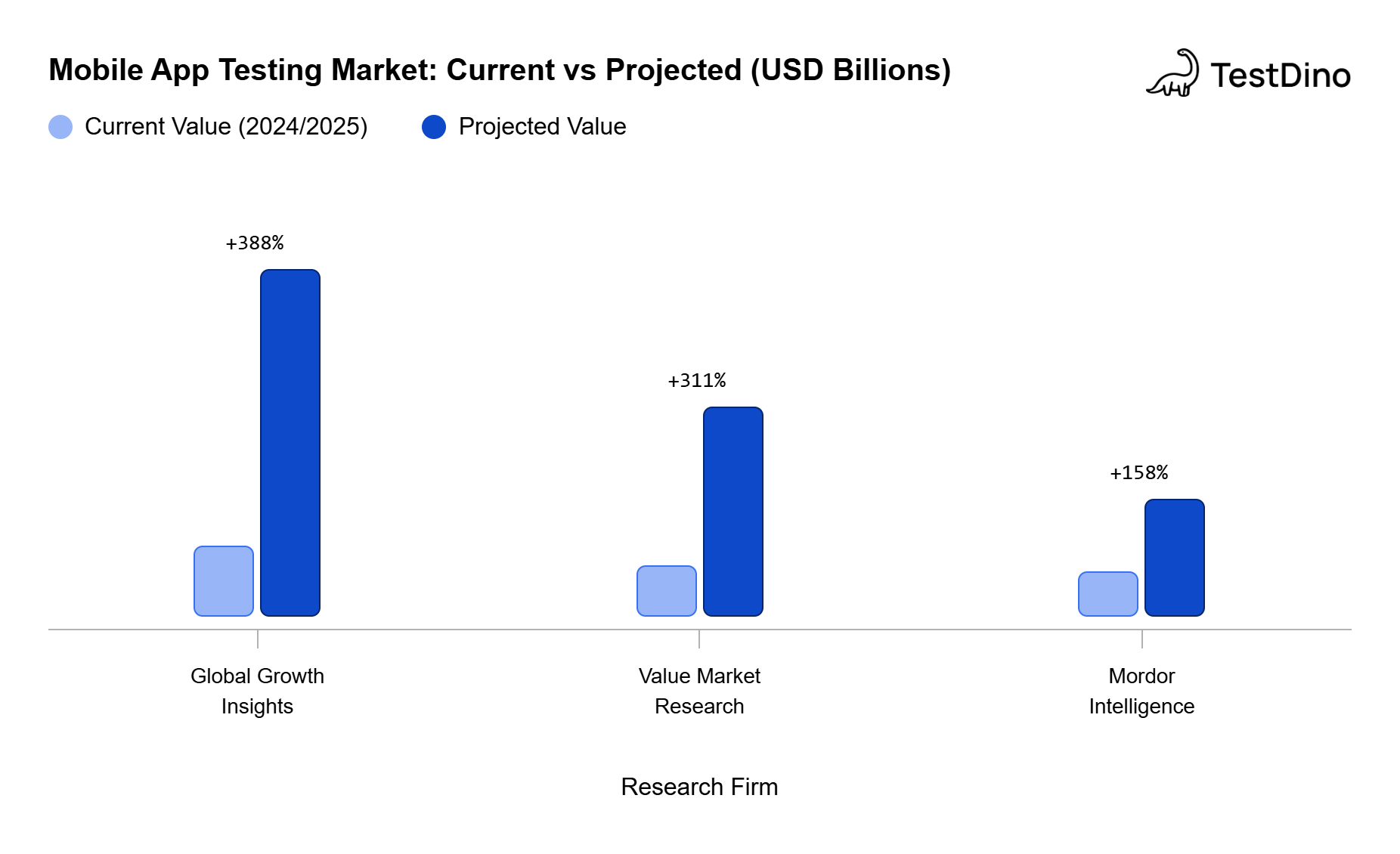
Multiple research firms track the mobile app testing market:
| Research Firm | Base Value | Projected Value | CAGR |
|---|---|---|---|
| Global Growth Insights | $11.93B (2025) | $58.22B by 2035 | 17.18% |
| Value Market Research | $8.53B (2025) | $35.1B by 2034 | 17.02% |
| Mordor Intelligence | $7.70B (2025) | $19.84B by 2031 | 17.09% |
| ImpactQA / Market Reports | N/A | $38.2B by 2033 | 14.2% |
All firms agree: the mobile testing market is growing at 14-17% annually.
What's driving growth
Several forces keep expanding the mobile testing market, and all of them benefit Appium:
- Device fragmentation: 24,000+ Android devices means you can't test on just a few. Automation is the only scalable answer.
- 5G rollout: An estimated 1.9 billion 5G subscriptions by 2026 are creating data-intensive apps that need more testing (Global Growth Insights, 2025).
- Cross-platform frameworks: React Native, Flutter, and .NET MAUI produce apps that run on both platforms. Teams need cross-platform testing tools to match.
- CI/CD adoption: Modern teams ship mobile updates weekly or even daily. Manual testing can't keep up.
Note: The broader automation testing market (not just mobile) is even larger. Fortune Business Insights values it at USD 20.60 billion in 2025, projecting USD 84.22 billion by 2034 at a 16.84% CAGR (Fortune Business Insights, 2026). Appium operates at the intersection of both the mobile testing and automation testing markets.
Appium 2.0 and 3.0: What changed
Appium isn't the same tool it was five years ago. The jump from Appium 1 to Appium 2 was a complete architecture overhaul.
Appium 2.0 introduced a modular architecture
In Appium 1, everything was bundled together. Drivers, plugins, and the server were all one package. That made updates slow and upgrades risky.
Appium 2.0 changed this fundamentally:
-
Pluggable drivers that install and update independently
-
Plugin ecosystem for extending functionality without forking the core
-
Independent versioning, so a driver update doesn't require a server update
-
W3C WebDriver standard compliance for a unified interface across platforms
This is like going from a monolithic phone (everything built in, nothing swappable) to a modular system where you can upgrade the camera without replacing the entire phone.
Appium 3.0 (current)
The latest release, v3.2.2 (March 9, 2026), continues refining the modular architecture (GitHub Releases).
Key additions:
-
Appium MCP (Model Context Protocol): Allows AI coding agents to interact with Appium directly
-
Improved extension management with symlink behavior across driver/plugin installations
-
Appium Inspector as a plugin instead of requiring a separate desktop app
Sponsorship and sustainability
Corporate sponsorships, not licensing revenue, sustain Appium:
| Sponsor | Role | Since |
|---|---|---|
| BrowserStack | Development & Strategic Partner | 2024 |
| TestMu AI (formerly LambdaTest) | Development & Strategic Partner | 2025 |
| HeadSpin | First Development Partner | 2024 |
| Sauce Labs | Premium Sponsor | 2013 |
Source: Appium Github repository, CheckThat.ai, 2026
This funding model ensures Appium stays free while compensating core contributors. In late 2025, LambdaTest rebranded to TestMu AI and deepened its partnership with Appium, signaling growing investment in the framework's long-term development.
Appium's challenges and limitations
Appium isn't perfect. Understanding its weaknesses helps teams make better tool choices.
The most common complaints from users (based on G2 reviews and community feedback):
-
Slow execution speed compared to native frameworks (Espresso, XCUITest)
-
Complex initial setup requiring Node.js, Appium server, platform-specific drivers, and SDK configurations
-
Test flakiness, especially with gesture-based tests and dynamic UI elements
-
High maintenance due to OS updates, device fragmentation, and driver compatibility
-
No built-in reporting. Appium requires third-party plugins or external test reporting tools for result analysis
Despite these issues, Appium earns 4.4/5 stars on G2 and 4.3/5 on Capterra. SoftwareReviews reports 87% of users would recommend it and 97% plan to continue using it (CheckThat.ai, 2026).
The pattern:
- Appium delivers on its cross-platform promise but requires ongoing investment in maintenance and infrastructure.
- Teams that treat Appium as a "set it and forget it" tool will struggle.
- Teams that invest in stable frameworks, page objects, and good debugging practices will succeed.
For teams dealing with flaky test issues in their mobile suites, the problems are similar to web automation. Dynamic waits, stable locators, and proper test isolation are the fundamentals.
However, even with these best practices, maintaining large-scale test suites can become resource-intensive as applications evolve and UI elements change frequently. This is where a newer category of tools is emerging.
AI-native platforms like Panto AI take a different approach by reducing reliance on selectors altogether and adapting to UI changes automatically. This can significantly lower test flakiness and ongoing maintenance effort for mobile teams.
Appium's evolving role: What the data says
Here's a summary of every signal we've covered:
| Signal | Status | Evidence |
|---|---|---|
| Enterprise Installed Base | Strong | 9,865-22,621 companies verified across three trackers |
| GitHub Activity | Strong | 21,273 stars, 356 contributors, v3.2.2 released Mar 2026 |
| npm Downloads | Moderate | ~833K/week and trending upward (server only, not full picture) |
| Job Market | Stable | ~1,600 US postings, 1,857 India postings |
| Competitor Pressure | Growing | Maestro and Detox are gaining traction |
| Speed vs Alternatives | Weak | 3-8x slower than native frameworks |
| Corporate Sponsorship | Growing | BrowserStack + TestMu AI + HeadSpin partnerships in 2024-2025 |
| Platform Coverage | Unmatched | Only tool covering iOS + Android + Windows + macOS + TV |
| Appium 2.0/3.0 Modernization | Positive | Modular architecture, plugin system, MCP support |
The bottom line: Appium isn't losing its market. But it's no longer the only option.
For cross-platform enterprise mobile testing, Appium remains the default. Nothing else matches its language support, platform coverage, and ecosystem maturity. But for teams with simpler needs, especially smaller teams or React Native shops, Maestro and Detox offer faster setup, lower maintenance, and comparable reliability.
The smart approach in 2026: use Appium for what it does best (broad, cross-platform regression suites) and supplement with native tools for speed-critical unit tests. Just like web testing teams often combine Playwright for new projects with Selenium for legacy suites, mobile teams are increasingly running dual frameworks.
FAQs

Jashn Jain
Developer Advocate