What Is a Software Factory? Definition, Benefits, and QA Guide
Discover how a software factory standardizes pipelines, automates quality gates, and transforms modern QA for the age of AI.
Software engineering teams are suddenly building features faster than anyone thought possible. New AI tools allow developers to generate thousands of lines of code in seconds, finishing massive projects almost overnight. This incredible speed feels like an unstoppable wave of progress that is completely changing how the industry operates.
The massive problem is that building fast does not mean building well. When mountains of code pile up every single day, human reviewers simply cannot read all of it. Dangerous mistakes easily slip through the cracks, and teams quickly realize that their old methods of checking work by hand are completely broken under this new speed.
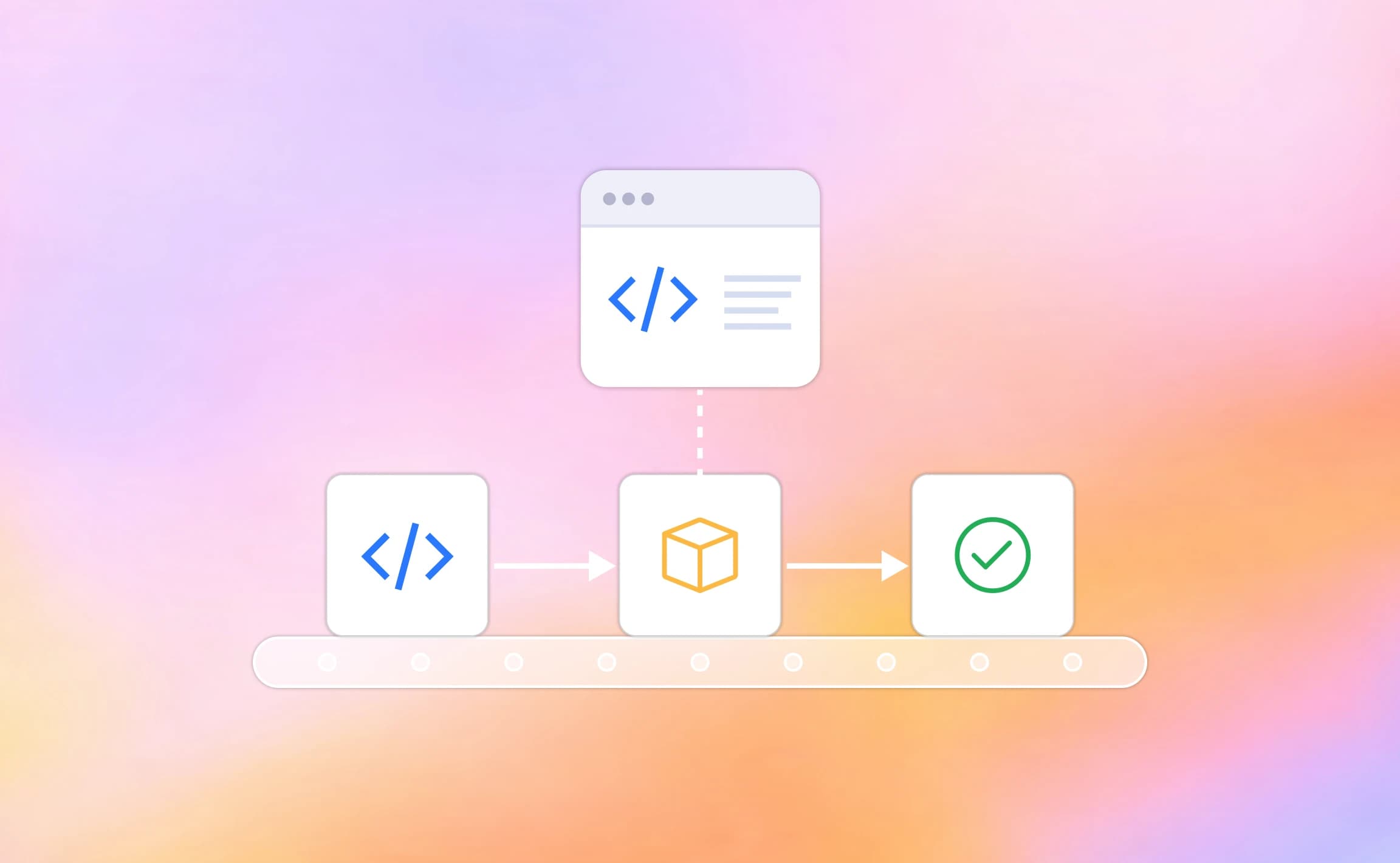
This guide will show you how to fix that problem by building a modern software factory. You will learn how to turn chaotic, unpredictable work into a smooth, automated assembly line. We will also show you how to set up automatic checks that guarantee every piece of software is safe before it ever reaches your customers.
What Is a Software Factory?
A software factory is a standardized, automated, and highly repeatable way to build and ship software. It utilizes templated pipelines, reusable components, and strict quality gates. This ensures output remains remarkably consistent and scalable regardless of which internal team builds the feature.
In practice, a modern software factory rests on a few critical building blocks. First, it requires strictly standardized CI/CD pipelines. Every single project must ship on the exact same paved road rather than a bespoke custom setup. Second, teams must rely entirely on reusable components and golden paths.
Third, you must implement automation everywhere. Your build, test, deploy, and provisioning stages must execute without human hand-offs. Fourth, objective governance and quality gates must be baked directly into the process. Finally, you must maintain deep observability over the line itself to monitor the health of the delivery process.

[notice_block bg="#EFF6FF" border="#BFDBFE" color="#1E40AF" icon=""]Definition: A software factory is an automated software assembly line that standardizes development, testing, and deployment to guarantee consistent quality at massive scale.[/notice_block]
The concept originated in large enterprise programs and platform engineering teams building internal developer platforms. However, the core idea is entirely universal. Standardizing how you build guarantees that consistency and speed naturally follow. You can see this shift documented heavily in the latest state of ai automation reports.
Core Components of a Software Factory
Every functioning factory is built on five foundational pillars. Missing any single one creates a weak point that breaks the entire line under pressure.
| Component | What It Does | Why It Matters |
|---|---|---|
| Templated CI/CD Pipelines | Standardized build and deploy paths every team inherits | Eliminates bespoke setups and configuration drift between projects |
| Reusable Components & Golden Paths | Shared libraries, starter kits, and approved architectural patterns | Prevents teams from reinventing the wheel on every project |
| Automated Testing Harness | Shift-left testing with quality gates on every pull request | Catches defects continuously instead of batching them before release |
| Policy-as-Code & Security Gates | Automated compliance checks, SBOM validation, and vulnerability scanning | Ensures security is verified automatically, not manually |
| Observability & Feedback Loops | Metrics flowing from production back into development | Creates a closed loop that continuously improves the factory output |
Standardized tooling is the thread connecting all five pillars. When every team uses the same testing framework, the same deployment scripts, and the same monitoring stack, you gain a shared language for quality. Without it, each project becomes its own island, and what you call a factory is really just a collection of disconnected workshops.
Infrastructure as Code (IaC) plays a critical role here. Your environments should be provisioned through code, not manual configuration. This makes the entire pipeline reproducible and auditable, which is essential for tracking your software supply chain.
Benefits of the Software Factory Approach
Adopting this model delivers measurable improvements across your entire engineering organization.
Faster time-to-market. Standardized pipelines eliminate the setup tax on every new project. Teams start shipping on day one instead of spending weeks configuring infrastructure.
Consistent quality across teams. When every project runs through identical quality gates, you stop worrying about which team built the feature.
Reduced manual toil. Automated hand-offs between stages free engineers from repetitive, error-prone manual work. This directly improves the developer experience (DevEx).
Scalable with AI-generated code. The pipeline handles machine-scale output the same way it handles human output. The gates do not care who wrote the code.
Measurable delivery health. You can track DORA metrics (deployment frequency, lead time for changes, mean time to recovery, and change failure rate) to prove your factory is actually working.
Improved security posture. Automated security gates catch vulnerabilities before merge. Software Bill of Materials (SBOM) validation ensures every dependency is verified.
Lower onboarding cost. New engineers inherit the factory pipeline on their first day. They do not need to learn a unique setup for each project.
Software Factory vs DevOps vs Platform Engineering
These three terms get confused constantly. They are related but describe different things at different levels.
| Aspect | DevOps | Platform Engineering | Software Factory |
|---|---|---|---|
| What it is | A culture of collaboration between development and operations | A discipline that builds internal tooling for developers | The standardized, automated delivery line itself |
| Primary focus | Breaking down organizational silos | Improving developer experience through self-service tools | Producing consistent, governed software at scale |
| Primary output | Shared responsibility and faster feedback | An Internal Developer Platform (IDP) | Repeatable, automated software production |
| Relationship | The cultural foundation | The team that builds the factory floor | The assembly line those practices produce together |
DevOps gives you the mindset. Platform engineering gives you the team. A software factory is what that team actually builds. You need all three, but the factory is the tangible, measurable system that delivers the results.
A common mistake is treating DevOps adoption as the finish line. DevOps without a factory is a philosophy without a product. Platform engineering without a factory is a team without a deliverable.
Why the Software Factory Is Required Now
The software factory is not a fundamentally new concept. However, the age of AI makes it urgently necessary today. When developers write every line manually, human effort rate-limits the output. When AI generates massive portions of the codebase, that human speed limit disappears entirely.
Three major components break down completely at AI scale. First, code review stops scaling. Reviewing machine-generated code takes significantly longer than writing it yourself. Consequently, reviewers scan instead of scrutinizing, allowing serious defects to slip into production.
Second, consistency erodes rapidly. Gathering more code from more sources faster inevitably creates architectural drift. You end up with conflicting design patterns and unpredictable failure modes. Finally, your green pipelines fill with tautological tests that pass without verifying anything. Saying a test passes stops meaning the software actually works.

Three critical risks at AI scale including review bottlenecks, consistency drift, and fake confidence in a software factory
Hand-crafting quality cannot keep pace with machine-scale output. A modern software factory answers this crisis by building an assembly line that produces quality by design. It ensures the incredible speed of AI does not cost you trust.
What a Software Factory Means for QA
In a true software factory, quality is built firmly into the pipeline itself. Testing stops being an isolated, manual phase right before a release. It becomes an automated, continuous system deciding exactly what ships to production. QA shifts from catching defects late to engineering the resilient system that prevents them.|

Comparison between manual Old QA at the end and continuous Factory QA inside a software factory pipeline

Tip: Treat your testing framework as a reusable component within your software factory. Every team should inherit the identical standardized testing setup.
This approach requires embracing shift-left, continuous testing. Automated tests must execute inside the pipeline on every single code change. You must enforce strict quality gates using objective thresholds for pass rates, flaky rates, and mutation scores to block bad builds automatically.
# An automated quality gate inside a software factory pipeline
jobs:
  quality-gate:
    runs-on: ubuntu-latest
    steps:
      - name: Enforce Test Health
        uses: testdino/quality-gate-action@v1
        with:
          max-flaky-rate: 2%
          min-pass-rate: 99%
Standardizing your test frameworks is completely non-negotiable. Testing must become a reusable asset rather than something engineers reinvent per project. You must track flaky test analysis just as rigorously as you track server uptime.
This forces the traditional QA role to evolve immediately. Professionals transition from manual gatekeepers into quality engineers who actively build and maintain the automated assembly line.
Before this shift, QA involved a person signing off at the very end. After this shift, QA involves a robust set of automated gates and health signals running continuously. You need reliable playwright test management tools to manage testing at this scale.
The Software Factory Monitoring Stack
You cannot safely operate a factory that you cannot see. A functional software factory demands deep observability at every single stage. Any blind spot in your pipeline is where your team's confidence will silently disappear.
The ultimate goal is creating a perfect end-to-end feedback loop. You must instrument the plan, build, test, release, and run phases meticulously. Each stage demands its own specific tooling to maintain consistently high standards.
| Factory Stage | What to observe | Representative tool |
|---|---|---|
| Pre-release / quality | Test health, flaky tests, quality gates | TestDino |
| Post-release / infrastructure | Errors, latency, uptime in production | Datadog |
| Users / product | User behavior, funnels, feature adoption | PostHog |

The three stages of software factory monitoring including TestDino, Datadog, and PostHog
These stages are highly complementary. Together, they provide absolute confidence during build, release, and runtime. The pre-release quality stage is currently the most affected by AI-scale output, making manual evaluation completely impossible.
You can calculate the massive hidden financial costs of manual test maintenance using the free Flaky Cost Calculator.
To stabilize the pre-release stage, platforms like TestDino evaluate each test run against highly configurable rules. They monitor maximum flaky rates and minimum pass rates continuously. The system posts these results directly as a mandatory GitHub Check Run.
// Standardized factory configuration for Playwright
export default {
  // Enforce consistent retries across all projects to accurately measure flakiness
  retries: process.env.CI ? 2 : 0,
  reporter: [['html'], ['testdino-reporter']],
};
This ensures a failing gate is highly visible in the pull request before any bad code merges. It computes flaky status directly from Playwright retry outcomes. If you are actively comparing playwright vs cypress, handling test retries gracefully is a critical decision factor.
Note: A test that fails and then passes on a retry is counted as flaky, not silently passed. A software factory must expose these hidden regressions.
A powerful factory platform compares runs and intelligently groups related failures. Consequently, one root cause does not read as forty separate breakages on your test failure analysis report. This creates the ultimate quality gate, feeding vital signals directly back into your test automation reporting loop.
If your teams generate tests using modern test generation strategies, establishing this automated line is essential. It permanently prevents the sudden influx of code from overwhelming your QA staff.
Adopting playwright best practices and implementing robust playwright locators are excellent first steps. However, without the broader factory pipeline, those local optimizations will eventually hit a severe operational bottleneck.
If you are exploring the broader playwright ai ecosystem, you absolutely need a factory capable of ingesting and validating that machine output securely.
How to Get Started with a Software Factory
You do not need to rebuild everything overnight. Start with these four steps and expand from there.
Step 1: Audit your current pipelines. Map every CI/CD configuration across your organization. Identify how many unique setups exist. The number will likely surprise you.
Step 2: Standardize on a single CI/CD template. Create one golden pipeline configuration that every new project inherits by default. This eliminates drift before it starts.
Step 3: Implement automated quality gates. Set objective thresholds for flaky rates, pass rates, and mutation scores. Wire them into your pipeline as mandatory checks that block merges when thresholds are violated. Platforms like TestDino test generation strategies make this straightforward.
Step 4: Build the monitoring stack. Connect pre-release quality (TestDino), post-release infrastructure (Datadog, Grafana), and user analytics (PostHog) into a single feedback loop. This gives you end-to-end visibility from code commit to user behavior.
Adopting playwright best practices and implementing robust playwright locators are excellent first steps for the testing layer. However, without the broader factory pipeline, those local optimizations will eventually hit a severe operational bottleneck.
If you are exploring the broader playwright ai ecosystem, you absolutely need a factory capable of ingesting and validating that machine output securely.
Conclusion
Testing and shipping software manually cannot keep up with AI-generated code. You must standardize your delivery pipelines so your raw speed does not compromise your quality. For modern QA teams, this means moving quality checks permanently into the pipeline itself. Enforce strict, automated gates and measure test health continuously to catch regressions before they reach your users.
FAQs

Savan Vaghani
Product Developer