JavaScript Testing Frameworks You Must Know in 2026
Not all testing tools are created equal. Discover the best JavaScript testing frameworks for unit, integration, and E2E coverage.
Very JavaScript project needs a way to check if the code actually works before it reaches users. A testing tool handles that job for you: it runs your code, checks the output, and tells you exactly what passed or failed, all before anything ships.
The landscape has shifted hard over the past two years. Vitest went from a newcomer to the highest-rated testing tool in developer satisfaction surveys. Playwright overtook Cypress in weekly npm downloads. Yet, in our experience consulting with hundreds of engineering teams, many are still stuck on legacy stacks from 2021. They are dealing with slow CI runs and flaky tests that nobody has time to fix.
This guide compares every major javascript testing frameworks available in 2026 with real adoption data, honest trade-offs, and working setup examples so you can make the right call for your architecture.
What is a JavaScript testing framework?
Definition: A JavaScript testing framework is a pre-built software environment that provides the necessary tools, APIs, and structure to write, execute, and review automated tests for JavaScript code. It typically includes a test runner, an assertion library, and mocking utilities.
It handles test discovery, assertion logic, mocking, and result output so you can focus on writing the actual test logic instead of building infrastructure around it. Whether you practice Test-Driven Development (TDD) or Behavior-Driven Development (BDD), these tools provide the foundation.
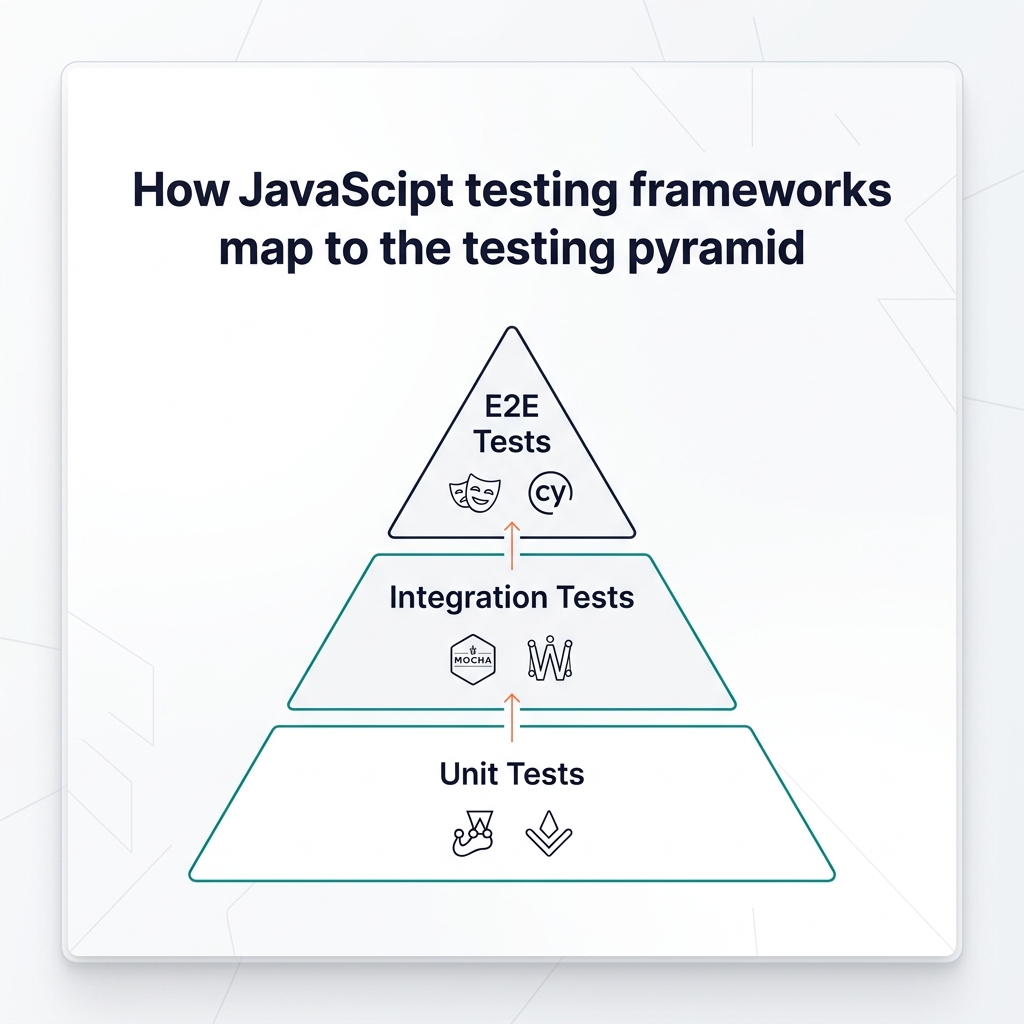
When it comes to JavaScript, types of software testing break down into three layers that matter most:
-
Unit tests check individual functions or modules in complete isolation.
-
Integration tests verify that multiple modules or services work together correctly.
-
End-to-end (E2E) tests simulate real user workflows inside an actual browser.
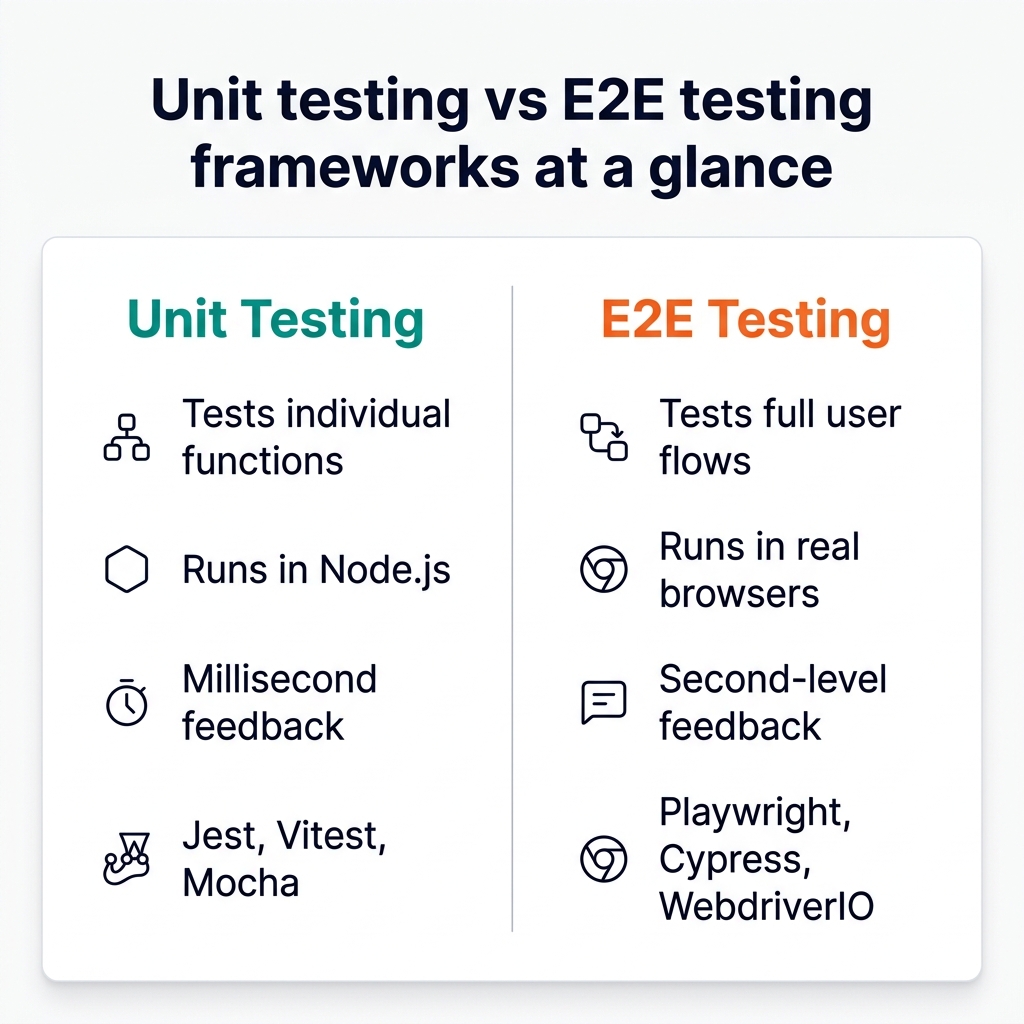
Each layer needs a different kind of tool. Jest and Vitest handle unit and integration testing well. Playwright and Cypress own the E2E space. The mistake we see most teams make is forcing one tool to cover everything, which leads to either painfully slow unit tests or unreliable browser coverage.
Understanding which framework fits which layer is the first step toward building a test suite that actually holds up over time.
The best JavaScript testing frameworks in 2026
Let's walk through each major framework in detail. We will start with JavaScript unit testing tools and then move into browser testing options.
Jest (v30.x)
Jest is maintained by Meta and remains the most widely used JavaScript test runner in the ecosystem. The State of JavaScript 2024 survey reported Jest usage by 7,262 respondents, more than any other testing tool.
It ships with a built-in assertion library, a mocking system, snapshot testing, and code coverage out of the box. For most React or Node.js projects, it works with zero configuration.
If you're new to this layer of testing, our guide to unit testing fundamentals breaks down what unit tests are, why they matter, and how frameworks like Jest fit into the picture.
const sum = require('./sum');
test('adds 1 + 2 to equal 3', () => {
  expect(sum(1, 2)).toBe(3);
});
Where Jest struggles:
In large monorepos with 500+ test files, Jest's startup time becomes noticeable. Each test file spins up a separate worker, and the overhead of module resolution compounds quickly. Teams in this situation often see 30 to 60 second cold starts before a single test runs.
Best for: Established React and Node.js codebases, teams that need a massive plugin ecosystem, and projects relying on snapshot testing.
Vitest (v3.x)
Vitest is the modern alternative that is rapidly displacing Jest for new projects. It is built on top of Vite and uses the same transformation pipeline as your build process. That eliminates the overhead of duplicate transpilation entirely.
In watch mode, Vitest leverages Vite's Hot Module Replacement (HMR) to re-run only the affected tests. On medium-sized projects, this delivers 5x to 15x faster feedback compared to Jest. The State of JS 2024 survey ranked Vitest highest in developer satisfaction.
import { describe, it, expect } from 'vitest';
import { fetchUserData } from './api';
describe('fetchUserData', () => {
  it('throws an error when API is unreachable', async () => {
    await expect(fetchUserData('invalid-endpoint')).rejects.toThrow('Network Error');
  });
});
Where Vitest struggles:
Some Jest plugins do not have Vitest equivalents yet. If your project depends heavily on custom test environments, migration may require more effort than a simple import swap.
Best for: New projects, Vite-based stacks (Vue, Svelte, React+Vite), and teams that prioritize execution speed above all else.
Mocha (v11.x)
Mocha is the veteran of the testing world. It is intentionally minimal and unopinionated. You bring your own assertion library (Chai), your own mocking library (Sinon), and your own coverage tool (Istanbul/nyc).
That flexibility is its biggest advantage and its biggest drawback. You get complete control over the stack, but the setup cost is significantly higher.
const { expect } = require('chai');
describe('Array', () => {
  describe('#indexOf()', () => {
    it('should return -1 when value is not present', () => {
      expect([1, 2, 3].indexOf(4)).to.equal(-1);
    });
  });
});
Where Mocha struggles:
Keeping four or five separate testing dependencies aligned across major version bumps is tedious. This dependency coordination is the primary reason teams migrate away over time.
Node.js built-in test runner
Since Node.js 20, the built-in node:test module has been stable enough for production use. For small utility libraries, it handles basic unit testing without adding a single devDependency to your project.
import { describe, it } from 'node:test';
import assert from 'node:assert/strict';
import { add } from './math.mjs';
describe('add', () => {
  it('sums two numbers', () => {
    assert.strictEqual(add(2, 3), 5);
  });
});
It will not replace Jest or Vitest for complex projects, but it fills a real gap for zero-dependency testing.
Head-to-head comparison: Jest vs Vitest vs Mocha
Here is how the three biggest JS unit testing tools stack up across the metrics that actually matter in daily use.
| Feature | Jest (v30.x) | Vitest (v3.x) | Mocha (v11.x) |
|---|---|---|---|
| Maintained by | Meta (Facebook) | Vite team | Open-source community |
| Built-in assertions | Yes (Chai-compatible) | No (requires Chai etc.) | |
| Built-in mocking | No (requires Sinon etc.) | ||
| Snapshot testing | |||
| Native TypeScript | Requires ts-jest | Out of the box | Requires ts-node |
| Native ESM support | Experimental | Out of the box | Requires flags |
| Watch mode speed | Moderate | Fast (HMR-driven) | Requires external setup |
| State of JS 2024 users | 7,262 | 3,986 | 2,082 |
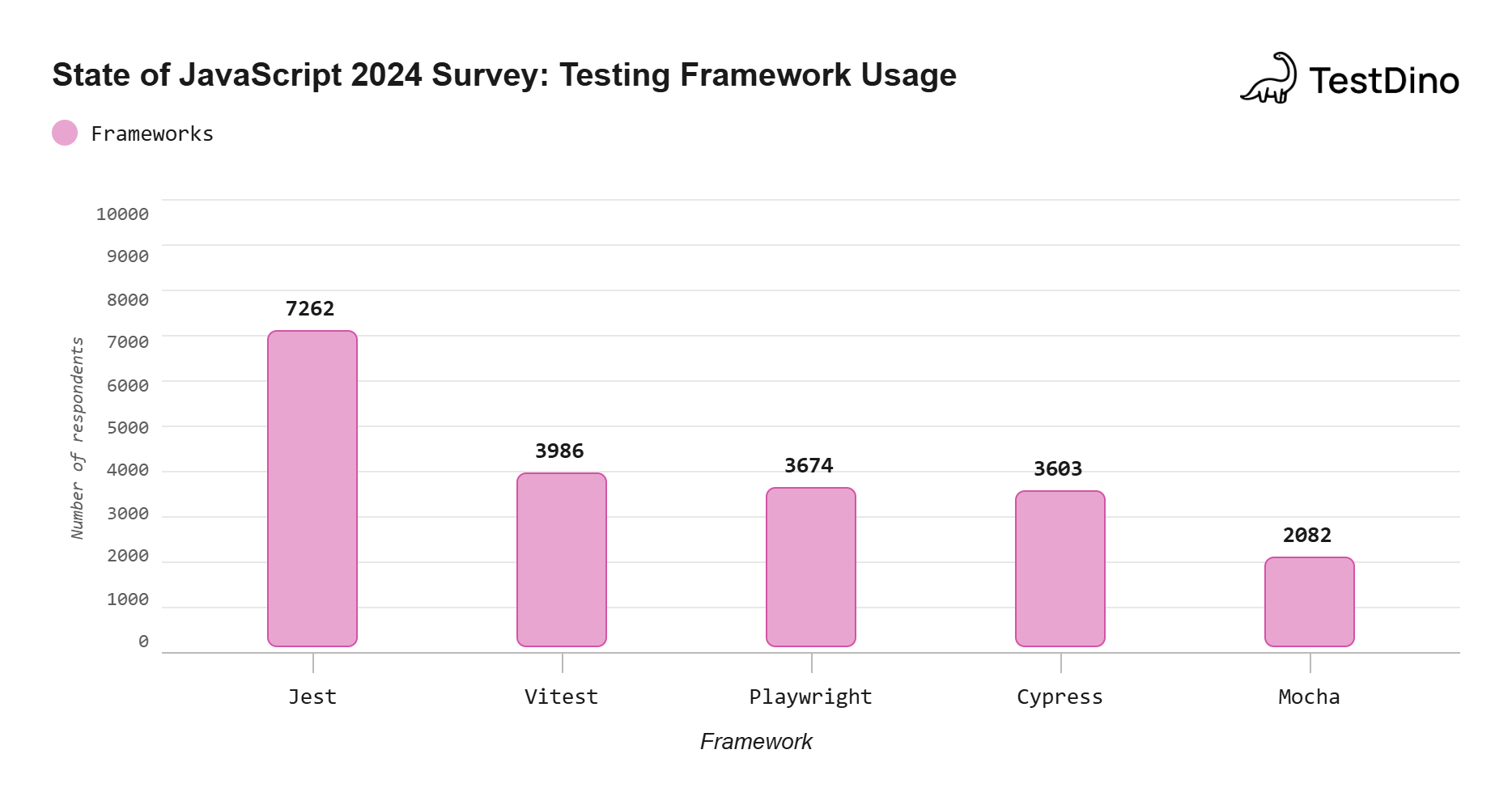
Source: State of JavaScript 2024 Survey (stateofjs.com)
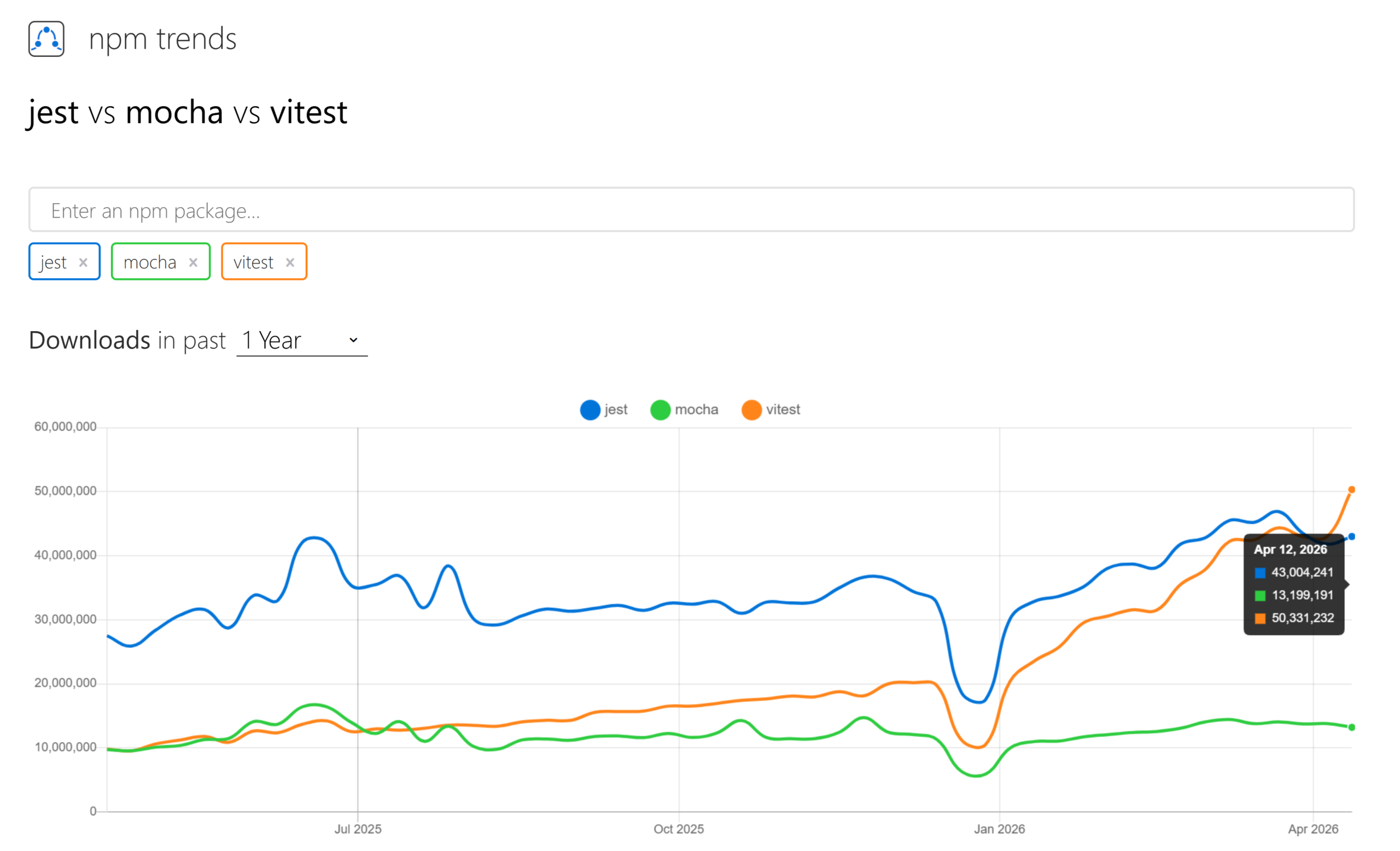
The trend behind these numbers matters more than the raw counts. Jest's usage has plateaued. Vitest has grown over 400% since 2023. Mocha continues a steady decline. The testing framework market data from npm download trends confirms this exact trajectory.
One detail most guides miss: Jest's custom transform pipeline is battle-tested for complex monorepos. Vitest handles this through Vite's resolve.alias, which works differently under the hood. Test the migration on a representative package before committing to a full switch.
End-to-end JavaScript testing frameworks
While unit tests run in Node, E2E javascript testing frameworks verify the entire application works the way a real user would interact with it inside a real browser.
Playwright (v1.50+)
Playwright is developed by Microsoft and supports Chromium, Firefox, and WebKit through a single unified API. Its auto-waiting mechanism automatically pauses until elements become actionable, eliminating timing-related test failures.
Key capabilities:
-
Cross-browser testing from a single test file.
-
Built-in Trace Viewer for post-mortem debugging.
-
Parallel execution through isolated contexts.
-
Native API testing.
const { test, expect } = require('@playwright/test');
test('user can log in', async ({ page }) => {
  await page.goto('https://demo.app/login');
  await page.locator('#email').fill('user@example.com');
  await page.locator('#password').fill('password123');
  await page.locator('button[type="submit"]').click();
  await expect(page).toHaveURL('/dashboard');
});
A detailed Playwright vs Selenium comparison shows that Playwright communicates directly with browser engines over the DevTools Protocol, resulting in faster and more reliable execution.
The learning curve to expect:
Playwright's fixture system is powerful but requires time to learn. You must understand test.extend() and how test isolation works through browser contexts.
Cypress (v14.x)
Cypress runs inside the browser alongside your application code. This architecture enables time-travel debugging, where you can hover over any command in the test log and see the exact DOM snapshot.
Key capabilities:
-
Time-travel debugging with visual snapshots.
-
Automatic reloading on file save.
-
Component testing support for React, Vue, and Angular.
describe('Login', () => {
  it('should log the user in', () => {
    cy.visit('/login');
    cy.get('#email').type('user@example.com');
    cy.get('#password').type('password123');
    cy.get('button[type="submit"]').click();
    cy.url().should('include', '/dashboard');
  });
});
Teams weighing Cypress vs Playwright for component testing often find the decision comes down to browser coverage requirements. Cypress historically supported only Chromium-family browsers.
The limitation to know:
Cypress cannot natively handle multi-tab workflows or cross-origin iframes without workarounds.
Other notable E2E tools
WebdriverIO (v9.x): Supports both web and mobile testing through Appium under a single API.
TestCafe: Uses script injection instead of WebDriver, simplifying setup.
For a broader look, the best test automation tools roundup covers cross-language options.
Many high-performing teams use a "split strategy." They run Vitest for fast unit tests that complete in milliseconds, and Playwright for critical end-to-end user flows.
| Framework | GitHub Stars (approx.) | Primary Use Case |
|---|---|---|
| Jest | 44,000+ | Unit / Integration |
| Vitest | 13,000+ | Unit / Integration |
| Mocha | 22,000+ | Unit / Integration |
| Playwright | 68,000+ | E2E / Browser |
| Cypress | 47,000+ | E2E / Browser |
How to choose the right JavaScript testing framework
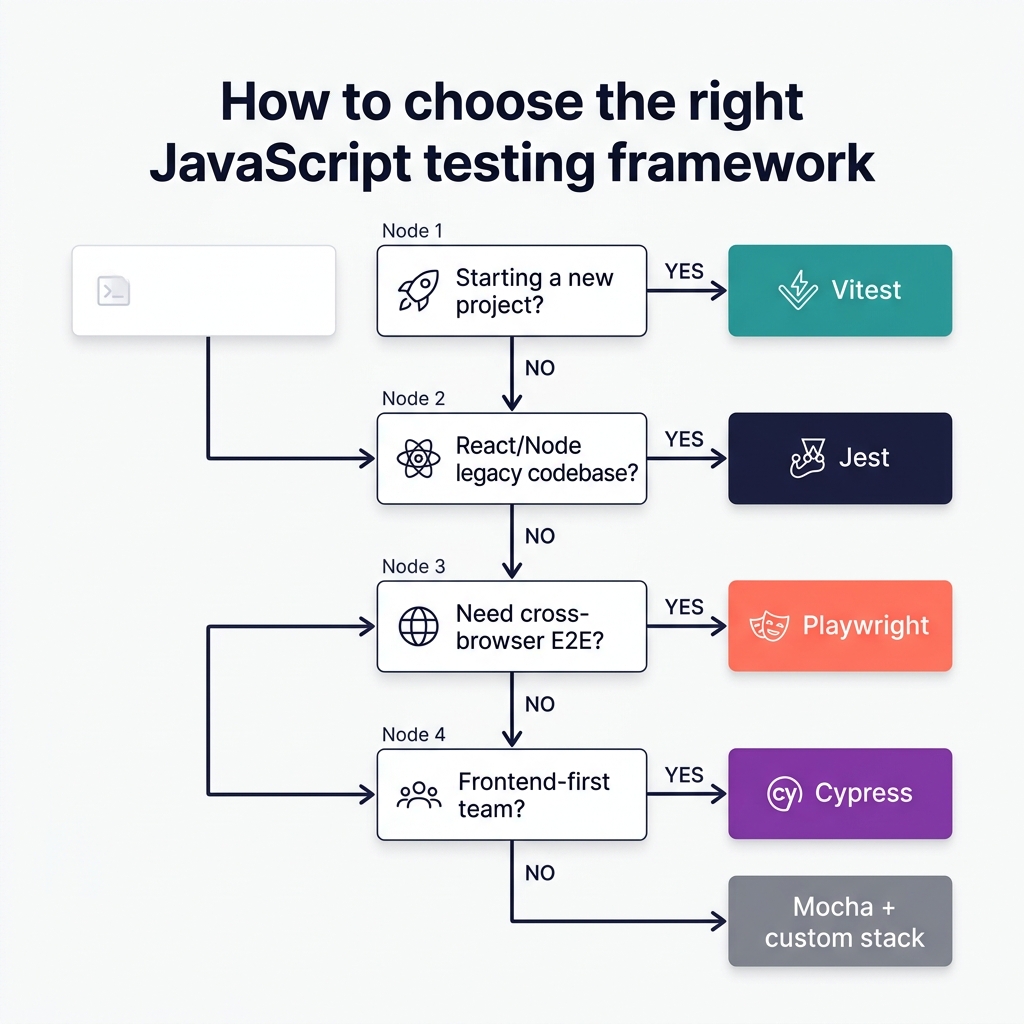
There is no single "best" javascript testing framework. The right choice depends on your project stage, your team's experience level, and which layer of the testing pyramid you need to cover.
Quick Framework Evaluation Checklist
Before committing to a new stack, ask your team these practical questions:
-
Do we need full cross-browser coverage? (If yes, lean toward Playwright)
-
Is our project built natively on Vite? (If yes, Vitest is the clear winner)
-
Are we migrating an old, massive legacy codebase? (If yes, stick to Jest to avoid plugin headaches)
-
Who is writing the majority of the tests? (Frontend devs often prefer Cypress for visual debugging; SDETs usually prefer Playwright for its API depth)
Choose Vitest if:
-
You are starting a new project or already using Vite.
-
TypeScript and ESM support must work out of the box.
-
Execution speed in watch mode is a top priority.
Choose Jest if:
-
You are working inside an established React monorepo.
-
You rely heavily on snapshot testing.
-
You need the largest ecosystem of community plugins.
Choose Playwright if:
-
You need cross-browser E2E testing.
-
You want built-in test reporting, tracing, and debugging tools.
-
You are building complex flows involving multiple tabs.
Choose Cypress if:
-
Your team is frontend-focused and values visual debugging.
-
You want the lowest barrier to entry for E2E tests.
Note: The shift from Mocha toward Vitest as the default choice for new projects has been a consistent trend since 2023.
The testing framework trends and state of automation data confirm this trajectory. If you are starting fresh today, Vitest and Playwright are the safest long-term bets.
Setting up your first test with each framework
Below are quick-start guides for the most popular javascript testing frameworks. Each example runs in under 2 minutes from a fresh project directory.
Vitest setup
npm create vite@latest my-app -- --template vanilla
cd my-app
npm install -D vitest
Add a test script to your package.json:
{
  "scripts": {
    "test": "vitest"
  }
}
Tip: If your project already uses Vite as its build tool, Vitest will share the same config and plugins automatically.
Jest setup
npm init -y
npm install -D jest{
"scripts": {
"test": "jest"
}
}Common gotcha: If you are using ESM syntax (import/export) in your project, Jest requires either the --experimental-vm-modules flag or a Babel/SWC transform. Vitest handles ESM natively.
Playwright setup
npm init playwright@latest
npx playwright test
The Playwright framework setup guide covers advanced configuration like sharding for parallel CI runs and integration with test management platforms. Teams that need to generate tests faster can also use the Playwright skill for AI-assisted test scaffolding.
When test failures start increasing across your CI pipeline, the framework itself is rarely the root cause. The issue usually comes down to how tests are structured, how flaky tests are tracked, and whether teams have visibility into failure patterns. TestDino helps by surfacing trends across runs.
E2E test performance benchmarks show that a well-optimized Playwright suite can run 200+ browser tests in under 3 minutes with proper sharding and debugging strategies. Following Playwright best practices prevents the kind of slow test accumulation that degrades CI feedback loops.
Conclusion: The Future of JavaScript Testing Frameworks
The javascript testing frameworks ecosystem in 2026 is mature, competitive, and highly segmented. You do not need to evaluate every single option on the market. Instead, pick the right tool for each layer of your testing pyramid and commit to it.
For unit and integration tests, Vitest is clearly the strongest choice for modern projects, while Jest remains a safe option for existing legacy codebases. For end-to-end tests, Playwright gives you the widest cross-browser coverage and powerful debugging utilities, while Cypress continues to offer a visually intuitive path to writing browser tests.
Ultimately, the best javascript testing framework is the one your team actually uses consistently. But whatever stack you pick, maintaining visibility into your test results over time is what turns a test suite from a passing checkbox into a reliable quality signal. That is exactly what TestDino is built to solve.
FAQs

Ayush Mania
Forward Development Engineer