Shift Left vs Shift Right Testing: Differences, Examples, and the 5-Step Loop That Uses Both
Shift left vs shift right testing compared with real data, Playwright examples, and a 5-step loop that connects both approaches.

Every team that ships software ends up arguing about the same thing: test harder before a release, or watch more closely after it? That argument has a name, shift left vs shift right testing, and it comes up in more planning meetings every quarter.
The trouble is that most teams pick a side. They either pour everything into pre-release checks and still get surprised after launch, or they lean on monitoring and let real users find the bugs.
This guide explains both approaches in plain words, compares them with real NIST and DORA data, shows Playwright examples for each, and ends with a 5-step loop that runs them together.
What shift left vs shift right testing actually means
Shift left vs shift right testing describes two directions on the same delivery timeline. Shift left moves testing earlier, into requirements, coding, and pull requests, so defects are found before release. Shift right extends testing past release into production, using real traffic, canary rollouts, and monitoring to find what pre-release checks could not.
Picture the life of a feature as a line. The far left is the first conversation about what to build. The far right is a real customer using it on a real phone. Every test you run sits somewhere on that line.
Traditional QA sat near the middle, after code was written but before it shipped. Shift left pulls testing toward the idea end. Shift right pushes it toward the customer end. Neither replaces the middle. They surround it.
Where the 2 terms came from
The phrase "shift left" was introduced by Larry Smith in a 2001 Dr. Dobb's Journal article, Shift-Left Testing. His point was organizational: integrate QA with development much earlier instead of handing finished code over a wall.
Shift right came later, as cloud deployments made production a place you could observe safely. Microsoft's DevOps guidance defines it as the practice of moving some testing later in the DevOps process to test in production.
Why it stopped being a debate
The same Microsoft guidance makes the case for both in a single sentence: many kinds of tests shift left easily, "but some classes of tests can't run without deploying part or all of a solution." That is the whole argument in miniature.
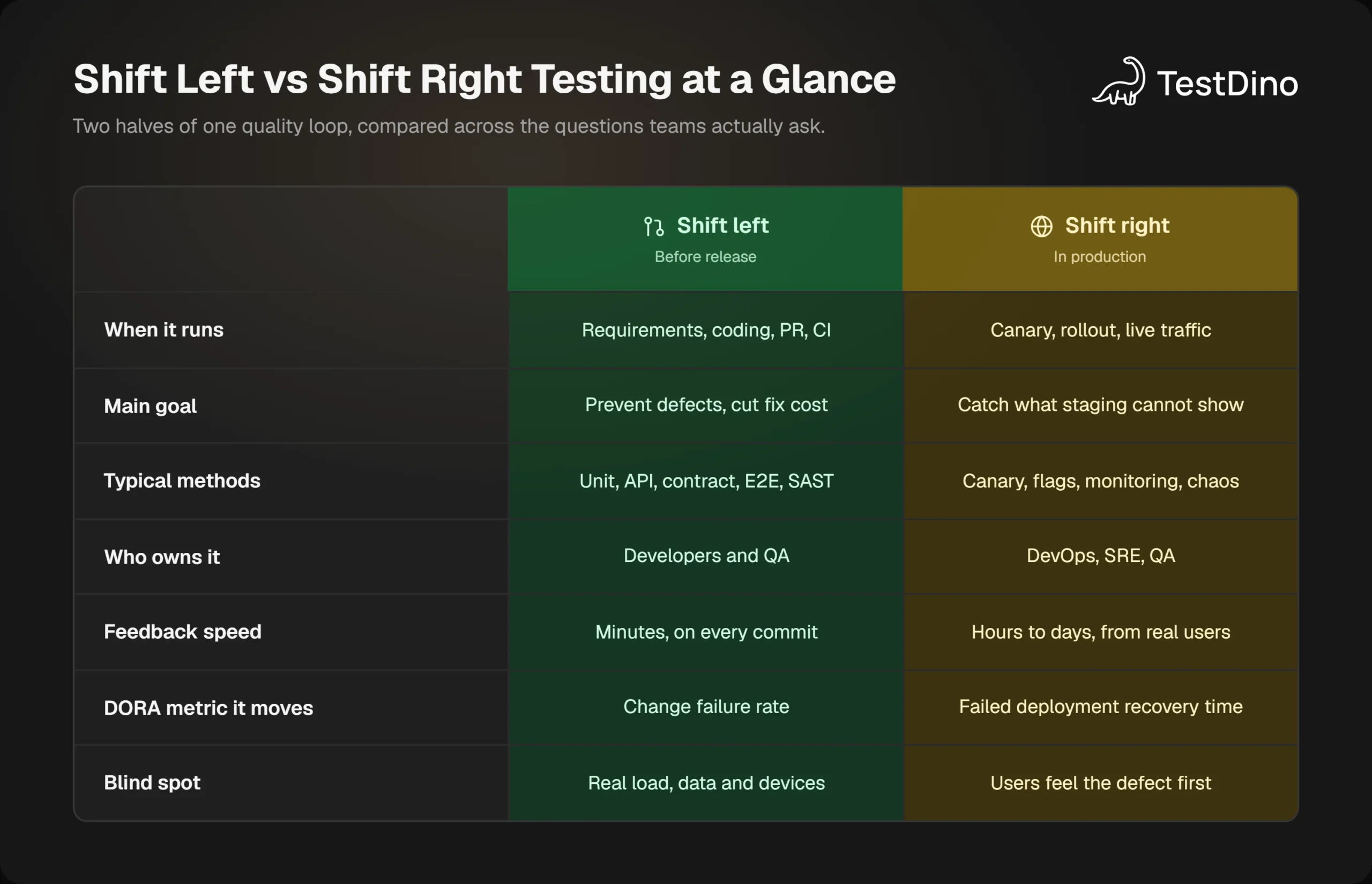
A solid test automation strategy therefore asks a different question. Not "left or right?" but "which risks do we remove before release, and which ones do we watch for after?" The infographic below puts the two side by side.
With the map in place, the next step is to look at each side closely, starting with the one most teams adopt first.
Shift left testing explained: finding bugs where they are cheapest
Shift left testing means developers and QA test a change while it is still small and fresh in someone's head. Unit tests, API tests, contract tests, static analysis, and a focused set of end-to-end checks all run on every commit, usually inside a pull request.
Microsoft's shift-left guidance describes a test taxonomy from L0 (fast in-memory unit tests) through L4 (integration tests that run against production). The goal is that most testing is completed before a change merges into the main branch.
Speed is the enabler. The same guidance reports that one Microsoft team runs over 60,000 unit tests in parallel in under 6 minutes, and goes from pull request to merge in about 30 minutes. Tests that slow are tests people actually wait for.
What shift left looks like in a Playwright pipeline
In a Playwright project, shift left starts in the config. Retries only run on CI, and a trace is recorded only when a test fails once, so a red run arrives with evidence attached instead of a screenshot and a guess.
import { defineConfig, devices } from '@playwright/test';

export default defineConfig({
  testDir: './tests',
  fullyParallel: true,
  forbidOnly: !!process.env.CI,
  retries: process.env.CI ? 2 : 0,
  reporter: [['html', { open: 'never' }], ['blob']],

  use: {
    baseURL: process.env.BASE_URL ?? 'http://localhost:3000',
    trace: 'on-first-retry',
  },

  projects: [
    { name: 'api', testMatch: /.*\.api\.spec\.ts/ },
    { name: 'chromium', use: { ...devices['Desktop Chrome'] } },
  ],
});
The trace: 'on-first-retry' setting is the shift-left workhorse. The Playwright trace viewer replays the DOM, network, and console for each step, which turns a 20-minute reproduction into a 2-minute read.
The pipeline then gates the pull request. A run in GitHub Actions that fails blocks the merge, which is exactly where you want a defect to stop.
name: Playwright PR gate
on:
  pull_request:
    branches: [main]
jobs:
  test:
    runs-on: ubuntu-latest
    timeout-minutes: 20
    steps:
      - uses: actions/checkout@v4
      - uses: actions/setup-node@v4
        with: { node-version: 22 }
      - run: npm ci
      - run: npx playwright install --with-deps chromium
      - run: npx playwright test --project=api --project=chromium
      - uses: actions/upload-artifact@v4
        if: ${{ !cancelled() }}
        with:
          name: playwright-report
          path: playwright-report/
Why early beats late: the NIST numbers
The best public data on this comes from the U.S. National Institute of Standards and Technology. Its 2002 study, The Economic Impacts of Inadequate Infrastructure for Software Testing, estimated the annual national cost of inadequate testing infrastructure at 59.5billion,ofwhich59.5billion,ofwhich22.2 billion could be removed through feasible improvements.
The part that matters for shift left is Table 6-4 of that report. Surveyed developers said a bug found during coding or unit testing takes an average of 2.4 hours to fix. The same bug found after release takes 13.1 hours.
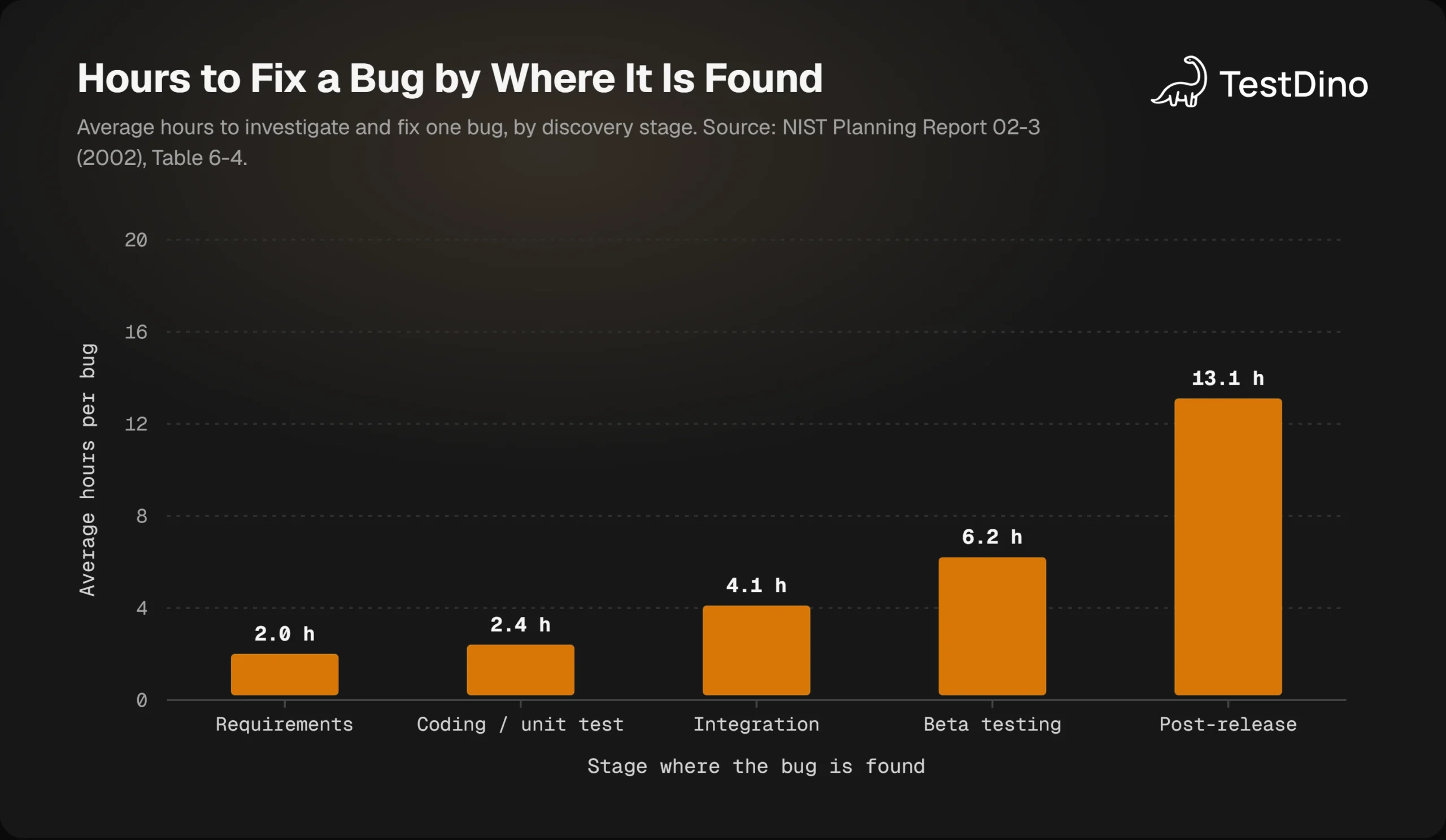
Two more details from the same report are worth keeping in mind. First, 85% of errors in the surveyed companies were found during coding and integration, so the expensive post-release bugs were already the minority. Second, the "feasible improvements" scenario in Table 6-5 cut the average time per bug by 16.9%, simply by finding bugs closer to where they were introduced.
That is the quiet case for shift left. You do not need to catch everything early. You need to move the distribution a little to the left, and the hours saved compound on every release.
Where shift left runs out of road
Pre-release environments are models of production, and models leave things out. Real data shapes, real traffic spikes, third-party outages, and the device in a customer's pocket are hard to reproduce on a CI runner. Microsoft's guidance puts it bluntly: "there's no full substitute for the production environment."
This is why teams keep separate checks for staging vs production rather than pretending one environment can answer every question. A green pipeline tells you the code does what the tests describe. It cannot tell you what the tests never imagined.

Tip: Before you argue for more pre-release testing, put a number on what a miss costs. You can estimate the dollar cost of a production bug and the yearly cost of flaky tests with TestDino's free calculators, then compare that against the CI minutes an extra gate would add.
Those blind spots are not a failure of shift left. They are the reason shift right exists.
Shift right testing explained: learning from real traffic
Shift right testing treats production as a test environment with the best data you will ever get. Microsoft describes it as using "real deployments to validate and measure an application's behavior and performance in the production environment."
The important word is measure. Shift right is not "deploy and hope." It is deploying to a small, controlled slice, comparing what happens against the previous version, and deciding with data whether to go wider or roll back.
Production also never sits still. Even when your code does not change, the infrastructure and dependencies underneath it do. That is why Microsoft's guidance notes that "a team is never done with testing in production."
5 shift right testing practices that matter most
- Canary or ring deployments. Google's SRE Workbook defines canarying as a partial and time-limited deployment of a change in a service and its evaluation. Its worked example uses a 5% canary population.
- Feature flags. Code ships dark and is switched on for a chosen group. If something breaks, the flag goes off in seconds and no rollback is needed.
- Synthetic monitoring. Scripted checks run against production on a schedule or right after a deploy, exercising the flows that make money.
- Real user monitoring and observability. Error rates, latency, and conversion are tracked per release so a regression shows up as a line that bends.
- Fault injection and chaos engineering. Teams deliberately break a dependency to prove that fallbacks, circuit breakers, and alerts work before a real outage tests them.
Microsoft's example for ring deployments makes the economics plain. It is better to catch a bug that stops shoppers completing a purchase "when less than 1% of customers are on that deployment tier, than after switching all customers at once."
Guardrails that keep shift right safe
Shift right is only safe when the blast radius is small and the exit is fast. Without those two properties, "testing in production" is just an incident with a nicer name.
Note: Minimum guardrails before any shift right practice: a first ring small enough to run your integration suite, an automated rollback or kill switch, synthetic checks that use dedicated test accounts, and fault injection limited to canary environments with little or no customer impact, as Microsoft's guidance recommends.
The Google SRE Workbook explains why these guardrails are not optional. Test environments are never fully identical to production, and tests never cover every scenario, so "you won't be able to detect all release-related defects until real traffic is hitting the service."
Where does the signal go once production starts talking? Teams that get value from shift right route production checks and CI results into the same Playwright observability platform, so the person who sees the canary fail can also see the trace from the last green run.
With both sides defined, the comparison that most people search for becomes much easier to read.
Shift left vs shift right testing: side-by-side comparison
The table below is the quick answer to shift left vs shift right testing. Everything after it explains the rows that matter most.
| Dimension | Shift left testing | Shift right testing |
|---|---|---|
| When it runs | Requirements, coding, pull request, CI | Canary, progressive rollout, live traffic |
| Main goal | Prevent defects and cut the cost of fixing them | Find defects that only real conditions expose |
| Environment | Local, CI runners, staging | Production, with a limited audience first |
| Typical methods | Unit, API, contract, E2E, static analysis | Canary, feature flags, synthetic checks, RUM, chaos |
| Who owns it | Developers and QA | DevOps, SRE, and QA |
| Feedback speed | Minutes, on every commit | Hours to days, from real usage |
| Cost of a miss | A red build | A customer-facing incident |
| DORA metric it moves most | Change failure rate | Failed deployment recovery time |
| Blind spot | Real load, real data, real devices | Users may feel a defect before you see it |
What each approach catches that the other misses
Shift left is strongest on logic. Wrong calculations, broken contracts between services, missing validation, and regressions in flows you already know about all fall to unit, API, and end-to-end tests. If you are unsure which types of software testing belong at which stage, the rule of thumb is simple: the cheaper and faster the test, the further left it goes.
Shift right is strongest on conditions. Slow queries that only appear at scale, a CDN config that differs by region, a payment provider that times out at month end, and the layout bug on one Android model are all production-only knowledge.
There is one trap in between. Tests that fail intermittently in CI look like shift-left noise but are often shift-right truth in disguise: a race condition or timing dependency that real users will hit too. Treat flaky tests as evidence, not as something to retry past.
How the 2 show up in DORA metrics
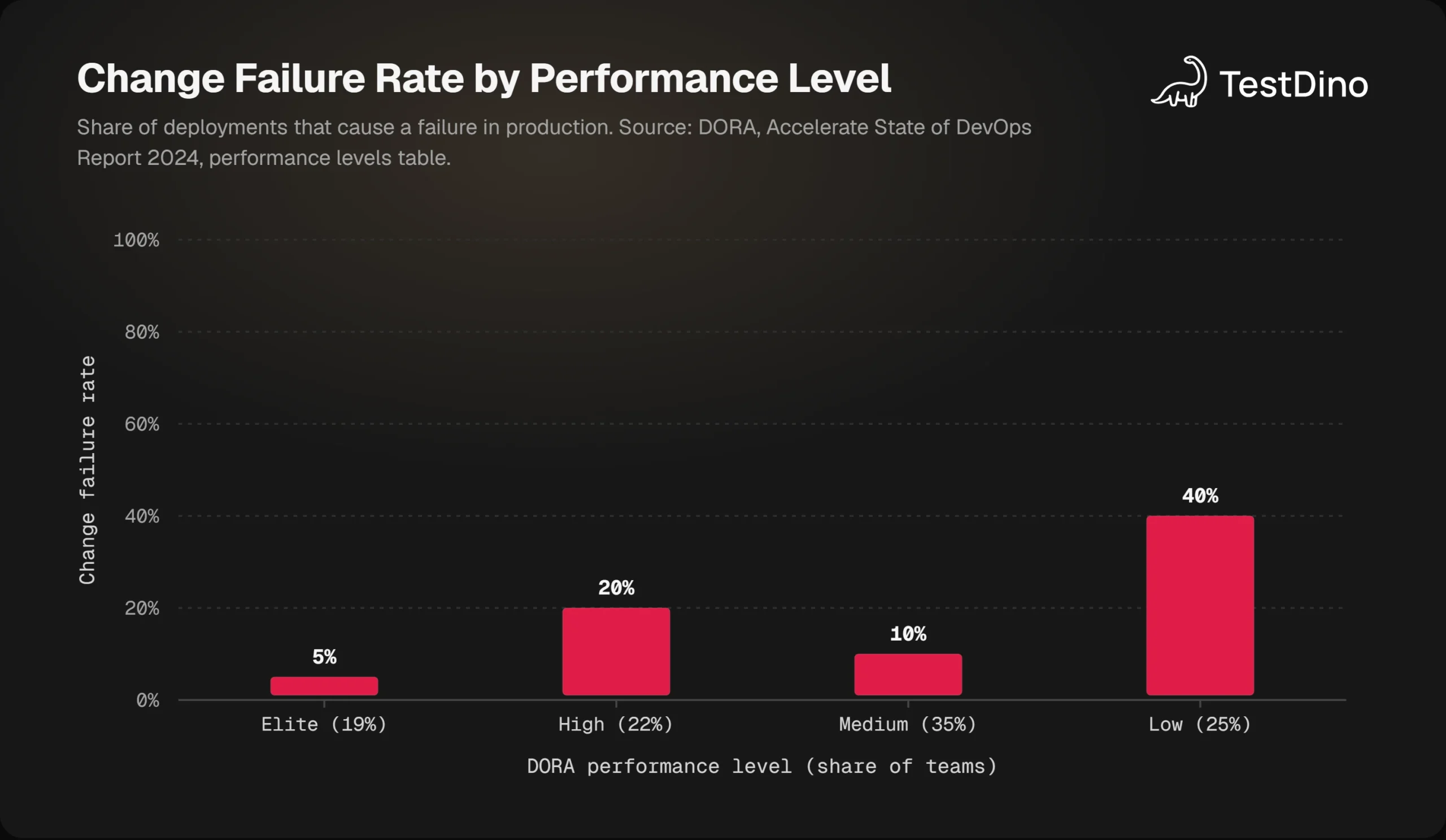
Change failure rate is the share of deployments that cause a failure in production. Failed deployment recovery time is how long it takes to restore service after one. In shift left vs shift right testing terms, shift left lowers how often a change fails, and shift right lowers how long the failure lasts.
The 2024 Accelerate State of DevOps Report from DORA groups respondents into four performance levels by cluster analysis. Elite teams reported a 5% change failure rate and recovered from a failed deployment in under an hour. Low performers reported 40% and took between a week and a month to recover.
The report also found something that surprised its own authors: the medium cluster (10%) had a lower change failure rate than the high cluster (20%). Throughput and stability are starting to move independently, which is one more reason to measure both halves of the loop separately.
One more finding from the same report belongs in any shift left vs shift right testing discussion. A 25% increase in AI adoption was associated with an estimated 1.5% drop in delivery throughput and a 7.2% drop in delivery stability. DORA's own explanation points back to "small batch sizes and robust testing mechanisms."
In other words, as more code is written faster, the testing on both sides of the release has to carry more weight, and your test quality metrics need to show whether it is. Knowing what each side is good at leads to the practical question: which one does your team need right now?
When to shift left, when to shift right, and when to do both
There is no universal answer, but there is a defensible order. Most teams get more from shift left first, because it has no safety prerequisites. Shift right needs rollout tooling and monitoring before it is safe to try.
Start with shift left when
- Your pipeline has no automated gate, or the gate runs so late that people merge around it.
- Most of your production incidents are logic bugs or regressions in known flows.
- You release infrequently, so each release carries a large batch of change.
- You do not yet have feature flags, ring deployments, or per-release monitoring.
Add shift right when
- You run microservices that reach production through many independent paths. Microsoft's guidance calls this out as a case where production compatibility testing is required regardless of pre-production coverage.
- Your incidents are mostly scale, data, or dependency problems that staging never reproduced.
- You deploy daily or more, so each change is small enough to canary safely.
- You already have rollback automation and dashboards you trust.
A decision rule you can defend
Rank your risks, not your tools. Ask which failures would hurt customers most, then ask whether a pre-release test could realistically catch each one. If yes, shift it left. If the honest answer is "only with real traffic," shift it right and build the guardrail first.
That is the same logic behind risk-based testing: effort follows impact and likelihood. Once each risk has a home, the two sides stop competing for budget and start feeding each other, which is what the next section builds.
How to combine shift left and shift right testing in 1 feedback loop
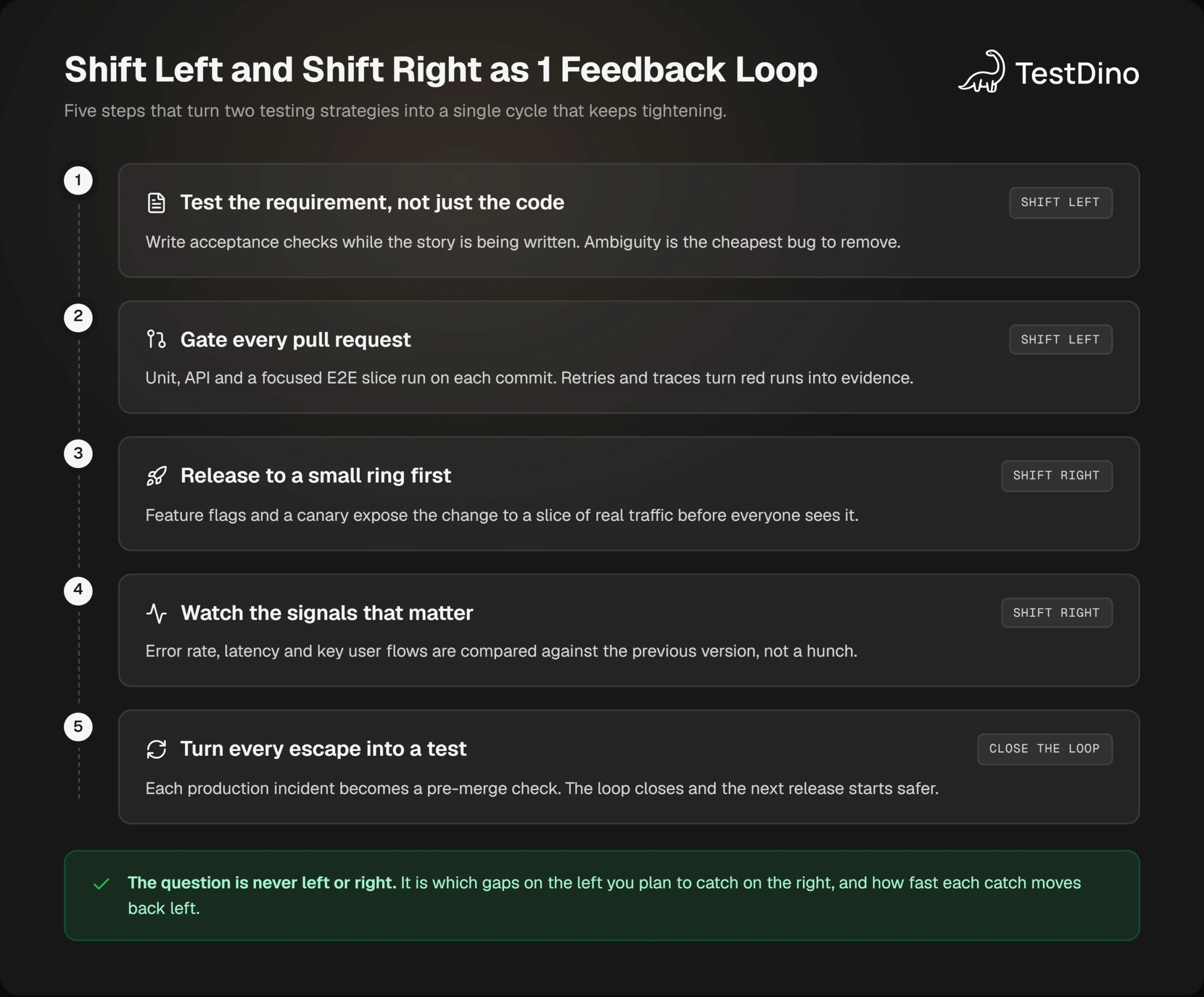
The strongest teams do not run shift left and shift right as two programs. They run one loop, where everything learned in production becomes a check before the next merge. The 5 steps below are that loop in order.
Steps 1 and 2: gate the change before merge
Step 1 happens before code exists. Write the acceptance checks while the story is being written, because an ambiguous requirement is the cheapest bug you will ever remove. Step 2 is the pull request gate from earlier, with one addition: tags that mark which tests are also safe to run against production.
import { test, expect } from '@playwright/test';

test('cart total applies a percentage coupon once', { tag: ['@smoke', '@prod'] }, async ({ page }) => {
  await page.goto('/cart?fixture=two-items');
  await page.getByLabel('Coupon code').fill('SAVE10');
  await page.getByRole('button', { name: 'Apply' }).click();
  await expect(page.getByTestId('cart-total')).toHaveText('$45.00');
});
Fast Playwright API testing covers the bulk of business rules at this stage, and a short E2E slice covers the flows customers would notice. Keep the gate under the time people are willing to wait, which usually means you need to reduce Playwright CI runtime with sharding before you add more tests.
Steps 3 and 4: release small, watch closely
Step 3 is the canary. The same @prod tests now run against the first ring, using dedicated test accounts and read-only or reversible actions. Step 4 compares the ring's error rate and latency against the previous version before promoting.
BASE_URL=https://canary.example.com npx playwright test --grep @prod --project=chromium --retries=1If you generate or maintain tests with an AI coding agent, the open-source Playwright skill gives the agent the locator, fixture, and tagging conventions this loop depends on, so production-safe tests stay production-safe.
Step 5: turn every escape into a test
Step 5 closes the loop. Every incident that reaches production becomes a named regression test in the pull request gate. The incident number in the file name is deliberate: six months later, nobody has to ask why this test exists.
import { test, expect } from '@playwright/test';

// Escaped to production on 2026-09-18: coupon applied twice when "Apply" was double-clicked.
test('double-clicking Apply does not stack the coupon', { tag: '@regression' }, async ({ page }) => {
  await page.goto('/cart?fixture=two-items');
  await page.getByLabel('Coupon code').fill('SAVE10');
  await page.getByRole('button', { name: 'Apply' }).dblclick();
  await expect(page.getByTestId('cart-total')).toHaveText('$45.00');
});
Good test failure analysis is what makes this step cheap. When a failure already carries its trace, its history, and the commit that introduced it, writing the regression test is a 10-minute job rather than an afternoon.
Teams that follow these 5 steps still get bitten by a handful of predictable mistakes, and they are worth naming before you start.
4 mistakes teams make with shift left and shift right testing
Treating shift right as permission to skip tests
The most common misreading of shift right is "we monitor production, so we can trim the pipeline." Monitoring finds a defect after a customer has already met it. The whole point of the loop is that shift right tells you what shift left should have caught, not that it replaces it.
Shifting left into a gate nobody waits for
A 90-minute pull request gate is a shift-left program in name only. Developers merge around it, and failures get a tolerance that destroys their value. Microsoft's guidance sets a bar worth copying: average L0 unit tests under 60 milliseconds, L1 under 400 milliseconds, and nothing at that level over 2 seconds.
End-to-end tests will never be that fast, which is why the slice that runs on every commit must be small and ruthlessly curated. Most Playwright slow tests are slow for reasons that can be fixed, and the rest belong in a nightly job, not the gate.
Letting production findings die in a chat thread
An incident gets fixed, the channel goes quiet, and the same class of bug returns in 3 months. Without step 5, shift right generates stories instead of tests. Make "incident becomes regression test" a required item in the postmortem template.
Measuring activity instead of outcomes
Test counts, coverage percentages, and dashboard counts all go up without anything getting safer. The outcomes that matter are the ones DORA tracks: how often a change fails, and how fast you recover when it does.
Tip: Track 2 numbers per release: defects caught before merge and defects caught in production. If the second number stops falling while the first keeps rising, you are writing the wrong pre-release tests, and the production list is telling you which ones to write instead.
Avoiding those mistakes is mostly a matter of discipline, but the right tooling makes the discipline much easier to keep.
Tools for shift left and shift right testing
No single product covers the whole loop, and that is fine. What matters is that the tools on each side can hand evidence to each other.
| Stage | Job to be done | Typical tools |
|---|---|---|
| Shift left | Unit and component tests | Vitest, Jest, Playwright component testing |
| Shift left | API, contract, and E2E tests | Playwright, Pact, Supertest |
| Shift left | Static analysis and security scanning | ESLint, SonarQube, CodeQL |
| Shift left | PR gating and parallel runs | GitHub Actions, GitLab CI, Azure Pipelines |
| Shift right | Progressive rollout | Feature flag services, Argo Rollouts, ring deployments |
| Shift right | Synthetic checks on production | Playwright tagged suites on a schedule |
| Shift right | Observability and RUM | OpenTelemetry, Grafana, Datadog |
| Shift right | Fault injection | Azure Chaos Studio, Gremlin, Chaos Mesh |
| Both | Test history, flake detection, failure analysis | TestDino |
The row that glues the loop together is the last one. When CI results and production checks land in the same Playwright test reporting view, you can see that a test which flaked 4 times last week is the same flow that failed in the canary today.
That is also where flake detection earns its place. Dedicated flaky test detection tools separate tests that fail because of timing from tests that fail because the product changed, so the pull request gate stays trusted and the production signal stays clean.
Conclusion
Shift left vs shift right testing was never a choice between two camps. Shift left finds the defects that are cheapest to fix, and the NIST data shows just how much cheaper: 2.4 hours during coding against 13.1 hours after release. Shift right finds the defects that no staging environment could show you, and DORA's numbers show what happens to teams that recover slowly.
The teams that do best run the two as one loop. Gate every pull request with fast, trusted tests. Release to a small ring and watch it. Then turn every escape into a test that sits in the gate forever. Each pass around the loop moves a little more risk to the left, which is the only direction it should ever travel.
If you want a checklist for the left half, the Playwright best practices guide covers locators, fixtures, and CI configuration in detail. Start there, add one shift right practice with proper guardrails, and let the loop do the rest.
FAQs

Krupa Gandhi
QA Tester