Will AI Replace QA Testers? What the 2026 Data Actually Says
Worried AI will take your QA job? Here is what 2026 labor data, tester surveys and real testing agents show.
Most testers now keep an AI tool open next to their test cases, and most of them also worry about keeping their job. The question "will AI replace QA testers" has moved from conference panels to one-on-one meetings with managers.
The trouble is that nearly every answer comes from a company selling a testing tool. The reassuring takes and the doom takes both skip the actual numbers and the actual tooling.
This guide puts the primary sources side by side: labor projections, tester surveys, and what Playwright test agents do when you run them. You leave knowing what is disappearing, what is growing, and what to learn next.
Will AI replace QA testers?
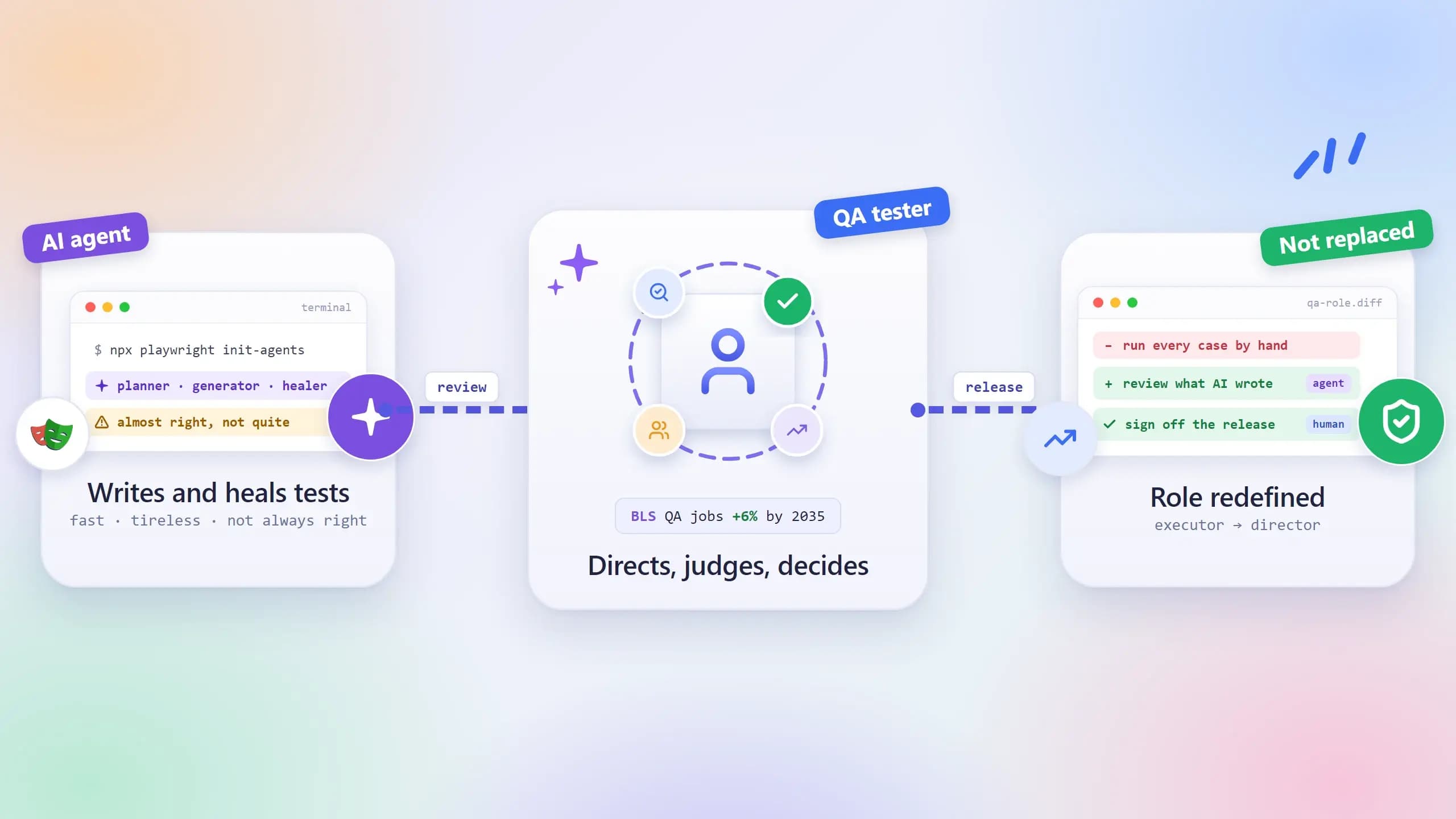
Will AI replace QA testers? Not as a profession. AI is replacing specific tasks: drafting test cases, repairing broken scripts, and sorting failures. It is not replacing the judgment about what to test, what a failure means, and whether a release is safe. Testers who only run scripted checks are exposed, while those who own risk and quality signals are in demand.
That two-part answer is what most articles flatten into a yes or a no. The yes camp points at agents writing tests. The no camp points at exploratory testing. Both describe real things, and both are only half the picture.
What labor data says about QA tester jobs
The clearest number comes from the U.S. Bureau of Labor Statistics. Its 2025 to 2035 projections in the Occupational Outlook Handbook show QA analyst and tester jobs still growing, just more slowly than developer jobs.
| Occupation (BLS category) | Jobs in 2025 | Projected jobs in 2035 | Change |
|---|---|---|---|
| Software quality assurance analysts and testers | 187,600 | 198,200 | +6% (+10,600) |
| Software developers | 1,717,800 | 1,892,600 | +10% (+174,700) |
| Combined group | 1,905,400 | 2,090,800 | +10%, about 106,100 openings a year |
The BLS lists the "continued expansion of software development for artificial intelligence" as a driver of demand, not a threat to it. The median wage for QA analysts and testers was $104,300 in May 2025.
Growth of 6% against 10% for developers is the honest signal here. The role is not vanishing, but the scripted slice of it is being squeezed. That is why test automation jobs keep asking for coding and CI skills rather than test case execution.
Why testers are worried anyway
The fear is real and measurable. In PractiTest's State of Testing Report 2026, 65.6% of the testing workforce said they were "Very Concerned" about the future of their profession.
The split inside that number matters more than the headline. Among individual practitioners, 68.9% were very concerned, against 55.6% of strategy leaders. The people who execute tests are more worried than the people who decide what gets tested.
That gap is the whole story of this article. To understand it, start with what AI is actually doing inside testing teams right now.
What AI already does in software testing today
Adoption is no longer the question. PractiTest puts global AI adoption among testers at 76.8%. The World Quality Report 2025 from OpenText, Capgemini and Sogeti, built on a survey of more than 2,000 senior executives, found 89% of organizations piloting or deploying Gen AI in quality engineering.
Only 37% of those organizations have Gen AI in production, and 52% are still in pilots. The tools are everywhere, but mature, scaled deployments are rare. That shapes how AI in software testing actually shows up day to day.
The payoff is real but uneven. The same report measures an average productivity boost of 19% from Gen AI in quality engineering, while one third of organizations say they have seen minimal gains. Having the tool and getting value from it are different things.
Drafting and maintaining tests
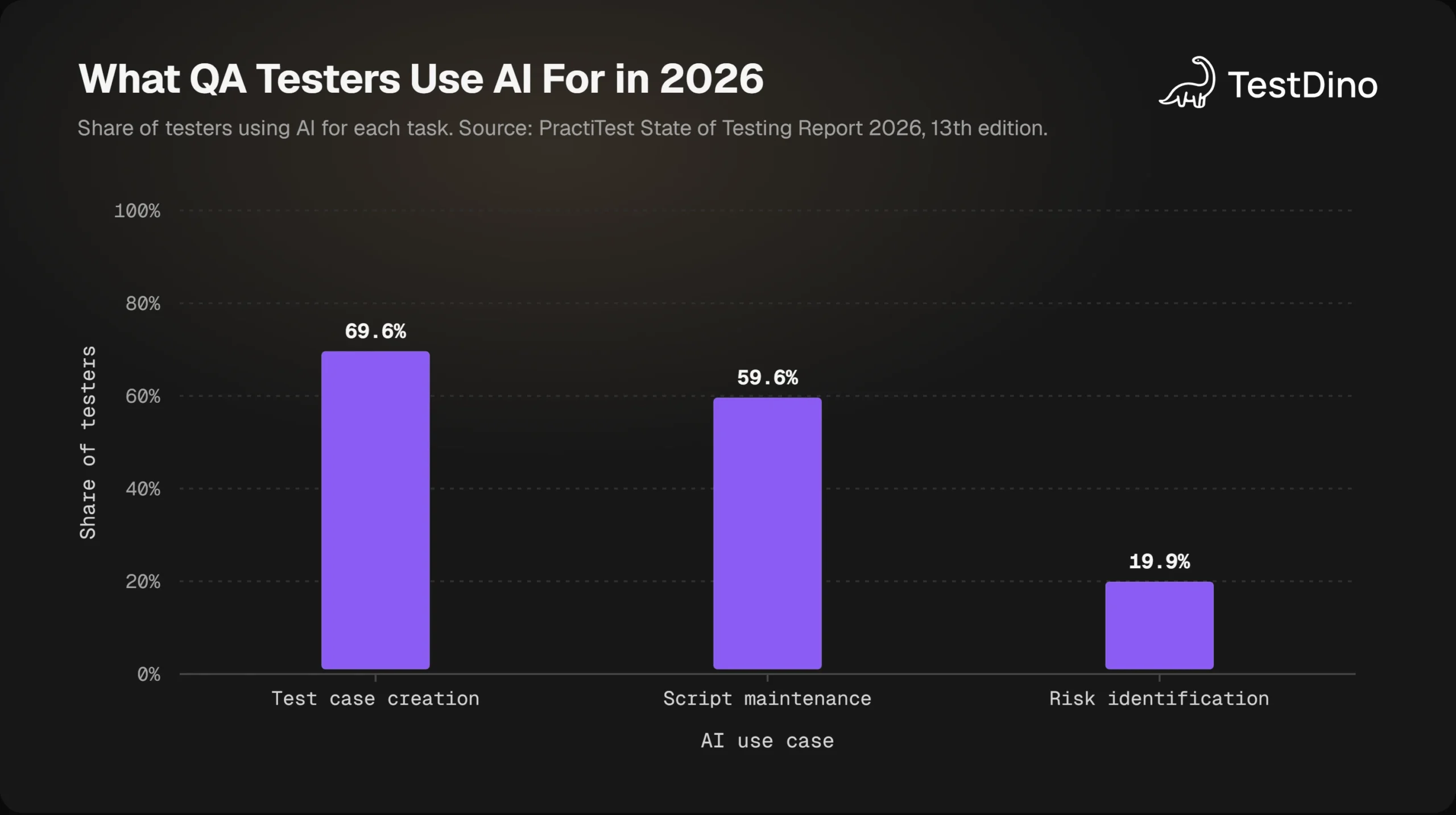
Ask testers what they use AI for and the answer is lopsided. In the PractiTest 2026 report, 69.6% use AI for test case creation and 59.6% use it for script maintenance. Only 19.9% use it for risk identification.
Read those three numbers together and a pattern appears. AI is doing the typing. The thinking about what matters, and what could go wrong, is still mostly human.
Running agents against a real app
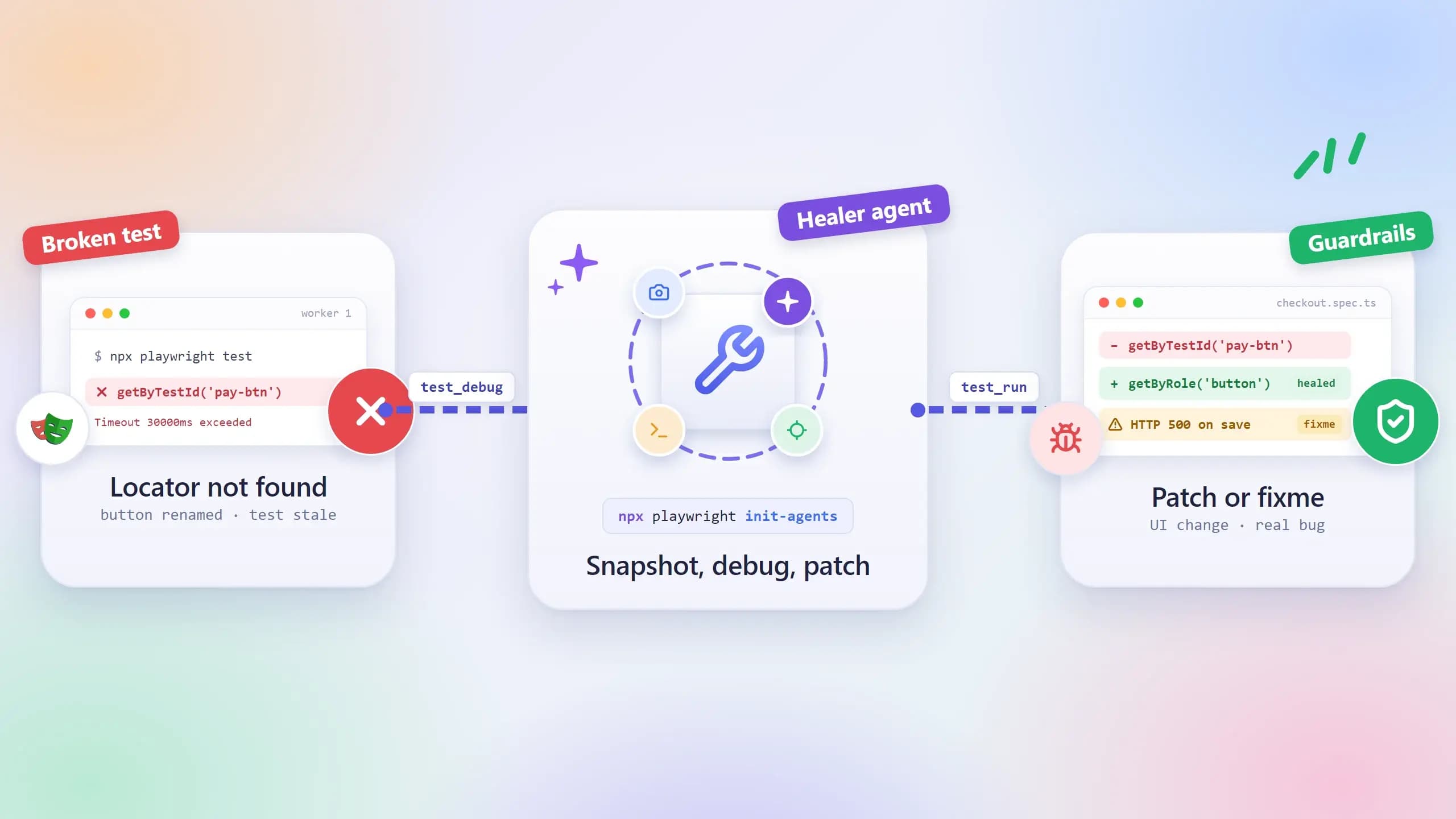
This is not theory. Playwright 1.56, released in October 2025, shipped three agent definitions described in the official Playwright test agents docs: a planner, a generator, and a healer. You add them to a project with one command.
npx playwright init-agents --loop=claudeThe planner explores your app and writes a Markdown test plan. The generator turns that plan into test files, verifying selectors and assertions live as it goes. The healer replays failing tests, inspects the UI, patches the test, and re-runs it.
That is a big chunk of what writing Playwright tests with AI used to mean, now wrapped in a workflow you can run from a terminal.
If your team runs these loops in Claude Code, the open source Playwright skill packages the conventions agents should follow, so generated tests land in your style instead of the model's default.
Note: The healer's documented output is "a passing test, or a skipped test if the healer believes that functionality is broken." A skipped test might be a real production bug. Someone has to read those skips, and that someone is a tester.
Triaging failures and reporting
The third area is what happens after a run. AI now groups failures by cause, separates flakes from real regressions, and drafts the summary a tester used to write by hand. Good test failure analysis has become a review task rather than a detective task.
All of this is real and useful. It is also exactly where the limits start to show.
Where AI testing tools still fall short
The almost right problem
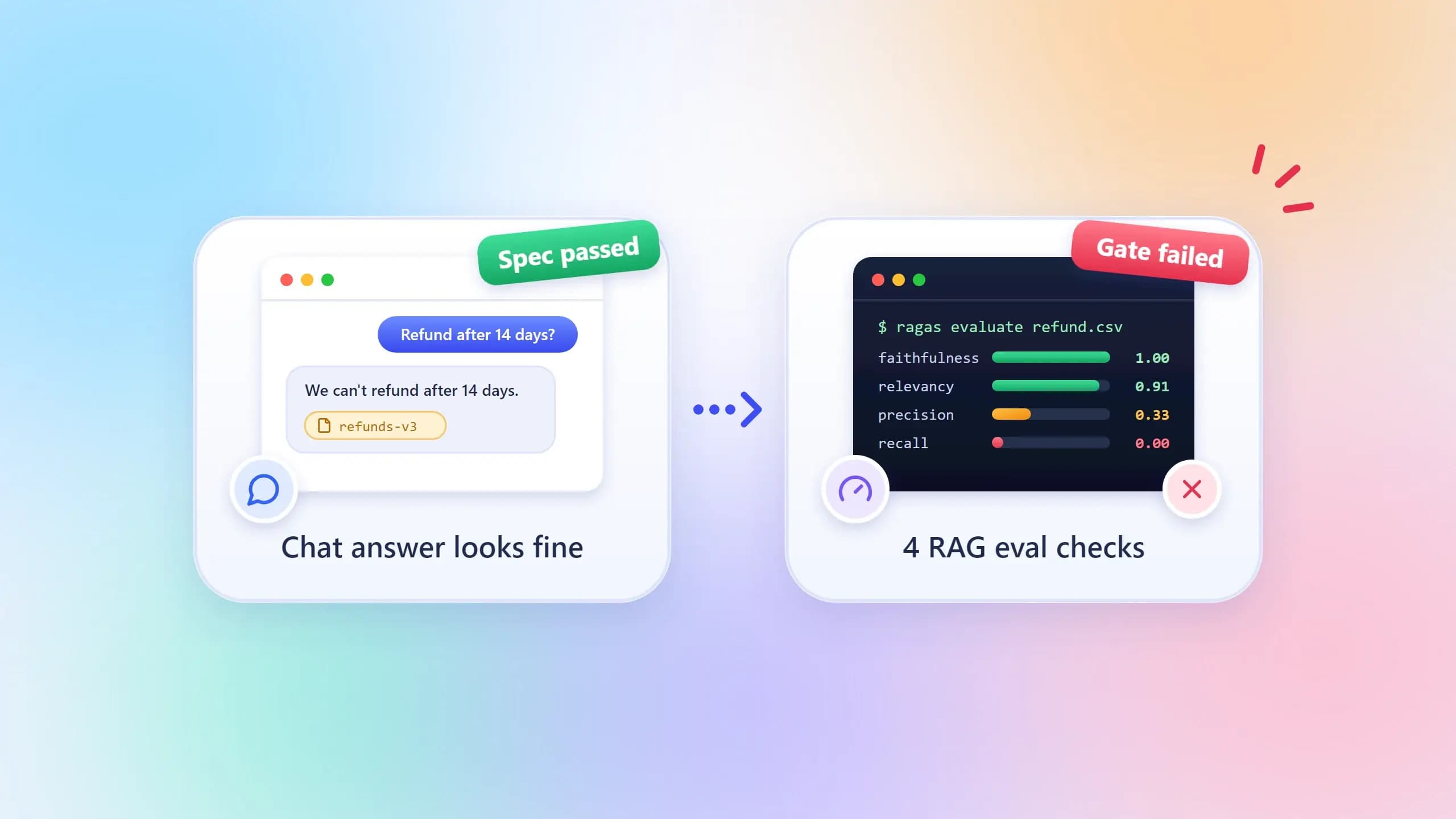
Stack Overflow's 2025 Developer Survey found 84% of developers using or planning to use AI tools. In the same survey, 66% picked "AI solutions that are almost right, but not quite" as the most common frustration, and 45.2% said debugging AI-generated code takes more time.
An almost-right test is worse than no test. It passes, so nobody looks at it, and it proves nothing about the behavior that matters. Trust reflects that: 46% of developers distrust AI accuracy, 33% trust it, and only 3.1% highly trust it.
This is why testing AI-generated code has become its own discipline. The volume of code went up and the certainty about each line went down.
Judgment, risk and context
The World Quality Report 2025 names the barriers executives hit when they try to scale: 67% cite data privacy risks, 64% integration complexity, and 60% hallucination and reliability concerns. Only 15% have reached enterprise-wide deployment. The report's own summary is blunt: "AI amplifies capability, but it cannot substitute for it."
The scaling numbers tell the same story from the executive side. In that report, 43% of organizations are still experimenting and 30% use Gen AI only in limited cases. Scaling stalls where nobody can validate what the model produced.
Pair that with the PractiTest number from earlier. If only 19.9% of testers use AI for risk identification, then deciding where the risk lives is still a human job. That is the core of risk-based testing, and no agent has a view of your business, your users, or your last outage.
The split looks like this once you lay it out task by task.
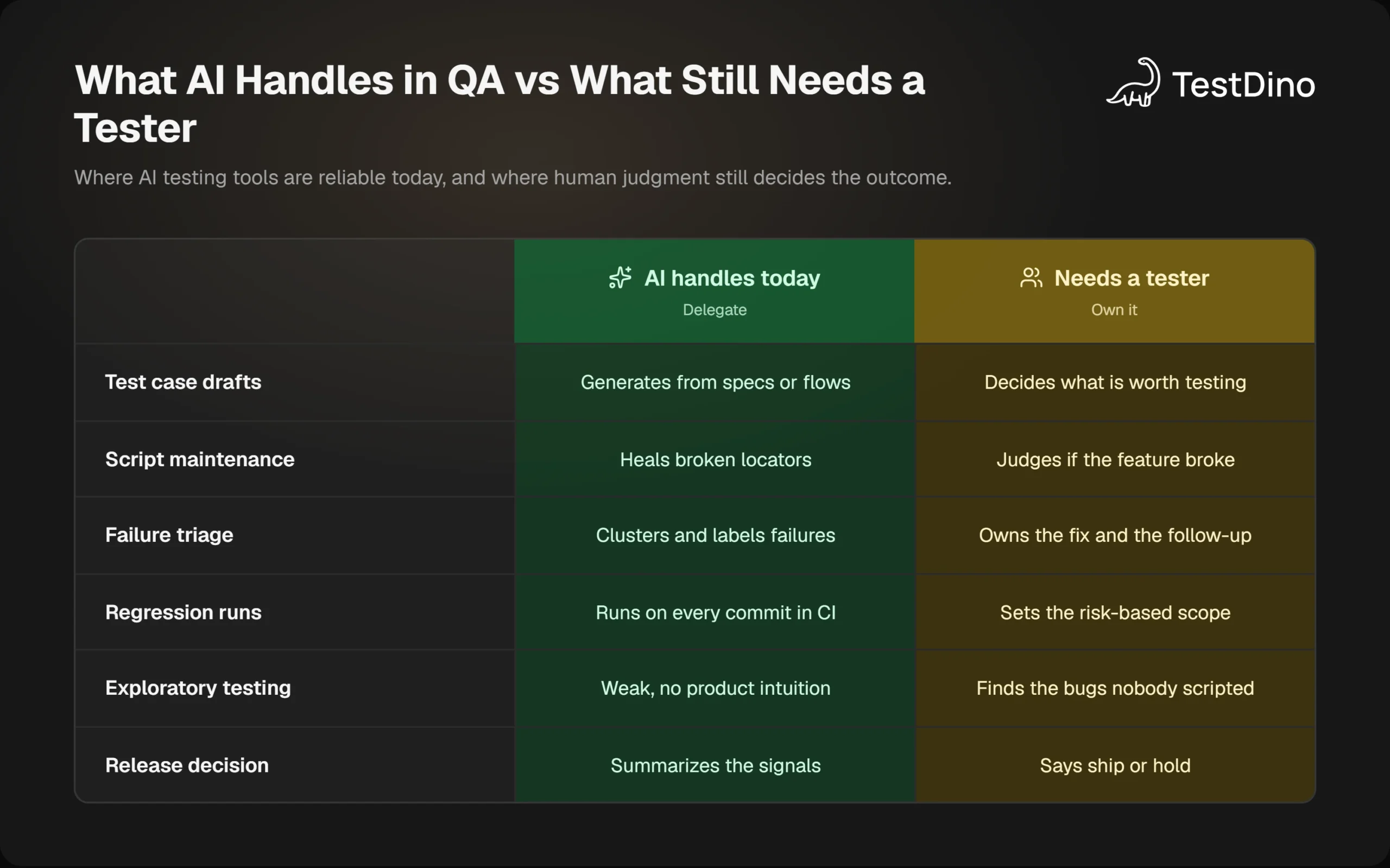
Exploratory testing deserves its own line. Agents follow a plan or a page. A tester wanders, gets suspicious, and tries the thing nobody specified. Those are the bugs that make the news, and they are still found by people.

Tip: Review every AI-generated test the way you would review a pull request from a new hire. Check that each assertion proves an outcome, not just that an element exists. A test full of toBeVisible() checks can pass while the feature is broken.
Once you separate the tasks AI handles from the ones it cannot, the job question gets much sharper. Which roles sit on which side of that line?
Which QA roles are at risk from AI, and which are growing
Roles that shrink
When people ask will AI replace QA testers, this is the role they are really asking about: the one whose output is a completed checklist. If your week is running the same regression cases by hand, logging pass or fail, and updating a spreadsheet, every one of those steps is something an agent or a CI pipeline does cheaper.
The second exposed role is the automation engineer who only converts manual cases into scripts. Generators now do the conversion. What they cannot do is decide which cases deserve to exist.
Notice what those two roles share. Their value sits in producing an artifact, a filled checklist or a script file, and artifacts are what generative tools produce cheapest. The roles that last sit in the decisions around those artifacts.
Roles that grow
The growing roles own the system around the tests rather than the tests themselves. Quality engineers who design the test automation strategy, wire gates into CI, and read the signals coming out of it are harder to replace, because the signals are what the business actually buys.
A newer growth area is testing the AI itself. Someone has to evaluate agents, prompts and model outputs before they reach users, and AI agent testing borrows directly from classic QA thinking about inputs, oracles and edge cases.
| Role | Exposure to AI (our read) | Why |
|---|---|---|
| Manual regression tester | High | Scripted execution is what agents and CI pipelines already do |
| Script-only automation engineer | Medium | Generators write boilerplate; deciding coverage still needs you |
| Quality engineer / SDET | Low | Owns CI gates, flake control and the signals leadership reads |
| Test strategist / QA lead | Low | Risk decisions and release calls are not delegated to models |
| AI quality / evals engineer | Growing | Every AI feature shipped needs someone to test it |
Pay data points the same direction. PractiTest found testers who use AI earning about 27% more on average than those who do not, roughly $45,400 against $35,800, while noting other factors could explain part of the gap. The Playwright job market shows the same tilt toward engineers who automate and analyze.
Whichever side of the table you are on today, the tests your team ships still have to be reviewed, run and understood. That is where good tooling earns its place.
Why more AI code means more testing work, not less
Here is the part the "will AI replace QA testers" debate usually misses. The same tools that write tests also write a lot more application code, and all of that code needs checking.
Google's 2025 DORA report, based on nearly 5,000 technology professionals, found AI adoption at 90%, up 14% from the prior year, with a median of two hours a day spent working with AI. AI use is now linked to higher delivery throughput.
The report calls ensuring software works as intended before release an ongoing challenge. More code is shipping faster, written by tools that 46% of developers distrust. The surface area for defects is growing, not shrinking.
Note: DORA describes AI as "a mirror and a multiplier." In cohesive organizations it boosts efficiency. In fragmented ones it highlights weaknesses. A weak testing practice does not get fixed by AI. It gets amplified.
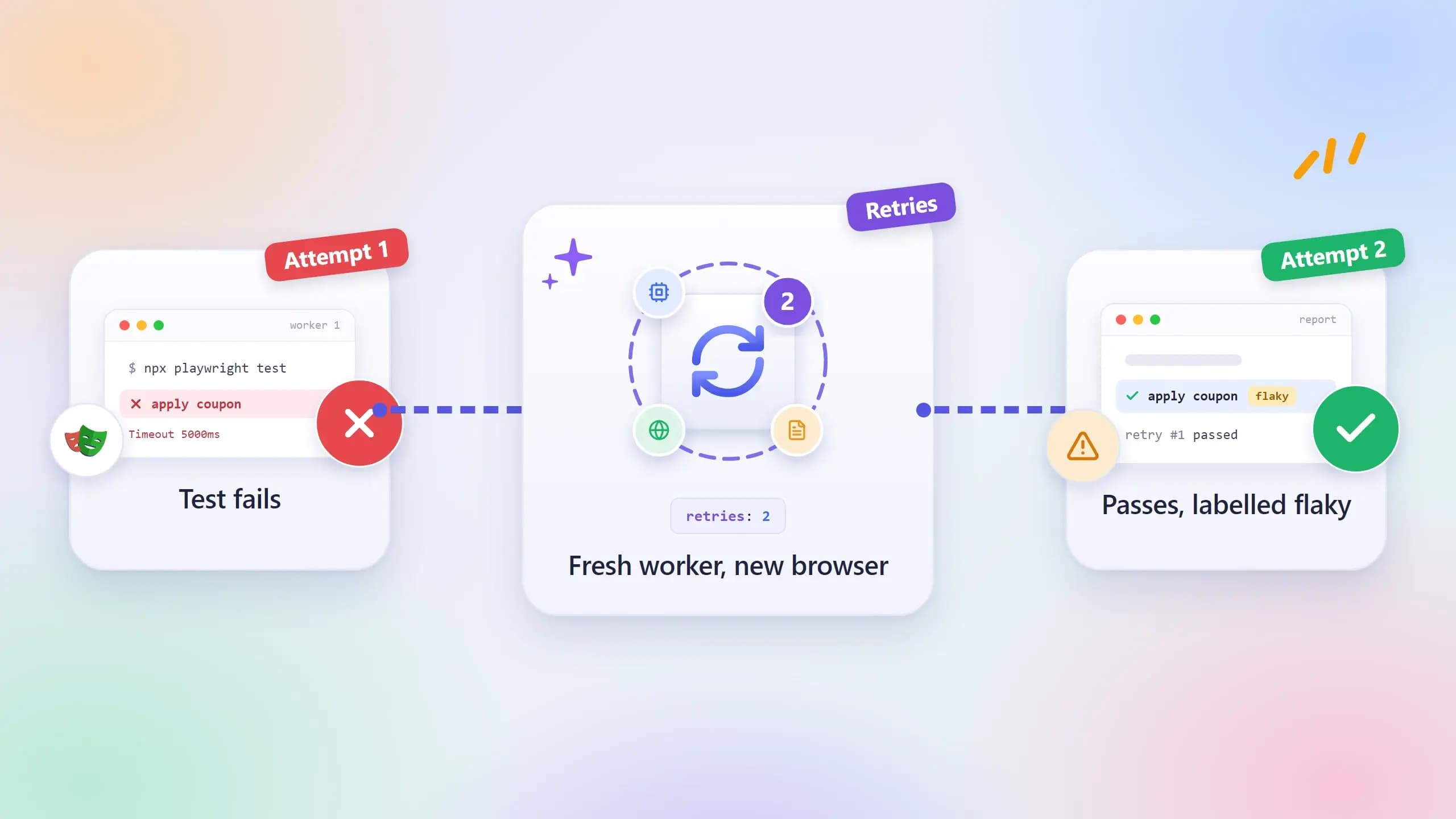
That amplification shows up first as noise. Teams generating tests quickly end up with more flaky tests, more reruns, and more time deciding whether a red build is real. You can put a yearly dollar figure on that with TestDino's free Flaky Cost Calculator.
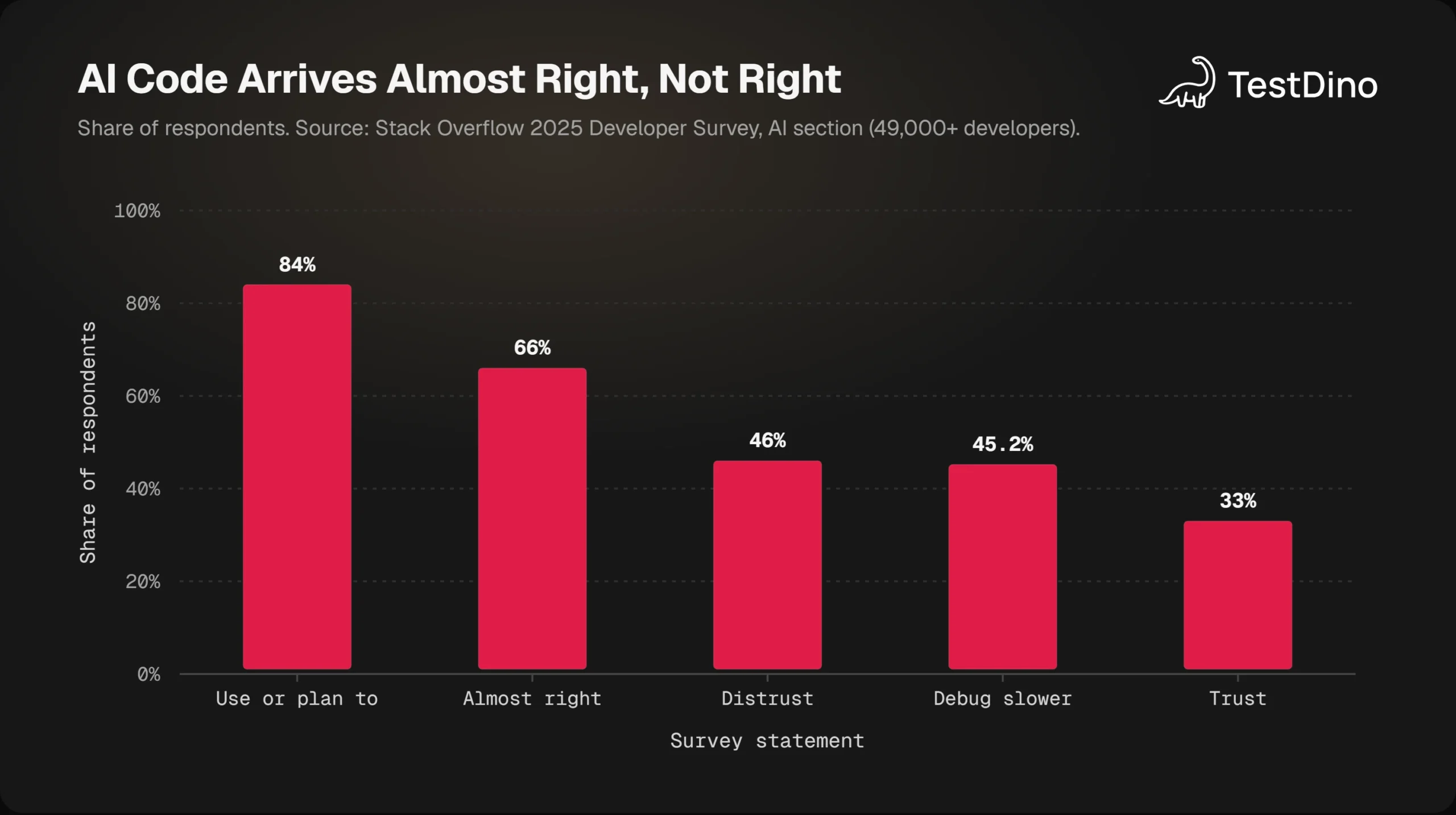
The economics follow from the chart. When drafting a test costs minutes instead of hours, teams write more tests, not fewer, and the state of AI in test automation shows exactly that. More tests means more results to interpret, and interpretation is the tester's job.
If the volume of code to verify is going up while the typing is going down, the tester's job has to change shape. Here is what that looks like.
Will AI replace QA testers, or redefine them? How the role is changing
From writing tests to directing agents
In the old model, a tester's output was the test file. In the new one, the tester's output is the plan, the seed, and the guardrails, and the agent does the typing. Playwright's planner, for example, starts from a seed test that sets up the environment it is allowed to explore.
import { test } from '@playwright/test';
test('seed: logged-in dashboard', async ({ page }) => {
  await page.goto('/dashboard'); // agents start every scenario from this state
});
The quality of what comes back depends on the quality of that direction. Vague plan, vague tests. The tester who can describe a user flow precisely, and name the outcomes that must hold, gets good tests out of a Playwright MCP loop. The tester who cannot gets a folder of green checks that prove nothing.
From pass or fail to quality signals
The second shift is in what testers report. A pass count tells leadership very little. Flake rate, failure clusters, time to first green, and the number of tests that never fail are the metrics that reveal whether a suite is trustworthy.
A suite with a high pass rate and a high flake rate is not healthy, it is noisy. A tester who can trace those flakes to three shared fixtures, and show that fixing them cuts reruns, is doing work no pass count reveals.
This is where a test intelligence platform replaces the spreadsheet. The tester's value moves from producing results to explaining them, and choosing the right test quality metrics becomes a core skill rather than a nice to have.
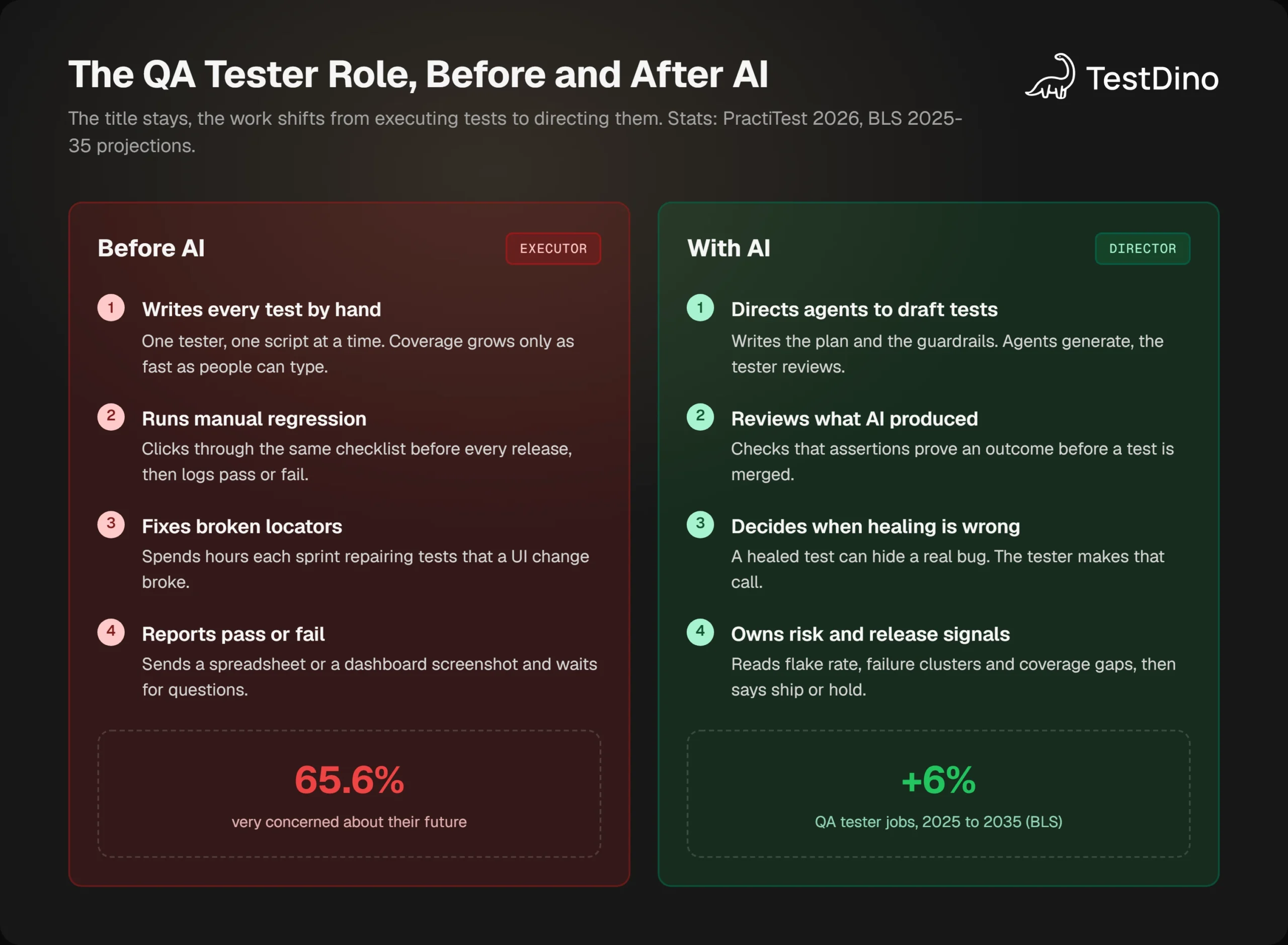
Put the two panels side by side and the job title barely changes while the work changes completely. That new shape maps directly onto a short list of skills.
6 skills QA testers need to stay relevant in the AI era
- Risk-based test design. Decide what to test and how deep, based on what breaks and what it costs. Only 19.9% of testers use AI for this, so it is where you are least replaceable.
- Reading code, including AI's. You do not need to write the framework, but you need to spot an assertion that proves nothing and a locator that will break next sprint.
- Directing testing agents. Write plans, seeds, and guardrails that planners and generators can act on, and know when a healed test is hiding a bug.
- CI fluency. Understand sharding, retries, and reporters well enough to make a suite fast and honest. Learning to reduce Playwright CI runtime is a concrete first project.
- Quality analytics. Track flake rate, change failure rate, and failure clusters, then translate them into a ship or hold call that leadership trusts.
- Testing AI features. Learn how an LLM evaluation framework works. Every product is adding AI features, and each one needs a tester who understands non-deterministic output.
None of these require a computer science degree. They require the willingness to move from executing checks to designing and judging them. If you are starting from manual testing, a structured path to learn Playwright gets you to skills 2, 3 and 4 in a few months.
Tip: Pick one suite your team already runs and own its health for 90 days: cut the flake rate, delete the tests that never fail, and present the trend. That single project demonstrates skills 1, 4 and 5 better than any certificate.
Skills 5 and 6 depend on seeing the data clearly. That is a tooling problem as much as a skills problem.
Conclusion
So, will AI replace QA testers? The data says it is replacing the task list, not the profession. The BLS still projects growth for the role through 2035. PractiTest shows AI handling test creation and maintenance while barely touching risk decisions. DORA and Stack Overflow show more code shipping with less certainty, which is more work for whoever verifies it.
The tester who executes scripts is competing with a command line. The tester who directs agents, reads the signals, and makes the release call is competing with nobody, because that work just grew.
Keep an eye on the wider software testing trends and the future of automated testing, then pick one of the six skills above and start this week.
FAQs

Pratik Patel
Co-founder